


Former president Lee Teng-hui (李登輝) said yesterday that both sides of the Taiwan Strait did not reach a consensus in 1992 on “one China” and that the Straits Exchange Foundation (SEF) should be abolished and replaced by official channels of negotiation.
Saying President Ma Ying-jeou (馬英九) had led Taiwan into a serious crisis since taking office on May 20, Lee urged Taiwanese to strengthen their oversight of the Ma administration, especially at a time when Association for Relations Across the Taiwan Strait (ARATS) Chairman Chen Yunlin (陳雲林) is set to visit next month.
Lee made the remarks during a forum organized by the Taiwan Advocates, of which Lee serves as the chairman. The theme of the event was national sovereignty and security.
“If there is no strong protest against the administration’s effort to denigrate national sovereignty, it is possible that at the upcoming meeting [between the SEF and ARATS], this denigration will be written down, thus producing a ‘2008 consensus’ more dreadful than the false one in 1992,” Lee told the forum.
The difficulties Taiwan is encountering, both at home and abroad, derive from the administration’s incompetence, Lee said, adding that it is “foolish” for the Ma administration to pin all its hopes on Beijing.
“Taiwan must depend on itself, not anyone else,” he said.
<>NO CONSENSUS<>
Lee said the SEF and ARATS did not reach a consensus on “one China” in 1992 and criticized Ma for recognizing the non-existent “consensus,” saying that Ma’s political thinking seemed not to have changed since before 1992.
“The Ma administration keeps saying that it will protect the Republic of China [ROC], but what they’re actually doing is annihilating the ROC,” he said. “I have no doubt that they will eliminate Taiwan.”
Lee said that cross-strait relations had been between two states since 1991 when the ROC Constitution was amended and the Temporary Provisions Effective during the Period of National Mobilization for the Suppression of the Communist Rebellion (動員勘亂時期臨時條款) were abolished. The constitutional amendments in 1992 further ensured Taiwan’s sovereignty by enshrining direct presidential elections.
“The ROC on Taiwan was already an independent sovereignty back in 1992,” Lee said. “It is no longer the ‘Taiwan region’ and that is the consensus of the 23 million people of Taiwan.”
<>‘ERRONEOUS’<>
Calling the Ma administration’s policies “erroneous,” Lee said Ma mistakenly defined cross-strait relations as domestic, thereby boosting Beijing’s confidence to claim sovereignty over Taiwan and creating a “rare historic opportunity” for China to annex Taiwan.
Lee said that negotiations must be conducted state-to-state and that the job of the SEF is redundant, adding that it ignores political reality to rely on a private agency to negotiate with China.
“The era of the SEF must end,” Lee said. “Cross-strait negotiations should be government to government and the official channel of negotiations should replace the old negotiation model of the two agencies.”
He also said it was hard to say whether such a private agency would sacrifice national interest for personal interests or the interests of a particular business or party.
Taiwan Solidarity Union Chairman Huang Kun-huei (黃昆輝), who served as chairman of the Mainland Affairs Council (MAC) in 1992, said bilateral negotiations in 1992 collapsed and that no consensus was reached.
He also dismissed Ma’s remarks that the so-called “1992 consensus” led to the meeting between top negotiators in Singapore in 1993.
At a separate setting yesterday, Democratic Progressive Party (DPP) Chairwoman Tsai Ing-wen (蔡英文) said it was unsuitable for the two quasi-official cross-strait agencies to negotiate anything concerning the political authority of the government.
However, she said it was necessary for the SEF to continue to exist because there were cross-strait affairs on the regular and technical level that needed to be taken care of.
The Presidential Office yesterday said the “best arrangement” at the current time was for the two agencies to conduct cross-strait negotiations.
Presidential Office Spokesman Wang Yu-chi (王郁琦) said the office respected Lee’s personal opinions, but that the two agencies had accomplished a lot over the years.
Regarding the so-called “1992 consensus,” Wang said Ma was certain of its existence because he was the vice chairman of the MAC at that time. Thanks to such consensus, Wang said, both sides began negotiating with each other in 1992.
The Chinese Nationalist Party (KMT) yesterday also dismissed Lee’s denial of the “1992 consensus.”
Deputy Secretary-General of the KMT Chang Jung-kung (張榮恭) told a press conference yesterday that it was a conclusion reached by the SEF and ARATS on negotiations over the issue of “one China” in October 1992.
The SEF issued an official letter to ARATS and suggested that each side of the Taiwan Strait should have its own interpretation of the concept of “one China,” and ARATS said it “respects and accepts the suggestion” in its reply, Chang said.
“Lee Teng-hui had approved the SEF letter and had mentioned the gist of the ‘1992 consensus’ in a Double Ten national day speech in 1999,” Chang said.
Chang said that Lee, in his speech in 1999, had said that “each of the two sides of the Taiwan Strait had its own views regarding ‘one China,’” and that in 2000, Lee had said that: “We think one China means the Republic of China, while China regards one China as the People’s Republic of China. This is one China, with each side having its own interpretation.”
Both comments made by Lee showed that he had acknowledged the existence of the “1992 consensus,” Chang said.
Chang said the idea of the “1992 consensus” had long been accepted and had played a role in cross-strait negotiations.
RETHINK? The defense ministry and Navy Command Headquarters could take over the indigenous submarine project and change its production timeline, a source said Admiral Huang Shu-kuang’s (黃曙光) resignation as head of the Indigenous Submarine Program and as a member of the National Security Council could affect the production of submarines, a source said yesterday. Huang in a statement last night said he had decided to resign due to national security concerns while expressing the hope that it would put a stop to political wrangling that only undermines the advancement of the nation’s defense capabilities. Taiwan People’s Party Legislator Vivian Huang (黃珊珊) yesterday said that the admiral, her older brother, felt it was time for him to step down and that he had completed what he

Taiwan has experienced its most significant improvement in the QS World University Rankings by Subject, data provided on Sunday by international higher education analyst Quacquarelli Symonds (QS) showed. Compared with last year’s edition of the rankings, which measure academic excellence and influence, Taiwanese universities made great improvements in the H Index metric, which evaluates research productivity and its impact, with a notable 30 percent increase overall, QS said. Taiwanese universities also made notable progress in the Citations per Paper metric, which measures the impact of research, achieving a 13 percent increase. Taiwanese universities gained 10 percent in Academic Reputation, but declined 18 percent

UNDER DISCUSSION: The combatant command would integrate fast attack boat and anti-ship missile groups to defend waters closest to the coastline, a source said The military could establish a new combatant command as early as 2026, which would be tasked with defending Taiwan’s territorial waters 24 nautical miles (44.4km) from the nation’s coastline, a source familiar with the matter said yesterday. The new command, which would fall under the Naval Command Headquarters, would be led by a vice admiral and integrate existing fast attack boat and anti-ship missile groups, along with the Naval Maritime Surveillance and Reconnaissance Command, said the source, who asked to remain anonymous. It could be launched by 2026, but details are being discussed and no final timetable has been announced, the source
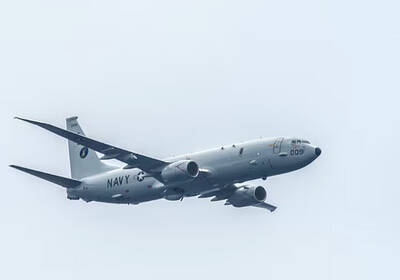
CHINA REACTS: The patrol and reconnaissance plane ‘transited the Taiwan Strait in international airspace,’ the 7th Fleet said, while Taipei said it saw nothing unusual The US 7th Fleet yesterday said that a US Navy P-8A Poseidon flew through the Taiwan Strait, a day after US and Chinese defense heads held their first talks since November 2022 in an effort to reduce regional tensions. The patrol and reconnaissance plane “transited the Taiwan Strait in international airspace,” the 7th Fleet said in a news release. “By operating within the Taiwan Strait in accordance with international law, the United States upholds the navigational rights and freedoms of all nations.” In a separate statement, the Ministry of National Defense said that it monitored nearby waters and airspace as the aircraft


 RSS
RSS