


The Democratic Progressive Party (DPP) caucus yesterday proposed a draft bill that would require any cross-strait agreements on issues concerning “critical national interests” be put to a referendum and decided on by Taiwanese voters.
“The proposed bill prohibits the government from authorizing civil groups to sign agreements between Taiwan and China on issues that concern national defense, diplomacy, finance and economics,” DPP caucus whip William Lai (賴清德) told a press conference.
Under the proposed bill, before the government signs any agreements with China, the Executive Yuan must submit drafts of the agreements to the Legislative Yuan. Those drafts must then be negotiated and passed by respective legislative committees and the agreements could only take effect after gaining the approval of Taiwanese voters in a referendum.
“The spirit of the bill is to make sure that Taiwan’s future is decided by its 23 million people,” Lai said, adding that such major agreements as the Closer Economic Partnership Arrangement (CEPA) with China must first obtain the approval of Taiwanese voters via a referendum.
DPP Legislator Chen Chi-yu (陳啟昱) said the proposed bill was also aimed at strengthening the Legislative Yuan’s monitoring system and supervising cross-strait agreements undertaken by the Executive Yuan on national issues.
As an example of why the bill was needed, Chen said that this June after an agreement on cross-strait charter flight services was signed by Taiwan’s Straits Exchange Foundation and its Chinese counterpart, “[President Ma Ying-jeou’s (馬英九) government] was oblivious to the legislature’s supervision but only informed the legislature later via an administrative directive.”
On agreements to be signed by civil groups authorized by the Mainland Affairs Council, the proposed bill said that the Executive Yuan must agree to the items and talk them over with the legislature before the agreement is signed.
Lai yesterday said that the caucus would send the proposed bill to the legislative Procedure Committee for approval next week.
When asked for comment, Chinese Nationalist Party (KMT) caucus secretary-general Chang Sho-wen (張碩文) dismissed the need for such a bill. Chang said the Legislative Yuan should deliberate over the content of the proposal as it might constitute a legislative interference in the executive branch.
Chang added that he would urge the Executive Yuan to propose its own version of the bill.
ADDITIONAL REPORTING BY FLORA WANG
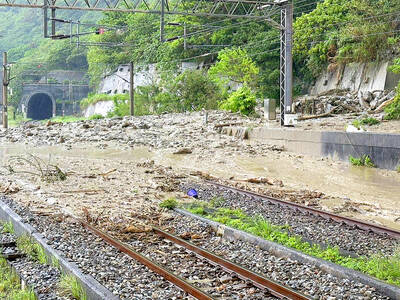
ROLLER-COASTER RIDE: More than five earthquakes ranging from magnitude 4.4 to 5.5 on the Richter scale shook eastern Taiwan in rapid succession yesterday afternoon Back-to-back weather fronts are forecast to hit Taiwan this week, resulting in rain across the nation in the coming days, the Central Weather Administration said yesterday, as it also warned residents in mountainous regions to be wary of landslides and rockfalls. As the first front approached, sporadic rainfall began in central and northern parts of Taiwan yesterday, the agency said, adding that rain is forecast to intensify in those regions today, while brief showers would also affect other parts of the nation. A second weather system is forecast to arrive on Thursday, bringing additional rain to the whole nation until Sunday, it

CONDITIONAL: The PRC imposes secret requirements that the funding it provides cannot be spent in states with diplomatic relations with Taiwan, Emma Reilly said China has been bribing UN officials to obtain “special benefits” and to block funding from countries that have diplomatic ties with Taiwan, a former UN employee told the British House of Commons on Tuesday. At a House of Commons Foreign Affairs Committee hearing into “international relations within the multilateral system,” former Office of the UN High Commissioner for Human Rights (OHCHR) employee Emma Reilly said in a written statement that “Beijing paid bribes to the two successive Presidents of the [UN] General Assembly” during the two-year negotiation of the Sustainable Development Goals. Another way China exercises influence within the UN Secretariat is
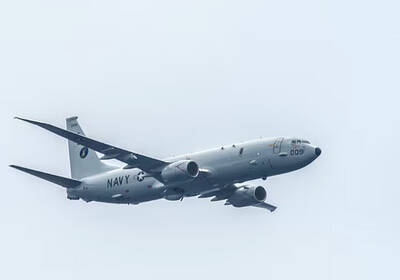
CHINA REACTS: The patrol and reconnaissance plane ‘transited the Taiwan Strait in international airspace,’ the 7th Fleet said, while Taipei said it saw nothing unusual The US 7th Fleet yesterday said that a US Navy P-8A Poseidon flew through the Taiwan Strait, a day after US and Chinese defense heads held their first talks since November 2022 in an effort to reduce regional tensions. The patrol and reconnaissance plane “transited the Taiwan Strait in international airspace,” the 7th Fleet said in a news release. “By operating within the Taiwan Strait in accordance with international law, the United States upholds the navigational rights and freedoms of all nations.” In a separate statement, the Ministry of National Defense said that it monitored nearby waters and airspace as the aircraft

Taiwan’s first drag queen to compete on the internationally acclaimed RuPaul’s Drag Race, Nymphia Wind (妮妃雅), was on Friday crowned the “Next Drag Superstar.” Dressed in a sparkling banana dress, Nymphia Wind swept onto the stage for the final, and stole the show. “Taiwan this is for you,” she said right after show host RuPaul announced her as the winner. “To those who feel like they don’t belong, just remember to live fearlessly and to live their truth,” she said on stage. One of the frontrunners for the past 15 episodes, the 28-year-old breezed through to the final after weeks of showcasing her unique


 RSS
RSS