


Official gaffes and policy flip-flops are among the many reasons for the government’s low approval rating, a government minister said yesterday.
Research, Development and Evaluation Commission Minister Jiang Yi-huah (江宜樺) told the legislature’s Judiciary, Organic Laws and Statutes Committee yesterday that the commission had analyzed the factors behind public dissatisfaction with the performance of President Ma Ying-jeou (馬英九) and the Chinese Nationalist Party (KMT) administration.
These included constant changes in government policies, improper remarks by government officials, weak and vague defense of administrative policies by government officials, and poor negotiations between government agencies and the legislature as well as the media.
“It is not a scientific analysis, but rather a political judgment,” Jiang said, adding that the conclusions the commission arrived at were not much different from those mentioned by the media.
Jiang made the remarks in response to a question by KMT Legislator Liao Cheng-ching (廖正井) asking Jiang whether the commission knew the approval rating of the administration had continued to drop.
Liao said the crux of the problem was government officials’ lack of confidence, adding that some did not have confidence in themselves because they lacked professional expertise and were afraid of upsetting the public.
“So they constantly change their mind — not to mention that they implement government policies poorly,” he said.
Liao, who proposed on Wednesday that high-ranking government officials forfeit their annual bonuses if Cabinet approval ratings remained low, said yesterday that he would not slash the budget earmarked for such purposes, but it would be a nice gesture if they chose to do so.
Asked by KMT Legislator Alex Fai (費鴻泰) about his thoughts on Liao’s proposal, Jiang said that approval ratings were just part of an official’s overall performance.
Fai concurred, saying opinion polls could be misleading because some officials were competent but might not be good at “grandstanding” or be “good-looking” enough to score high on the polls.
KMT Legislator Lai Shyh-bao (賴士葆) disagreed, however, saying that government officials were “arrogant, bureaucratic and egoistic” and afraid to shoulder responsibility and that he did not see any exceptions.
While Jiang did not reveal the result of the commission’s most recent poll on the approval ratings of Ma and Premier Liu Chao-shiuan (劉兆玄), he said it was “similar to those polls conducted by other outlets using scientific methods,” with a difference of plus or minus 5 percent.
A poll released by Global Views magazine last month showed that Ma’s approval rating dropped to its lowest point in his political career — 24.9 percent.
The poll conducted by the commission in August showed that Ma’s approval rating slipped from 70 percent in March to 47 percent. A separate poll conducted by the Democratic Progressive Party (DPP) in August showed Ma’s approval rate was 37 percent.
Democratic Progressive Party (DPP) legislators Wong Chin-chu (翁金珠) and Ker Chien-ming (柯建銘) criticized the commission for selectively publishing its results.
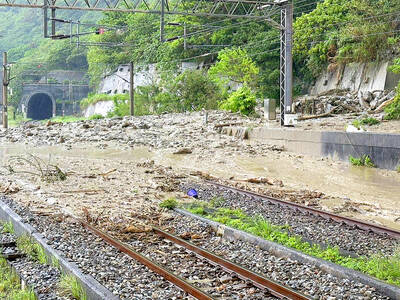
ROLLER-COASTER RIDE: More than five earthquakes ranging from magnitude 4.4 to 5.5 on the Richter scale shook eastern Taiwan in rapid succession yesterday afternoon Back-to-back weather fronts are forecast to hit Taiwan this week, resulting in rain across the nation in the coming days, the Central Weather Administration said yesterday, as it also warned residents in mountainous regions to be wary of landslides and rockfalls. As the first front approached, sporadic rainfall began in central and northern parts of Taiwan yesterday, the agency said, adding that rain is forecast to intensify in those regions today, while brief showers would also affect other parts of the nation. A second weather system is forecast to arrive on Thursday, bringing additional rain to the whole nation until Sunday, it
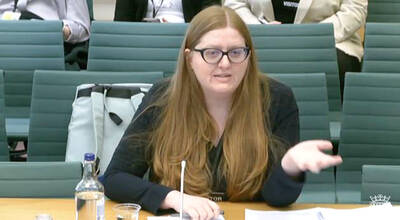
CONDITIONAL: The PRC imposes secret requirements that the funding it provides cannot be spent in states with diplomatic relations with Taiwan, Emma Reilly said China has been bribing UN officials to obtain “special benefits” and to block funding from countries that have diplomatic ties with Taiwan, a former UN employee told the British House of Commons on Tuesday. At a House of Commons Foreign Affairs Committee hearing into “international relations within the multilateral system,” former Office of the UN High Commissioner for Human Rights (OHCHR) employee Emma Reilly said in a written statement that “Beijing paid bribes to the two successive Presidents of the [UN] General Assembly” during the two-year negotiation of the Sustainable Development Goals. Another way China exercises influence within the UN Secretariat is
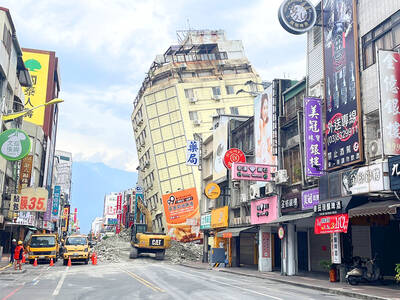
LANDSLIDES POSSIBLE: The agency advised the public to avoid visiting mountainous regions due to more expected aftershocks and rainfall from a series of weather fronts A series of earthquakes over the past few days were likely aftershocks of the April 3 earthquake in Hualien County, with further aftershocks to be expected for up to a year, the Central Weather Administration (CWA) said yesterday. Based on the nation’s experience after the quake on Sept. 21, 1999, more aftershocks are possible over the next six months to a year, the agency said. A total of 103 earthquakes of magnitude 4 on the local magnitude scale or higher hit Hualien County from 5:08pm on Monday to 10:27am yesterday, with 27 of them exceeding magnitude 5. They included two, of magnitude
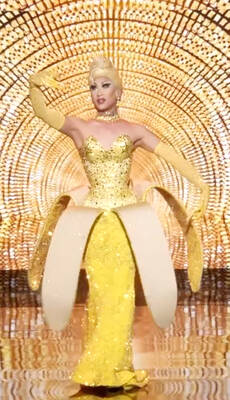
Taiwan’s first drag queen to compete on the internationally acclaimed RuPaul’s Drag Race, Nymphia Wind (妮妃雅), was on Friday crowned the “Next Drag Superstar.” Dressed in a sparkling banana dress, Nymphia Wind swept onto the stage for the final, and stole the show. “Taiwan this is for you,” she said right after show host RuPaul announced her as the winner. “To those who feel like they don’t belong, just remember to live fearlessly and to live their truth,” she said on stage. One of the frontrunners for the past 15 episodes, the 28-year-old breezed through to the final after weeks of showcasing her unique


 RSS
RSS