


Moving halfway around the world is never an easy decision. The decision is especially complicated for families with children of special needs because they are faced with the uncertainty of whether their children will be able to enjoy the same support network abroad as they did in their native countries.
Charles Garrett had similar concerns when he decided to take the offer to become deputy director of the British Trade and Cultural Office in Taipei in 2005.
“With our children, the main concern was education and whether they were going to be happy and settled,” Garrett said during a recent interview with the Taipei Times. “We have five children and it was the concern for each of our children. But it was more difficult to provide for our second child, who has Down syndrome.”
To make sure his teenage daughter would enjoy all the educational support she needed in Taipei, Gerrett and his wife began looking into schools very carefully.
“The fact that the [Taipei] European School (TES) here would be able to integrate a child with Down syndrome was a very important factor. It meant I could take the job in Taipei,” he said.
UNKNOWN NUMBERS
The size of the special needs population within the expatriate community in Taiwan is not known, nor is the number of specialists working within the special needs programs in Taiwan’s international schools, partly because some schools — TES for example — are concerned about confidentiality.
“We won’t give out that information [regarding the number of students with special needs or special education teachers],” said Zoe Gare, coordinator of special needs programs at TES. “There are some [special needs] children and the percentage of [the] children would be what we expect in any school in England or the United States.”
Other schools, like Taipei American School (TAS), are equally discreet.
“TAS treats all of our special needs’ children’s programs and situations with the utmost discretion. We do not believe that publicly discussing our students’ needs is beneficial to them,” TAS community relations personnel Frances Yu said in an e-mail on Sept. 8 in response to the Taipei Times’ inquiries.
Nevertheless, international schools in Taiwan, like TES, play a prominent role in providing support for parents and children with special needs in the expatriate community.
“We try to be as inclusive as possible,” Gare said, adding that most of the children follow regular curriculums with other students in class.
“We might have special needs teachers or assistants helping them in different ways to access the curriculum,” she said, adding that the curriculum is adapted for them according to the needs of the children.
Ruth Martin, head of TES’ British Infant Section, said the school would sometimes give the children special one-on-one sessions if they got upset or obstructed other children from learning.
In Taichung, schools like Morrison Academy offer programs targeting students’ learning needs in accordance with each student’s individual education program.
NO SPECIAL EDUCATION
In Kaohsiung, Kaohsiung American School, for instance, offers “enrichment programs and/or differentiation of instruction” for its students, but as the school’s Web site states, there is no formal special education program provided at the school.
Despite the schools’ offer of resources, for parents and children with special needs, obtaining help and support in their native languages in Taiwan may sometimes prove difficult.
“If Chinese is their first language, of course they can access all the specialists. If Chinese is not their [native] language, then [they would have] this difficulty,” Gare said.
“We also have Dutch parents who might need a speech and language therapist or German or French or Spanish [parents] ... it’s a complexity of the number of the languages the children speak,” Martin said.
Gare and Martin both mentioned difficulties met by the school to recruit specialists who have English as their first language in Taipei.
Garrett also observed similar language barriers from his daughter’s experience in developing her social support network in Taipei.
“Socially, it is more difficult for a child with Down syndrome, and in fact that’s one area quite difficult in Taipei,” Garrett said.
A deeper relationship, Garrett said, often comes when his daughter is surrounded by people who have similar needs.
“But here in Taiwan, children in that situation, they speak Chinese, not English and automatically there is a barrier there and [it’s] more difficult to provide that support for her,” he said.
OUTSIDE HELP
But Garrett made an effort to help his daughter, now 15, obtain support from outside the expatriate community, for example, by having her participate in a swimming club for people with special needs in the Wuchang Junior High School on Fuxing N Road.
“One of the other concerns of bringing in a child with Down Syndrome is the general reaction of the society,” he said.
The public often feels uncomfortable with the presence of children with Down syndrome because it has very little knowledge of them, he said.
“When they [the public] feel uncomfortable, very often, human reaction is just to switch off,” he said.
“We’ve been to a number of countries where that is the case, but in Britain generally or many countries in Europe or here in Taiwan, it’s not the case. It’s a much warmer and comfortable approach to children with Down syndrome,” he said.
Having enjoyed the support the family needs since his daughter was born, Garrett has been involved in a number of campaigns to “give something back.”
“There are other parts of the world where parents and children in a similar situation have zero support,” he said.
One of the campaigns is to raise funding for a program in Russia — where 95 percent of children with Down syndrome were in orphanages when the campaign was launched in 1996 — by doing activities Garret called “inspirational” to sponsors such as walks in the Arctic and climbing mountains in Switzerland.
“There are a lot of people out there who just see the human needs irrespective of the geographical boundary,” he said.
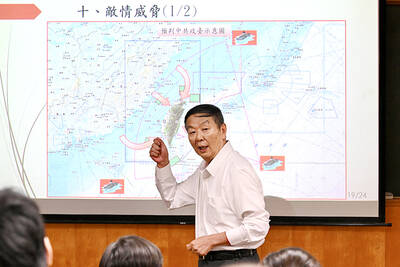
RETHINK? The defense ministry and Navy Command Headquarters could take over the indigenous submarine project and change its production timeline, a source said Admiral Huang Shu-kuang’s (黃曙光) resignation as head of the Indigenous Submarine Program and as a member of the National Security Council could affect the production of submarines, a source said yesterday. Huang in a statement last night said he had decided to resign due to national security concerns while expressing the hope that it would put a stop to political wrangling that only undermines the advancement of the nation’s defense capabilities. Taiwan People’s Party Legislator Vivian Huang (黃珊珊) yesterday said that the admiral, her older brother, felt it was time for him to step down and that he had completed what he
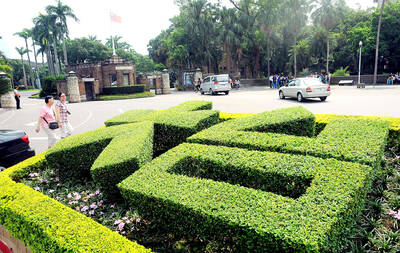
Taiwan has experienced its most significant improvement in the QS World University Rankings by Subject, data provided on Sunday by international higher education analyst Quacquarelli Symonds (QS) showed. Compared with last year’s edition of the rankings, which measure academic excellence and influence, Taiwanese universities made great improvements in the H Index metric, which evaluates research productivity and its impact, with a notable 30 percent increase overall, QS said. Taiwanese universities also made notable progress in the Citations per Paper metric, which measures the impact of research, achieving a 13 percent increase. Taiwanese universities gained 10 percent in Academic Reputation, but declined 18 percent
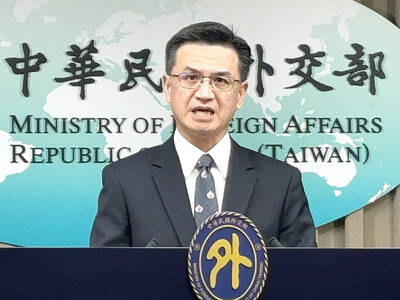
BULLY TACTICS: Beijing has continued its incursions into Taiwan’s airspace even as Xi Jinping talked about Taiwan being part of the Chinese family and nation China should stop its coercion of Taiwan and respect mainstream public opinion in Taiwan about sovereignty if its expression of goodwill is genuine, the Ministry of Foreign Affairs (MOFA) said yesterday. Ministry spokesman Jeff Liu (劉永健) made the comment in response to media queries about a meeting between former president Ma Ying-jeou (馬英九) and Chinese President Xi Jinping (習近平) the previous day. Ma voiced support for the so-called “1992 consensus,” while Xi said that although the two sides of the Taiwan Strait have “different systems,” this does not change the fact that they are “part of the same country,” and that “external

UNDER DISCUSSION: The combatant command would integrate fast attack boat and anti-ship missile groups to defend waters closest to the coastline, a source said The military could establish a new combatant command as early as 2026, which would be tasked with defending Taiwan’s territorial waters 24 nautical miles (44.4km) from the nation’s coastline, a source familiar with the matter said yesterday. The new command, which would fall under the Naval Command Headquarters, would be led by a vice admiral and integrate existing fast attack boat and anti-ship missile groups, along with the Naval Maritime Surveillance and Reconnaissance Command, said the source, who asked to remain anonymous. It could be launched by 2026, but details are being discussed and no final timetable has been announced, the source


 RSS
RSS