


Anyone who has seen the Jum’ah congregational prayers being performed on Fridays at the Taipei Grand Mosque may believe that Islam is well-accepted and prosperous in Taiwan — however, the reality is just the opposite.
“O ye who believe! When the call is proclaimed to prayer on Friday, hasten earnestly to the Remembrance of Allah, and leave off business: That is best for you if ye but knew,” the Koran extols the followers of Islam.
And thus, when the muezzin — the person chosen to call the Friday prayer — cried out the adhan, or the call for Jum’ah, last Friday, hundreds of Muslims from more than 30 countries entered the Taipei Grand Mosque, cleansed themselves and began their weekly congregation and worship inside the main sanctuary.
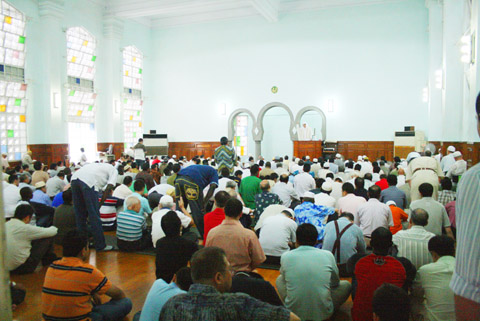
PHOTO: LOA IOK-SIN, TAIPEI TIMES
“I often ask people to guess which event that takes place every Friday in Taipei attracts hundreds of people from more than 30 countries to the same place, at the same time and to do the same thing,” said Caroline Kuo (郭麗敏), secretary-general of the International Organization of Folk Art in Taiwan, an international organization that promotes cross-cultural learning around the world.
“The answer is the Jum’ah,” she said.
After the Jum’ah was over, people greeted one another, chatted with friends and bought food items at the small Halal market located in a hall in the mosque.
Halal refers to food that does not contain forbidden substances and meat slaughtered in accordance with Islamic law.
One of the issues that Muslims in Taiwan face is a shortage of clergy at the six mosques around the country.
“Many local Muslim families send their children to study Islam or in other fields in Arabic countries, but after completing their studies, they don’t necessarily want to join the clergy — many of them are working for the Ministry of Foreign Affairs,” said Ishag Ma (馬孝棋), deputy secretary-general of the Chinese Muslim Association.
“To resolve the issue, we hire clergy from Myanmar and Thailand, because they are equally qualified and are able to speak Mandarin as well,” Ma said.
He said that many people from Muslim communities in China’s Yunnan Province escaped to neighboring Myanmar and Thailand because of wars and turmoil during the 20th century.
Many children of the Yunnan Muslim families studied Islam in Arabic countries and became qualified clergy, Ma said.
Musa Ma (馬子誠), former chairman of the Longgang (龍岡) Mosque in Jhongli City (中壢), Taoyuan County, is one of those who moved here from Myanmar.
The Longgang area, where around 300 Muslim households live in the vicinity of the mosque, is home to a rare practicing Muslim community in Taiwan.
Most of the community’s residents are refugees from China’s Muslim regions who followed the Chinese Nationalist Party (KMT) regime when it lost the civil war in China and fled to Taiwan, Musa Ma said.
The Muslim population in the area has grown from only seven to eight households in 1949 to 300 because the building of the mosque attracted families and friends of the original households to move there.
For Musa Ma, lack of Islamic education for children in Taiwan’s Muslim families is a big problem.
“Without Islamic education, children would not take Islam seriously, and when they grow up, they would forget about their tradition,” he said.
Muslims in Taiwan face many more challenges than just education and a shortage of clergy.
“Islam is more than a religion, it’s also a lifestyle,” said Abdullah Liu (柳根榮), the imam —or leader — of the Longgang Mosque, who came to Taiwan from Myanmar.
“We have to follow rules in the Koran strictly, but it may be difficult because Taiwan is not an Islamic country,” Liu said.
For example, according to the Koran, the remains of the deceased have to be buried in soil, “but it’s not always easy to find burial grounds in Taiwan, not to mention that many cemeteries require family members of the deceased to reopen the tomb and put the remains of the deceased into an urn after some years,” Liu said, adding that according to Islamic law, when one is buried, he or she should remain buried there permanently.
“Besides, Muslims cannot eat pork, and can only eat Halal meats — that’s not always easy to find,” Liu said.
Manoucherhr Ghorbani-Koshikaki, an Iranian who has been living in Taiwan for over a decade, knows exactly what Liu means.
“When I first arrived in Taiwan, I did not eat anything and only drank water for three days because I didn’t know what I could eat,” Ghorbani-Koshikaki said.
Maria Wang (王天圓), a 15-year-old Muslim living in Bade City (八德), Taoyuan County, has the same concern, but she has found her own solution.
“I usually bring my own lunchbox to school, and when meeting friends for a meal, I go out after eating at home and just sit at the table talking to my friends,” she said.
Social interaction also has its pitfalls.
“Muslims are not supposed to have physical contact with a person of the opposite sex that isn’t a family member or spouse,” Wang said. “So whenever a girl holds out her hand, wanting to shake hands with me when we first meet, I have to just say ‘sorry.’”
Wearing a headscarf is another issue.
“I don’t wear a headscarf to school, I wear it only when I go to the mosque,” Wang said.
“My classmates wouldn’t discriminate against me if I wore the headscarf, but they would look at me strangely,” she said.
Meanwhile, for Muslims who came here as migrant workers, performing the daily ritual prayers five times a day — one of the “five pillars” of being a Muslim — also presents difficulties.
“I work about 24 hours a day — I take care of my boss’ mother, and I do chores and whatever my boss asks me to do,” said a caretaker from Indonesia who wished to be called only “Atan.”
“Yes, I want to perform my daily prayers like a good Muslim should, but how is that possible?” she asked.
While it may still be a while before mainstream society in Taiwan understands Islam, Ishag Ma is hopeful.
In order to help children from Muslim families to retain their religious traditions, the mosques in Taiwan have been offering Koran study classes and summer camps.
“So far, it has been successful,” Ishag Ma said.
“With more and more Muslims from other countries moving to Taiwan, I hope that they would plant the new seeds for Islam in Taiwan,” he said.
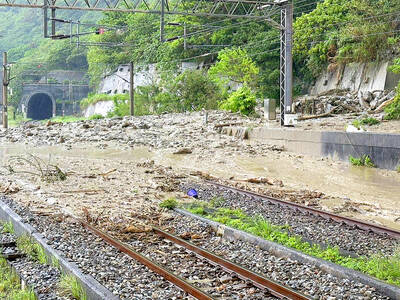
ROLLER-COASTER RIDE: More than five earthquakes ranging from magnitude 4.4 to 5.5 on the Richter scale shook eastern Taiwan in rapid succession yesterday afternoon Back-to-back weather fronts are forecast to hit Taiwan this week, resulting in rain across the nation in the coming days, the Central Weather Administration said yesterday, as it also warned residents in mountainous regions to be wary of landslides and rockfalls. As the first front approached, sporadic rainfall began in central and northern parts of Taiwan yesterday, the agency said, adding that rain is forecast to intensify in those regions today, while brief showers would also affect other parts of the nation. A second weather system is forecast to arrive on Thursday, bringing additional rain to the whole nation until Sunday, it

CONDITIONAL: The PRC imposes secret requirements that the funding it provides cannot be spent in states with diplomatic relations with Taiwan, Emma Reilly said China has been bribing UN officials to obtain “special benefits” and to block funding from countries that have diplomatic ties with Taiwan, a former UN employee told the British House of Commons on Tuesday. At a House of Commons Foreign Affairs Committee hearing into “international relations within the multilateral system,” former Office of the UN High Commissioner for Human Rights (OHCHR) employee Emma Reilly said in a written statement that “Beijing paid bribes to the two successive Presidents of the [UN] General Assembly” during the two-year negotiation of the Sustainable Development Goals. Another way China exercises influence within the UN Secretariat is
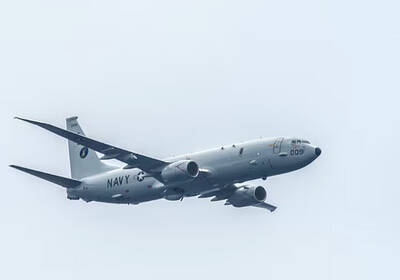
CHINA REACTS: The patrol and reconnaissance plane ‘transited the Taiwan Strait in international airspace,’ the 7th Fleet said, while Taipei said it saw nothing unusual The US 7th Fleet yesterday said that a US Navy P-8A Poseidon flew through the Taiwan Strait, a day after US and Chinese defense heads held their first talks since November 2022 in an effort to reduce regional tensions. The patrol and reconnaissance plane “transited the Taiwan Strait in international airspace,” the 7th Fleet said in a news release. “By operating within the Taiwan Strait in accordance with international law, the United States upholds the navigational rights and freedoms of all nations.” In a separate statement, the Ministry of National Defense said that it monitored nearby waters and airspace as the aircraft

Taiwan’s first drag queen to compete on the internationally acclaimed RuPaul’s Drag Race, Nymphia Wind (妮妃雅), was on Friday crowned the “Next Drag Superstar.” Dressed in a sparkling banana dress, Nymphia Wind swept onto the stage for the final, and stole the show. “Taiwan this is for you,” she said right after show host RuPaul announced her as the winner. “To those who feel like they don’t belong, just remember to live fearlessly and to live their truth,” she said on stage. One of the frontrunners for the past 15 episodes, the 28-year-old breezed through to the final after weeks of showcasing her unique


 RSS
RSS