


The Cabinet yesterday approved five measures to enhance cross-strait securities exchanges, which officials said would promote the internationalization of the local stock market and encourage more medium and long-term foreign capital inflow.
“It’s difficult to estimate an exact figure for potential influx of foreign capital, but to establish a laissez-faire and open market would surely attract more foreign participation,” Financial Supervisory Commission (FSC) Vice Chairwoman Susan Chang (張秀蓮) told a press conference.
The proposal was drafted by the FSC in consultation with the Council of Economic Planning and Development, the Mainland Affairs Council and the Central Bank of the Republic of China (Taiwan).
A policy goal is to indirectly open the local stock market to Chinese capital. Current regulation do not allow Chinese investors to purchase Taiwanese stocks.
To meet the goal, the government will abolish a regulation on foreign institutional investor (FII) funds that requires the presentation of written statements to prove that the capital that would be put into local securities and futures markets would not be from China when registering with the Taiwan Stock Exchange Corp (TSEC).
China started to allow its Qualified Domestic Institutional Investors (QDII) to invest in offshore funds last June, so keeping the regulation on FII funds in the country would only impede them from the local stock market, Chang said.
A measure to open mutual listings of Exchanged Traded Funds (ETF) on the Taiwan and Hong Kong stock markets is also expected to meet Cabinet goals, as Chinese would then be able to indirectly invest in Taiwan’s local stock market via their transactions in Hong Kong’s stock market.
Taiwan-issued ETFs will be able to go public on the Hong Kong stock market when the FSC reaches an agreement on the exchange of information and examination with Hong Kong’s Security and Futures Bureau, under a side letter based on the bilateral Memorandum of Understanding of 1996, Chang said.
Chang said the FSC would also allow Hong Kong-issued ETFs to list on the local stock market based on the principle of equality and reciprocity.
The government is also aiming at attracting Taiwanese capital back to the country by allowing companies listed on the Hong Kong Stock Exchange to realize their second listings on Taiwan’s stock market or issue Taiwan Depository Receipts (TDR).
The move would make Hong Kong exchanges the 18th overseas stock market with which companies listed for more than six months can have second listings in Taiwan's stock market.
But companies that have registered in China, foreign companies whose main shareholders are Chinese, and 20 percent of shares of companies that are directly or indirectly owned by Chinese will be excluded from the measure for the moment, Chang said.
“The exceptions are just a temporary remedy, as the ministry is now deliberating whether to remove the ban on Chinese investment in Taiwan,” Chang said.
Another measure was to cancel rules that allow offshore funds to invest a certain ratio in Chinese shares as well as Hong Kong/Macau H and red chip shares.
Previously, offshore funds and overseas funds raised by securities investment trust enterprise and discretionary investment businesses could invest up to 0.4 percent of their net assets in Chinese shares and up to 10 percent of their net assets in Hong Kong/Macau H and red chip shares.
Private funds of securities investment trust firms are not allowed to purchase shares in the Chinese stock market and red-chip and H shares in Hong Kong and Macau stock market, while future trust funds and discretionary future trading businesses are also banned from future transactions in China.
Chang said the government would loosen all the regulations, but added that the percentage by which the government would raise the ratio has yet to be determined.
“Twenty-four funds have been forced to close for failing to conform to the ratios. Given the tendency of holding more red-chip shares, it’s necessary to revise the regulations,” Chang said.
The government also said it would allow local securities investment trust firms to invest in China or purchase shares of China’s investment funds management companies and allow local futures firms to invest in China’s counterparts directly or indirectly.
Also See: Central bank to continue fiscal tightening: analysts

Chinese President Xi Jinping (習近平) yesterday met with former president Ma Ying-jeou (馬英九) at the Great Hall of the People in Beijing, with Xi’s opening statement once more emphasizing that people on both sides of the Taiwan Strait are Chinese and that foreign intervention cannot change their inevitable unification. Xi said that 5,000 years of history of zhonghua minzu (中華民族, ethnic Chinese group) have seen their ancestors move to Taiwan to establish new lives, while also documenting them fighting side-by-side against foreign forces and finally freeing Taiwan. “Both sides are Chinese,” and there are no issues that cannot be worked through, he
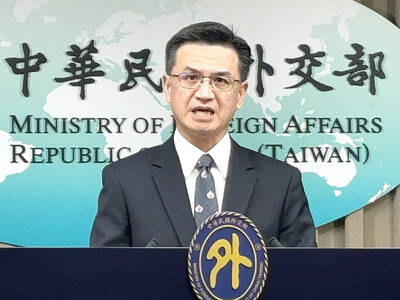
BULLY TACTICS: Beijing has continued its incursions into Taiwan’s airspace even as Xi Jinping talked about Taiwan being part of the Chinese family and nation China should stop its coercion of Taiwan and respect mainstream public opinion in Taiwan about sovereignty if its expression of goodwill is genuine, the Ministry of Foreign Affairs (MOFA) said yesterday. Ministry spokesman Jeff Liu (劉永健) made the comment in response to media queries about a meeting between former president Ma Ying-jeou (馬英九) and Chinese President Xi Jinping (習近平) the previous day. Ma voiced support for the so-called “1992 consensus,” while Xi said that although the two sides of the Taiwan Strait have “different systems,” this does not change the fact that they are “part of the same country,” and that “external

UNDER DISCUSSION: The combatant command would integrate fast attack boat and anti-ship missile groups to defend waters closest to the coastline, a source said The military could establish a new combatant command as early as 2026, which would be tasked with defending Taiwan’s territorial waters 24 nautical miles (44.4km) from the nation’s coastline, a source familiar with the matter said yesterday. The new command, which would fall under the Naval Command Headquarters, would be led by a vice admiral and integrate existing fast attack boat and anti-ship missile groups, along with the Naval Maritime Surveillance and Reconnaissance Command, said the source, who asked to remain anonymous. It could be launched by 2026, but details are being discussed and no final timetable has been announced, the source

CHANGING OF THE GUARD: Wellington Koo would likely take over as defense minister, while Joseph Wu would head the National Security Council, reports said President-elect William Lai (賴清德) yesterday tapped former Cabinet secretary-general Cho Jung-tai (卓榮泰) to be the next premier, to take office after the inauguration on May 20. Lai made the announcement at a news conference in Taipei, at which he unveiled the slogan “an active and innovative Cabinet,” or “AI” Cabinet. Cho, 65, served as the Cabinet secretary-general from September 2005 to January 2006 and again from September 2017 to December 2018, when Lai was premier under President Tsai Ing-wen (蔡英文). Lai stepped down from the post in late December 2018 to run for DPP chairman, a role left vacant following Tsai’s departure after


 RSS
RSS