


Russian President Dmitry Medvedev on Saturday blamed the US for the world’s current economic woes and put forward Russia’s growing energy power as a possible solution.
Speaking at a meeting of high-powered business executives in Saint Petersburg, Medvedev said the US was behind a global credit crunch and that investment in biofuels had helped cause a world food crisis.
“It is precisely the gap between the US’ formal role in the world economy and its real capabilities that was one of the key reasons for the current crisis,” Medvedev said. “Russia is a global player. We understand our responsibility for the fate of the world and want to participate in forming the rules of the game, not because of so-called imperial ambitions, but because ... we have the resources.”
Medvedev also took a swipe at US enthusiasm for biofuels, saying that while Russia offered global energy security, others “emphasized the production of biofuels — and we’ve seen the results of that.”
US Secretary of Commerce Carlos Gutierrez told reporters at the forum that Medvedev had made “some very powerful statements” but dismissed the president’s comments about a “crisis,” saying there was “a downturn in growth.”
This was Medvedev’s first major economic speech since taking over as Kremlin chief last month after Vladimir Putin’s eight-year presidency and his comments were being closely watched for signs of future economic strategy.
The world’s biggest energy power has been cushioned from the global credit crisis by high oil prices and the conference venue of Saint Petersburg — Russia’s “window on Europe” — allowed Russia to present itself as a pillar of stability.
Medvedev has promised to boost the rule of law, cut down on corruption and ease conditions for small businesses.
The president also said on Saturday he would turn Moscow into a major world financial center and told investors not to be afraid of growing investment by Russian companies abroad, saying it was not “speculative or aggressive.”
Under his predecessor Putin, Russia’s economy expanded steadily on the back of soaring energy export revenues. But international experts say it has recently shown signs of overheating and there is growing concern about risks for foreign investors.
A key issue preoccupying investors at the conference was the future of TNK-BP, a Russian-British oil company riven by infighting between BP and its Russian partners, and also facing tax probes from the authorities.
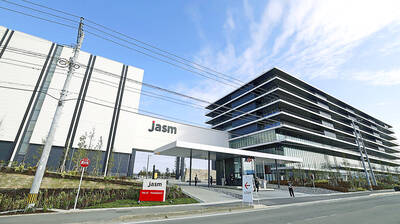
The subsidiary of Taiwan Semiconductor Manufacturing Co (TSMC, 台積電) in Kumamoto, Japan, turned a profit in the first quarter of this year, marking the first time the first fab of the unit has become profitable since mass production started at the end of 2024. According to the contract chipmaker’s financial statement released on Friday, Japan Advanced Semiconductor Manufacturing Inc (JASM), a joint venture running the fab in Kumamoto, posted NT$951 million (US$30.19 million) in profit in the January-to-March period, compared with a loss of NT$1.39 billion in the previous quarter, and a loss of NT$3.25 billion in the first quarter of
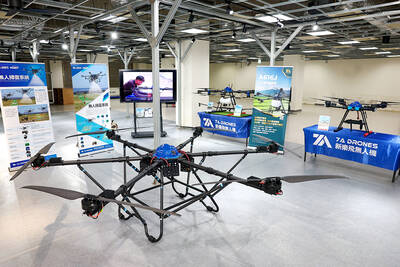
DRONE CENTRAL: Taiwan aims to become Asia’s democratic hub for drones, with most exports focused on high-quality military-grade models, an official said Taiwan’s drone industry is expected to expand significantly by 2030, producing 100,000 units per month and exporting half of them, the Ministry of Economic Affairs said yesterday. Current drone production capacity is about 15,000 units per month, but the industry can quickly scale up as demand increases, Industrial Development Administration Director-General Chiou Chyou-huey (邱求慧) told a news conference in Taipei. Taiwan’s drone output grew 2.5-fold last year to NT$12.9 billion (US$408.3 million) under a government program to develop the uncrewed vehicle sector, he said. The Executive Yuan in October last year approved plans to invest NT$44.2 billion into domestic production of uncrewed aerial
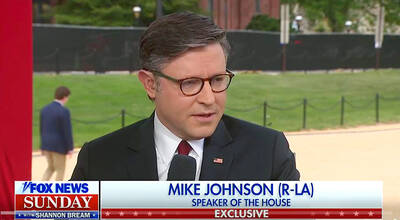
RESOLUTE BACKING: Two Republican senators are planning to introduce legislation that would impose immediate sanctions on China if it attempts to invade Taiwan US House of Representatives Speaker Mike Johnson on Sunday reaffirmed US congressional support for Taiwan, saying the US and “all freedom-loving people” have a stake in preventing China from seizing Taiwan by force. Johnson made the remarks in an interview with Fox News Sunday on US President Donald Trump’s summit with Chinese President Xi Jinping (習近平) last week. In an interview that aired on Friday on Fox News, just as Trump wrapped up a high-stakes visit to China, he said he has yet to green-light a new US$14 billion arms package to Taiwan and that it “depends on China.” “It’s a very good
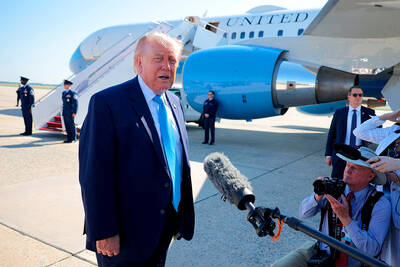
US President Donald Trump yesterday said he would speak to President William Lai (賴清德) as his administration considers whether to move ahead with a US$14 billion weapons sale to Taiwan — a potential arms deal that has drawn criticism from China. “Well, I’ll speak to him. I speak to everybody,” Trump told reporters yesterday when asked if he had any plans to call his counterpart, although he did not offer a time frame for when such a conversation could take place. Trump previously said he would speak to the person “that’s running Taiwan,” without specifying who he meant. “We have that situation very


 RSS
RSS