


Proposals for dealing with the unfolding global financial crisis that has roiled economies around the world and led to higher food and energy prices have dominated the spring meetings of the IMF and the World Bank.
The sessions concluded yesterday with a meeting of the bank’s policy-setting committee, which is expected to focus on how the crisis is effecting developing countries, especially poor ones where the World Bank is trying to help reduce poverty.
“We must respond to the immediate emergency situation,” World Bank President Robert Zoellick said before the meeting. “But we must respond in such a way that can seize opportunities” to help developing countries achieve objectives, such as improving healthcare and reducing malnutrition and infant mortality.
He said other topics included promoting investment in Africa, climate change and rising food prices.
“In the US and Europe over the last year we’ve been focused on the prices of gasoline at the pump,” Zoellick said. “While many worry about filling their gas tanks, many others around the world are struggling to fill their stomachs. And it’s getting more and more difficult every day.”
He said in many developing countries, the poor spend up to 75 percent of their income on food, so when basic food prices rise, “it hits hard.”
Zoellick has said that in order to deal with the immediate crisis, the international community must close a US$500 million food gap identified by the UN World Food Program.
A similar warning on food prices was sounded on Saturday by the head of the IMF, Dominique Strauss-Kahn. He said there would be dire consequences if food prices remain high in developing countries, especially in Africa.
He added that the problem could also create trade imbalances that would impact major advanced economies, “so it is not only a humanitarian question.”
Governments in Haiti, Egypt and the Philippines, among others, are already facing social unrest because of rising food prices and shortages.
If the price spike continues, “thousands, hundreds of thousands of people will be starving. Children will be suffering from malnutrition, with consequences for all their lives,” Strauss-Kahn said.
Earlier on Saturday, Germany’s development minister, who was attending the World Bank’s meeting yesterday, called for greater regulation of the global biofuels market to prevent its expansion from driving up food prices.
“It is unacceptable for the export of agrofuels to pose a threat to the supply situation of the very people already living in poverty,” Heidemarie Wieczorek-Zeul said in a statement.
She said the world needs new rules that balance goals, including climate change mitigation, food security and social development.
The development group Oxfam, a frequent IMF critic, said rich countries are largely responsible for the food crisis because they have been cutting aid and encouraging biofuel production.
“Rich countries’ demand for biofuel is driving up food prices and is a big part of the problem,” said Elizabeth Stuart, an Oxfam policy adviser.
Also See: Haitian PM ousted over food prices
Also See: FAO seeks means to limit impact of biofuel on food
RETHINK? The defense ministry and Navy Command Headquarters could take over the indigenous submarine project and change its production timeline, a source said Admiral Huang Shu-kuang’s (黃曙光) resignation as head of the Indigenous Submarine Program and as a member of the National Security Council could affect the production of submarines, a source said yesterday. Huang in a statement last night said he had decided to resign due to national security concerns while expressing the hope that it would put a stop to political wrangling that only undermines the advancement of the nation’s defense capabilities. Taiwan People’s Party Legislator Vivian Huang (黃珊珊) yesterday said that the admiral, her older brother, felt it was time for him to step down and that he had completed what he

Taiwan has experienced its most significant improvement in the QS World University Rankings by Subject, data provided on Sunday by international higher education analyst Quacquarelli Symonds (QS) showed. Compared with last year’s edition of the rankings, which measure academic excellence and influence, Taiwanese universities made great improvements in the H Index metric, which evaluates research productivity and its impact, with a notable 30 percent increase overall, QS said. Taiwanese universities also made notable progress in the Citations per Paper metric, which measures the impact of research, achieving a 13 percent increase. Taiwanese universities gained 10 percent in Academic Reputation, but declined 18 percent
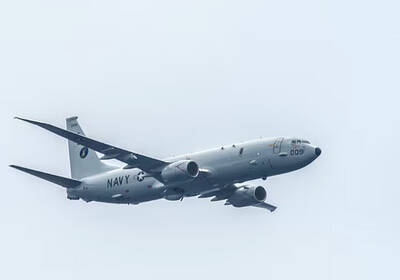
CHINA REACTS: The patrol and reconnaissance plane ‘transited the Taiwan Strait in international airspace,’ the 7th Fleet said, while Taipei said it saw nothing unusual The US 7th Fleet yesterday said that a US Navy P-8A Poseidon flew through the Taiwan Strait, a day after US and Chinese defense heads held their first talks since November 2022 in an effort to reduce regional tensions. The patrol and reconnaissance plane “transited the Taiwan Strait in international airspace,” the 7th Fleet said in a news release. “By operating within the Taiwan Strait in accordance with international law, the United States upholds the navigational rights and freedoms of all nations.” In a separate statement, the Ministry of National Defense said that it monitored nearby waters and airspace as the aircraft
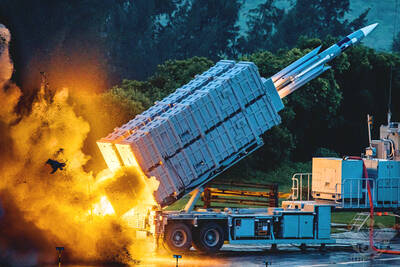
UNDER DISCUSSION: The combatant command would integrate fast attack boat and anti-ship missile groups to defend waters closest to the coastline, a source said The military could establish a new combatant command as early as 2026, which would be tasked with defending Taiwan’s territorial waters 24 nautical miles (44.4km) from the nation’s coastline, a source familiar with the matter said yesterday. The new command, which would fall under the Naval Command Headquarters, would be led by a vice admiral and integrate existing fast attack boat and anti-ship missile groups, along with the Naval Maritime Surveillance and Reconnaissance Command, said the source, who asked to remain anonymous. It could be launched by 2026, but details are being discussed and no final timetable has been announced, the source


 RSS
RSS