


Chinese President Hu Jintao's (
Nevertheless, caution was warranted, Ma told reporters yesterday after a private meeting with American Institute in Taiwan (AIT) Chairman Raymond Burghardt at Chinese Nationalist Party (KMT) headquarters in Taipei.
"We still need to confirm his comments and gain a better understanding of what he said," Ma said.
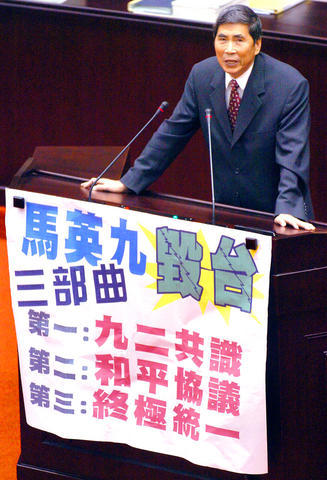
PHOTO: LIAO CHEN-HUEI, TAIPEI TIMES
Hu reportedly indicated during a telephone conversation with US President George W. Bush on Wednesday that he would be willing to reopen cross-strait talks on the basis of the so-called "1992 consensus," which describes that both sides concede separate interpretations of the "one China" policy.
The "consensus" is not universally recognized as valid in Taiwan.
Ma said that since China's state-run news agency Xinhua did not make any mention of "one China, with each side having its own interpretation" in its Chinese news release, he would remain cautious about Hu's comments and continue to seek more information on the content of Hu and Bush's conversation.
"If the US and Chinese presidents both accepted the concept of `one China, with each side having its own interpretation,' it should have a positive impact on future cross-strait relations," Ma said.
In its English news release, Xinhua quoted Hu as telling Bush: "It is China's consistent stand that the Chinese mainland [sic] and Taiwan should restore consultation and talks on the basis of the 1992 consensus."
The report said Hu also expressed appreciation to the US for its "one China" policy, and "opposing" Taiwanese independence, last week's referendum on UN membership and Taiwan's bids to join international organizations that require statehood.
Xinhua only mentioned the "1992 consensus" in the Chinese version of the report.
Ma said it was important for China to accept that the "1992 consensus" stipulated separate interpretations of "one China."
He said that Taiwan interpreted "one China" to mean "the Republic of China (ROC)."
Burghardt yesterday expressed optimism about future US-Taiwan relations, saying he believed the two nations' relationship would be "excellent" under Ma's administration.
Prior to his one-hour closed meeting with Ma, Burghardt had visited President Chen Shui-bian (
Burghardt told Chen during the meeting, which was open to the media, that the US would not come between Taiwan and China in terms of dealing with cross-strait issues and preconditions for cross-strait dialogue.
"The way in which you choose to deal with the tough issues, or the preconditions set by one side or the other, are your business, not our business," Burghardt said.
"But personally I have great faith that people will find ways to talk once again, just as they found a way in the past," he said. "Americans have always respected and been impressed by the ability of huaren [Chinese] on both sides of the Strait to find a way to talk with each other."
The AIT chairman made the remarks after Chen sought his views on two questions: whether the so-called "1992 consensus" actually existed and whether the Cairo Declaration was a legitimate document on which China could base a claim for sovereignty over Taiwan.
Burghardt declined to express an opinion in the presence of the media, saying that, "I think it's perhaps best that we do those in private. I don't trust my ability as a historian to do so in public."
Chen said he wished Burghardt could give him an account of Bush's stance on the "1992 consensus" when he spoke to Hu on Wednesday.
Chen said the "consensus" had been made up by then Mainland Affairs Council chairman Su Chi (
The president said it would be a good thing for Taiwan and China to engage in dialogue, "which is an objective that we have worked hard for the past eight years."
Nevertheless, it would be very strange if cross-strait dialogue were to be based on the "1992 consensus," he said.
"Eight years ago, the Beijing government also asked me to accept the so-called `1992 consensus,' but we couldn't accept it because we believe it does not exist," Chen said.
"If such a consensus had truly been reached during talks in Hong Kong between China and Taiwan in 1992, why did nobody mention it at the time and why was no reference to it made between 1992 and 2000?" Chen said.
Beijing would never accept the Chinese Nationalist Party's (KMT) definition that "each side has its own interpretation of `one China,'" he said, as that would imply "two Chinas" or "one Taiwan, one China."
"Beijing refuses to accept that Taiwan is a sovereign country and would not agree that `one China' could refer to the ROC," Chen said.
He said that the Cairo Declaration could not be used as a legal foundation for China to claim sovereignty over Taiwan.
Not only was the declaration not signed by US president Franklin Roosevelt, British prime minister Winston Churchill and dictator Chiang Kai-shek (
"When Churchill was questioned about it in the British parliament, he said that the Cairo Declaration could not be seen as a legal foundation for China to claim it owned sovereignty over Taiwan," Chen said.
In a meeting with print media later yesterday, Burghardt reiterated the US' apparent "hands-off" approach to possible Taipei-Beijing talks, stressing that Washington's interpretation of the "1992 consensus" was "not important" and that the US would be pleased to see both sides reach a compromise on a vehicle for negotiations.
"The US interpretation is not important. How to determine a basis for negotiations was something that was decided by the mainland [sic] and Taiwan in 1992," Burghardt said.
No matter what language or which term is used to label the 1992 meeting, whether it be an "agreement" or a "consensus," it was an agreement to enable talks to be held, he said.
"If the two sides can find a formula that works for them and feel comfortable with, without betraying [their] own core interest in coming up with the formula, then what is there for the US to have an opinion about?" Burghardt said.
He said the US has long maintained that it had no intention to function as a mediator in cross-strait negotiations and that he surmised both sides might not even welcome US intervention in the process.
The "1992 consensus" also dominated much of the discussion in the legislature yesterday.
In response to a question from KMT Legislator John Wu (
Chang said the government had reservations about the content of the Bush-Hu discussion, because there seemed to be a "gap" between China's official press release after the telephone call and the "general interpretation of the consensus" in the world.
"We are not confident that China meant it" when Hu said China was willing to resume cross-strait negotiation on the basis of the "1992 consensus," Chang said.
Mainland Affairs Council Chairman Chen Ming-tong (陳明通) said that he would not consider the result of the Bush-Hu discussion a major improvement in cross-strait relations unless Hu publicly stated that he agreed Taiwan could define "one China" as the ROC.
"Cross-strait relations are complicated. We should not cheer too soon," Chen Ming-tong said. "Over the years, we have not benefited from our ambiguity strategy. What we need now is a clear-cut strategy."
Wu, however, called the result of the Bush-Hu dialogue a "good beginning."
Wu said that it was more important that the international community dealt with issues concerning cross-strait relations based on the "1992 consensus."
He also rejected the Democratic Progressive Party caucus' previous claim that the KMT's emphasis on the consensus was part of its plan to "sell out" Taiwan.
"If the KMT's support of the 1992 consensus were a strategy to sell out Taiwan, the KMT would not have won the presidential election," Wu said.
Additional reporting by Jenny W. Hsu and flora wang
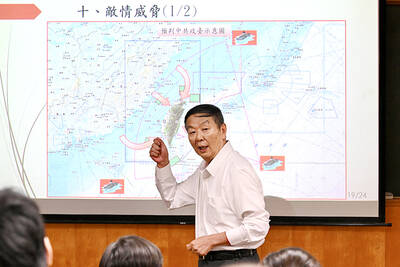
RETHINK? The defense ministry and Navy Command Headquarters could take over the indigenous submarine project and change its production timeline, a source said Admiral Huang Shu-kuang’s (黃曙光) resignation as head of the Indigenous Submarine Program and as a member of the National Security Council could affect the production of submarines, a source said yesterday. Huang in a statement last night said he had decided to resign due to national security concerns while expressing the hope that it would put a stop to political wrangling that only undermines the advancement of the nation’s defense capabilities. Taiwan People’s Party Legislator Vivian Huang (黃珊珊) yesterday said that the admiral, her older brother, felt it was time for him to step down and that he had completed what he
Taiwan has experienced its most significant improvement in the QS World University Rankings by Subject, data provided on Sunday by international higher education analyst Quacquarelli Symonds (QS) showed. Compared with last year’s edition of the rankings, which measure academic excellence and influence, Taiwanese universities made great improvements in the H Index metric, which evaluates research productivity and its impact, with a notable 30 percent increase overall, QS said. Taiwanese universities also made notable progress in the Citations per Paper metric, which measures the impact of research, achieving a 13 percent increase. Taiwanese universities gained 10 percent in Academic Reputation, but declined 18 percent
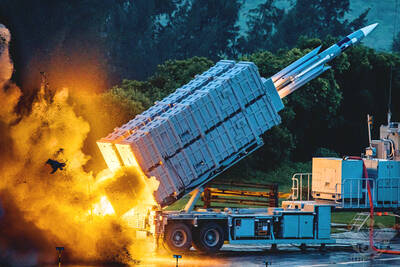
UNDER DISCUSSION: The combatant command would integrate fast attack boat and anti-ship missile groups to defend waters closest to the coastline, a source said The military could establish a new combatant command as early as 2026, which would be tasked with defending Taiwan’s territorial waters 24 nautical miles (44.4km) from the nation’s coastline, a source familiar with the matter said yesterday. The new command, which would fall under the Naval Command Headquarters, would be led by a vice admiral and integrate existing fast attack boat and anti-ship missile groups, along with the Naval Maritime Surveillance and Reconnaissance Command, said the source, who asked to remain anonymous. It could be launched by 2026, but details are being discussed and no final timetable has been announced, the source
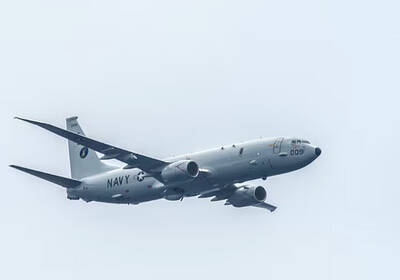
CHINA REACTS: The patrol and reconnaissance plane ‘transited the Taiwan Strait in international airspace,’ the 7th Fleet said, while Taipei said it saw nothing unusual The US 7th Fleet yesterday said that a US Navy P-8A Poseidon flew through the Taiwan Strait, a day after US and Chinese defense heads held their first talks since November 2022 in an effort to reduce regional tensions. The patrol and reconnaissance plane “transited the Taiwan Strait in international airspace,” the 7th Fleet said in a news release. “By operating within the Taiwan Strait in accordance with international law, the United States upholds the navigational rights and freedoms of all nations.” In a separate statement, the Ministry of National Defense said that it monitored nearby waters and airspace as the aircraft


 RSS
RSS