


President Chen Shui-bian (
"Although the premier deserves praise for resigning before the new legislature convenes, for the benefit of the public the convention should be reexamined in light of recent amendments to the Constitution," Chen said in a five-point response to Chang's resignation letter.
Chen's letter was sent to the Cabinet yesterday, with Chang calling a press conference for 10:30am this morning.
Chang led his Cabinet in resigning on Thursday.
As well as following convention, the Cabinet's resignation was seen as paving the way for Chen to consult with the Chinese Nationalist Party (KMT) on forming a new Cabinet.
The new legislature, of which the KMT controls a nearly three-quarters majority, will open on Friday.
Following the KMT's refusal to offer suggestions on the formation of a Cabinet reshuffle, Chen decided to ask Chang to stay on in order to avoid political upheaval.
Instead of accepting Chang's resignation and then reappointing him premier, a practice that had been followed when previous premiers were reappointed, Chen chose to reject Chang's resignation.
Chen cited a constitutional amendment that gives the president the power to appoint the premier without consulting the legislature.
"The 1997 constitutional amendment states that there is no relationship between legislative elections and a premier's term of office. The premier is not obliged to tender his or her resignation after a new legislature is elected," Chen said.
Chen said a 2005 constitutional amendment that lengthened legislators' terms of office from three years to four years in step with that of the president but maintained the difference in the dates of their inaugurations had also influenced his decision.
"If a premier needs to resign twice in the space of three months and 19 days, that is bound to have a negative effect on the government and political stability. We should consider this problem seriously," Chen said.
Chen said that constitutional interpretations No. 387 and No. 419, which stipulate that a premier should tender his or her resignation after the election of a new legislature on the basis that the executive should be responsible to the legislature, were outdated.
"Premier Chang has dedicated himself to official business and performed well. He ought to continue to lead the government," Chen said.
Vice President Annette Lu (呂秀蓮) yesterday gave her full support to Chen's decision.
"I don't think what the president did showed disrespect to the legislature," Lu said when approached for comment.
Meanwhile, at a press conference, KMT caucus whip Kuo Su-chun (
"[Chen] did not want to follow the right path and has taken an unusual step. He thought he was setting a new constitutional precedent, but has he respected constitutional precedents?" Kuo said.
KMT Legislator Wu Yu-sheng (
Wu said Chen wanted Chang to remain in office so that he could campaign for DPP presidential candidate Frank Hsieh (
"[Chen] has put the DPP's interests ahead of the stability of the nation," Wu said.
When asked for comment in Tainan, KMT presidential candidate Ma Ying-jeou (
Additional reporting by Flora Wang
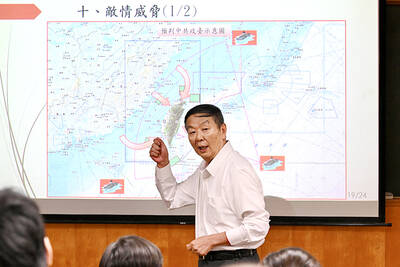
RETHINK? The defense ministry and Navy Command Headquarters could take over the indigenous submarine project and change its production timeline, a source said Admiral Huang Shu-kuang’s (黃曙光) resignation as head of the Indigenous Submarine Program and as a member of the National Security Council could affect the production of submarines, a source said yesterday. Huang in a statement last night said he had decided to resign due to national security concerns while expressing the hope that it would put a stop to political wrangling that only undermines the advancement of the nation’s defense capabilities. Taiwan People’s Party Legislator Vivian Huang (黃珊珊) yesterday said that the admiral, her older brother, felt it was time for him to step down and that he had completed what he
Taiwan has experienced its most significant improvement in the QS World University Rankings by Subject, data provided on Sunday by international higher education analyst Quacquarelli Symonds (QS) showed. Compared with last year’s edition of the rankings, which measure academic excellence and influence, Taiwanese universities made great improvements in the H Index metric, which evaluates research productivity and its impact, with a notable 30 percent increase overall, QS said. Taiwanese universities also made notable progress in the Citations per Paper metric, which measures the impact of research, achieving a 13 percent increase. Taiwanese universities gained 10 percent in Academic Reputation, but declined 18 percent
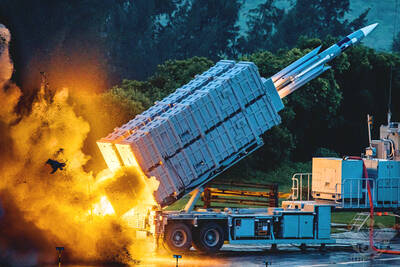
UNDER DISCUSSION: The combatant command would integrate fast attack boat and anti-ship missile groups to defend waters closest to the coastline, a source said The military could establish a new combatant command as early as 2026, which would be tasked with defending Taiwan’s territorial waters 24 nautical miles (44.4km) from the nation’s coastline, a source familiar with the matter said yesterday. The new command, which would fall under the Naval Command Headquarters, would be led by a vice admiral and integrate existing fast attack boat and anti-ship missile groups, along with the Naval Maritime Surveillance and Reconnaissance Command, said the source, who asked to remain anonymous. It could be launched by 2026, but details are being discussed and no final timetable has been announced, the source
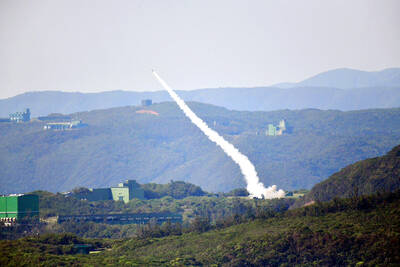
SHOT IN THE ARM: The new system can be integrated with Avenger and Stinger missiles to bolster regional air defense capabilities, a defense ministry report said Domestically developed Land Sword II (陸射劍二) missiles were successfully launched and hit target drones during a live-fire exercise at the Jiupeng Military Base in Pingtung County yesterday. The missiles, developed by the Chungshan Institute of Science and Technology (CSIST), were originally scheduled to launch on Tuesday last week, after the Tomb Sweeping Day holiday long weekend, but were postponed to yesterday due to weather conditions. Local residents and military enthusiasts gathered outside the base to watch the missile tests, with the first one launching at 9:10am. The Land Sword II system, which is derived from the Sky Sword II (天劍二) series, was turned


 RSS
RSS