


More than 200 bodyguards completed their training at the National Security Bureau (NSB) yesterday and will be deployed to protect candidates in the March presidential election.
The bureau is required by law to provide security protection to presidential and vice presidential candidates from their registration date until the election is over. Registration for candidates will start on Saturday, and the election will be held on March 22.
NSB chief Shi Hwei-yow (
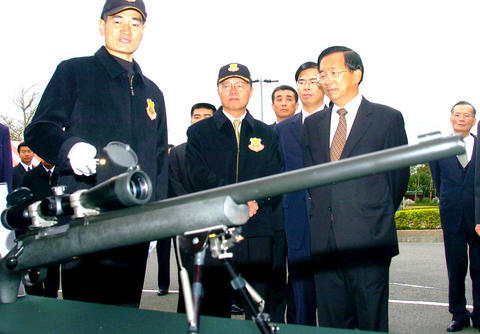
PHOTO: PATRICK LIN, AFP
Shi said that the bureau would offer monetary rewards to informants who expose any misconduct by the recruits.
He said the bureau would deploy 45 security personnel to protect each set of candidates, and they have rented apartments near the candidates' homes.
"We are like the midwife whose job is to ensure the safety of the mother and the baby," he said. "It is not our concern whether the baby is a boy or a girl."
Speaking at a commencement ceremony at the Special Forces Center in Dazhi (
On March 19, 2004, bullets grazed Chen's stomach and hit Vice President Annette Lu's (
Although the inquiry into the case has ended and the investigation report was made public, the political repercussions continue, Chen said.
Chen emphasized the importance of protecting candidates in the country's fourth presidential election, which he said bore historic significance and would draw a lot of international attention.
Protecting the candidates is a legal responsibility, not a service for specific individuals or political parties, Chen said.
Security personnel must refrain from engaging in any activity that interferes with their legal duties, he said.
After the speech, Chen inspected the bureau's display of the latest security equipment and vehicles and watched a performance of martial arts and shooting skills.
Among the new equipment, a French-made acoustic gunshot detector attracted the most attention. Officials said the system can locate the origin of a gunshot by detecting the shock waves created by the projectile as it leaves the muzzle of a gun. However, it is only suitable for use at fixed locations.
Chen expressed great interest in the gunshot detector, often turning to ask Shi questions.
In related news, Democratic Progressive Party (DPP) presidential candidate Frank Hsieh (謝長廷) said he would wear a bulletproof vest only when it was necessary because the heavy vests could be burdensome, especially when he has a busy schedule.
Hsieh's camp introduced its campaign team yesterday. Former Government Information Office (GIO) minister Pasuya Yao (姚文智) heads the culture and information department; Cheng Wen-tsang (鄭文燦) heads the news department; and former DPP legislator Luo Wen-chia (羅文嘉) will be executive officer of the policy committee.
Additional reporting by Hsu Shao-hsuan
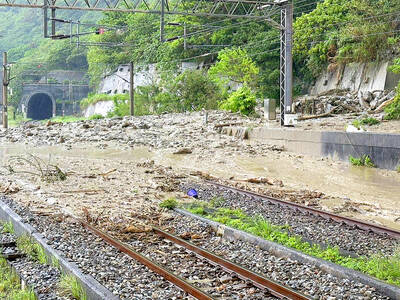
ROLLER-COASTER RIDE: More than five earthquakes ranging from magnitude 4.4 to 5.5 on the Richter scale shook eastern Taiwan in rapid succession yesterday afternoon Back-to-back weather fronts are forecast to hit Taiwan this week, resulting in rain across the nation in the coming days, the Central Weather Administration said yesterday, as it also warned residents in mountainous regions to be wary of landslides and rockfalls. As the first front approached, sporadic rainfall began in central and northern parts of Taiwan yesterday, the agency said, adding that rain is forecast to intensify in those regions today, while brief showers would also affect other parts of the nation. A second weather system is forecast to arrive on Thursday, bringing additional rain to the whole nation until Sunday, it
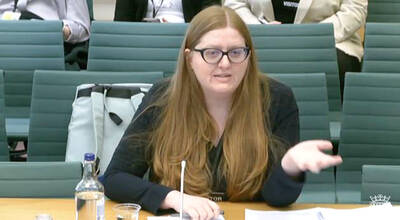
CONDITIONAL: The PRC imposes secret requirements that the funding it provides cannot be spent in states with diplomatic relations with Taiwan, Emma Reilly said China has been bribing UN officials to obtain “special benefits” and to block funding from countries that have diplomatic ties with Taiwan, a former UN employee told the British House of Commons on Tuesday. At a House of Commons Foreign Affairs Committee hearing into “international relations within the multilateral system,” former Office of the UN High Commissioner for Human Rights (OHCHR) employee Emma Reilly said in a written statement that “Beijing paid bribes to the two successive Presidents of the [UN] General Assembly” during the two-year negotiation of the Sustainable Development Goals. Another way China exercises influence within the UN Secretariat is
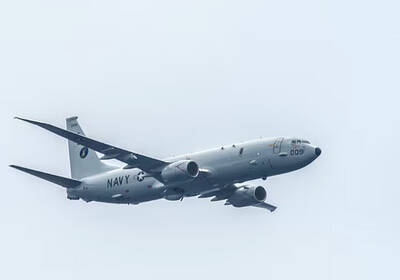
CHINA REACTS: The patrol and reconnaissance plane ‘transited the Taiwan Strait in international airspace,’ the 7th Fleet said, while Taipei said it saw nothing unusual The US 7th Fleet yesterday said that a US Navy P-8A Poseidon flew through the Taiwan Strait, a day after US and Chinese defense heads held their first talks since November 2022 in an effort to reduce regional tensions. The patrol and reconnaissance plane “transited the Taiwan Strait in international airspace,” the 7th Fleet said in a news release. “By operating within the Taiwan Strait in accordance with international law, the United States upholds the navigational rights and freedoms of all nations.” In a separate statement, the Ministry of National Defense said that it monitored nearby waters and airspace as the aircraft

Taiwan’s first drag queen to compete on the internationally acclaimed RuPaul’s Drag Race, Nymphia Wind (妮妃雅), was on Friday crowned the “Next Drag Superstar.” Dressed in a sparkling banana dress, Nymphia Wind swept onto the stage for the final, and stole the show. “Taiwan this is for you,” she said right after show host RuPaul announced her as the winner. “To those who feel like they don’t belong, just remember to live fearlessly and to live their truth,” she said on stage. One of the frontrunners for the past 15 episodes, the 28-year-old breezed through to the final after weeks of showcasing her unique


 RSS
RSS