


South African President Thabo Mbeki was licking his wounds yesterday after being toppled by Jacob Zuma as the ruling African National Congress' (ANC) leader in a move that threatens to usher in a turbulent new era.
"Zunami Rules" read the front-page headline of the Sowetan above a photo of a jubilant Zuma hugging Mbeki in a rare show of camaraderie between the pair after a bitter leadership contest that was finally announced late on Tuesday.
As Dren Nupen, head of the ANC elections commission, announced that Zuma had won 2,329 votes to 1,505 for Mbeki, the delegates gathered at a conference in northern Polokwane erupted into celebration.
The result marks a major humiliation for Mbeki, who had wanted unfettered control in his last two years as head of state before he is constitutionally obliged to stand down, and must now deal with a rival center of power.
"The victory means that while Zuma will hold sway at party headquarters at Luthuli House, Johannesburg, Mbeki will continue to run the country from the Union Buildings, raising the prospect of a power struggle pitting party against state," the Business Day newspaper said.
The Star newspaper declared that Mbeki was now a "lame duck president" and warned his government "could be crippled and forced to account to the newly elected leadership."
Neither man made any comment to reporters on Tuesday night. A Zuma press conference scheduled for yesterday was also canceled as delegates met behind closed doors to discuss the make-up of the 86-strong national executive committee.
"We thought it best that he should address the conference before he addresses the media," ANC spokesman Steyn Speed said.
Victory caps a remarkable comeback for the scandal-plagued Zuma, who still faces the prospect of being charged with corruption.
The 65-year-old was sacked by Mbeki as deputy head of state in 2005 when his financial adviser was jailed for fraud. Later Zuma stood trial for raping a family friend less than half his age.
Although Zuma was acquitted, he was widely ridiculed for testifying he had showered after sex with his HIV-positive accuser to prevent infection.
Given the ANC's large majority in parliament, Zuma would normally almost be guaranteed the job of state president in elections in 2009 after his victory in the party contest.
But he faces being charged with corruption after losing a recent court bid to have a series of search warrants declared illegal.
An ethnic Zulu whose earthy charm contrasts sharply with the aloof Mbeki, Zuma has cashed in on growing disillusionment with the government's failure to eradicate poverty in the 13 years since the end of whites-only rule.
Although Mbeki, also 65, can point to an uninterrupted period of growth, unemployment is unofficially estimated to be around 40 percent.
Many analysts believe, however, that Mbeki's defeat was more as a result of his distant and authoritarian style, which had alienated many in his party, rather than a firm vote of confidence in Zuma.
Deputy Foreign Minister Aziz Pahad, one of Mbeki's closest allies, said it was important the ANC now unite after the conference exposed deep divisions.
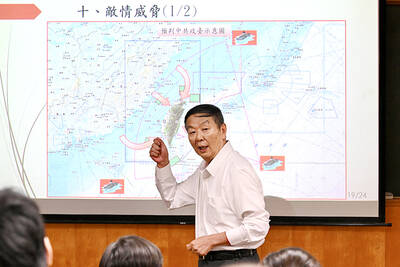
RETHINK? The defense ministry and Navy Command Headquarters could take over the indigenous submarine project and change its production timeline, a source said Admiral Huang Shu-kuang’s (黃曙光) resignation as head of the Indigenous Submarine Program and as a member of the National Security Council could affect the production of submarines, a source said yesterday. Huang in a statement last night said he had decided to resign due to national security concerns while expressing the hope that it would put a stop to political wrangling that only undermines the advancement of the nation’s defense capabilities. Taiwan People’s Party Legislator Vivian Huang (黃珊珊) yesterday said that the admiral, her older brother, felt it was time for him to step down and that he had completed what he
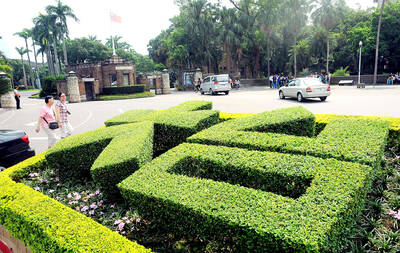
Taiwan has experienced its most significant improvement in the QS World University Rankings by Subject, data provided on Sunday by international higher education analyst Quacquarelli Symonds (QS) showed. Compared with last year’s edition of the rankings, which measure academic excellence and influence, Taiwanese universities made great improvements in the H Index metric, which evaluates research productivity and its impact, with a notable 30 percent increase overall, QS said. Taiwanese universities also made notable progress in the Citations per Paper metric, which measures the impact of research, achieving a 13 percent increase. Taiwanese universities gained 10 percent in Academic Reputation, but declined 18 percent
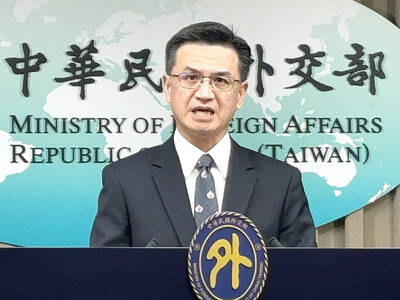
BULLY TACTICS: Beijing has continued its incursions into Taiwan’s airspace even as Xi Jinping talked about Taiwan being part of the Chinese family and nation China should stop its coercion of Taiwan and respect mainstream public opinion in Taiwan about sovereignty if its expression of goodwill is genuine, the Ministry of Foreign Affairs (MOFA) said yesterday. Ministry spokesman Jeff Liu (劉永健) made the comment in response to media queries about a meeting between former president Ma Ying-jeou (馬英九) and Chinese President Xi Jinping (習近平) the previous day. Ma voiced support for the so-called “1992 consensus,” while Xi said that although the two sides of the Taiwan Strait have “different systems,” this does not change the fact that they are “part of the same country,” and that “external
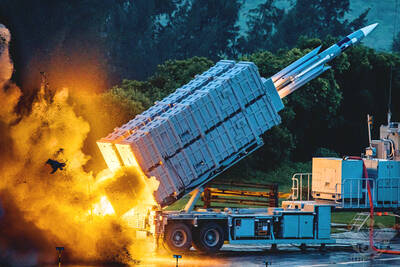
UNDER DISCUSSION: The combatant command would integrate fast attack boat and anti-ship missile groups to defend waters closest to the coastline, a source said The military could establish a new combatant command as early as 2026, which would be tasked with defending Taiwan’s territorial waters 24 nautical miles (44.4km) from the nation’s coastline, a source familiar with the matter said yesterday. The new command, which would fall under the Naval Command Headquarters, would be led by a vice admiral and integrate existing fast attack boat and anti-ship missile groups, along with the Naval Maritime Surveillance and Reconnaissance Command, said the source, who asked to remain anonymous. It could be launched by 2026, but details are being discussed and no final timetable has been announced, the source


 RSS
RSS