


Two outspoken political veterans faced off yesterday in one of Hong Kong's most keenly watched legislative elections since Britain returned the territory to China a decade ago, a race some are calling a referendum on democracy.
Although eight candidates were vying for the legislative seat, pre-election polls showed it was largely between two well-known, and politically divisive, female former officials -- Anson Chan (
Chan, dubbed ``Hong Kong's conscience'' for her championing of civil liberties, had the backing of the pro-democracy camp -- political parties that want Hong Kong to be able to elect all its lawmakers and leader by 2012.
Currently, only half the legislature is elected by voters, and Beijing has refused to set a date for full democracy.
Chan's closest rival, former security chief Ip, is squarely in the pro-administration corner, claiming to be fully supportive of full democracy for the vibrant, capitalist city, but only when Beijing gives its approval.
Whoever wins the election won't change Hong Kong's political landscape -- the legislature will still be controlled by Beijing's local allies.
Still, the balloting is seen as an important gauge of the public's desire for democratic reforms.
"Pro-Beijing voices are too strong in the legislature. I want to see one more pro-democracy lawmaker to balance the power," Susanna Yip said as she left a polling station, having voted for Chan.
"It's no doubt democracy is important, but I'm more concerned about how our livelihood can be improved," said IT executive Linda Au, who voted for Ip.
Political analysts expect the territory's Communist leaders in Beijing to keep a close eye on the election, but doubt whether the outcome will lead to any real change for Hong Kong.
"Beijing has already made up its mind on Hong Kong's democratic development. It's unlikely that it will allow universal suffrage in 2012, regardless of whether Chan wins the election or not," said James Sung, a political academic at the City University of Hong Kong.
However, Sung said a win by Chan would be a fillip for the pro-democracy movement, which suffered a huge blow in last month's district elections when Beijing-allied parties swept the board.
Analysts put that loss down to voters' reluctance to rock the boat when the economy is on an upswing, due in part to Hong Kong's close relationship with mainland China.
"No matter whether the economy is robust or not, there must be someone in the legislature to monitor and scrutinize the government," Chan told voters while canvassing at a public housing estate yesterday.
Hong Kong's leader is chosen by an 800-member committee loyal to Beijing and only half of its 60 legislators are elected, with the rest picked by interest groups.
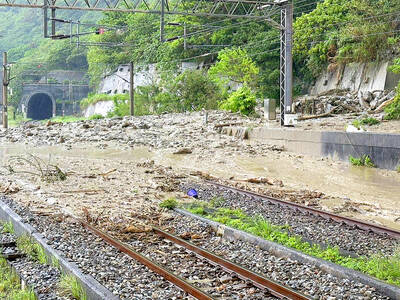
ROLLER-COASTER RIDE: More than five earthquakes ranging from magnitude 4.4 to 5.5 on the Richter scale shook eastern Taiwan in rapid succession yesterday afternoon Back-to-back weather fronts are forecast to hit Taiwan this week, resulting in rain across the nation in the coming days, the Central Weather Administration said yesterday, as it also warned residents in mountainous regions to be wary of landslides and rockfalls. As the first front approached, sporadic rainfall began in central and northern parts of Taiwan yesterday, the agency said, adding that rain is forecast to intensify in those regions today, while brief showers would also affect other parts of the nation. A second weather system is forecast to arrive on Thursday, bringing additional rain to the whole nation until Sunday, it

CONDITIONAL: The PRC imposes secret requirements that the funding it provides cannot be spent in states with diplomatic relations with Taiwan, Emma Reilly said China has been bribing UN officials to obtain “special benefits” and to block funding from countries that have diplomatic ties with Taiwan, a former UN employee told the British House of Commons on Tuesday. At a House of Commons Foreign Affairs Committee hearing into “international relations within the multilateral system,” former Office of the UN High Commissioner for Human Rights (OHCHR) employee Emma Reilly said in a written statement that “Beijing paid bribes to the two successive Presidents of the [UN] General Assembly” during the two-year negotiation of the Sustainable Development Goals. Another way China exercises influence within the UN Secretariat is

LANDSLIDES POSSIBLE: The agency advised the public to avoid visiting mountainous regions due to more expected aftershocks and rainfall from a series of weather fronts A series of earthquakes over the past few days were likely aftershocks of the April 3 earthquake in Hualien County, with further aftershocks to be expected for up to a year, the Central Weather Administration (CWA) said yesterday. Based on the nation’s experience after the quake on Sept. 21, 1999, more aftershocks are possible over the next six months to a year, the agency said. A total of 103 earthquakes of magnitude 4 on the local magnitude scale or higher hit Hualien County from 5:08pm on Monday to 10:27am yesterday, with 27 of them exceeding magnitude 5. They included two, of magnitude

Taiwan’s first drag queen to compete on the internationally acclaimed RuPaul’s Drag Race, Nymphia Wind (妮妃雅), was on Friday crowned the “Next Drag Superstar.” Dressed in a sparkling banana dress, Nymphia Wind swept onto the stage for the final, and stole the show. “Taiwan this is for you,” she said right after show host RuPaul announced her as the winner. “To those who feel like they don’t belong, just remember to live fearlessly and to live their truth,” she said on stage. One of the frontrunners for the past 15 episodes, the 28-year-old breezed through to the final after weeks of showcasing her unique


 RSS
RSS