


Military helicopters and ships joined rescue and relief operations yesterday, as aid workers on the ground struggled to reach the victims of a savage cyclone that tore apart villages and towns in southwest Bangladesh, killing a reported 1,100 people.
Tropical Cyclone Sidr flattened tens of thousands of homes on Thursday and left millions more without power in the deadliest storm in the impoverished South Asian country in more than a decade. More than 1 million coastal villagers were forced to evacuate to government shelters.
Rescuers battled along roads that were washed out or blocked by wind-blown debris to try to get water and food to people stranded by flooding. Some employed the brute force of elephants to help in their efforts.
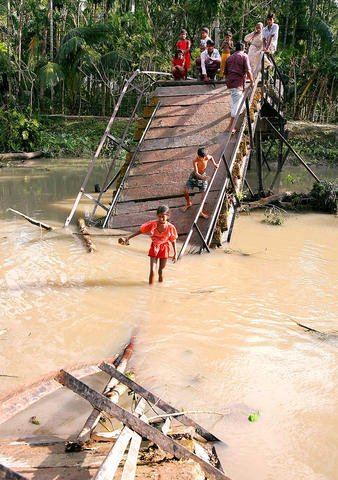
PHOTO: AFP
The Ministry of Disaster Management, which has struggled to collect detailed information from the devastated area because of the disruptions to power and communications, put the official death toll at 932.
"The toll is rising fast, as we receive more information from outlying areas where telephone lines have been restored," said Mokhlesur Rahman, a ministry official in Dhaka.
Yesterday the army deployed helicopters to deliver supplies to the remotest areas, while navy ships delivered supplies and dispensed medical assistance to migrant fishing communities living on and around hundreds of tiny islands, or shoals, along the coast, the Inter Services Public Relations department said in a statement.
At least 270 people died in Patuakhali south of Dhaka, while Barguna suffered at least 160 deaths, Rahman said.
The United News of Bangladesh news agency, which has reporters deployed across the devastated region, said the count from each affected district put the death toll even higher, to at least 1,100.
The damage to lives, housing and crops will be "extremely severe," UN Undersecretary-General for Humanitarian Affairs John Holmes said on Friday, adding that the world body was making millions of dollars in aid available to Bangladesh.
Several international humanitarian organizations, like UNICEF and CARE, were working alongside government and local volunteer agencies to provide safe drinking water and emergency supplies in the affected areas.
"We are hopeful that emergency preparedness in place and quick action has successfully reduced the loss of human life," Suman Islam of CARE Bangladesh said in an e-mail statement.
"But many people are now homeless, crops and livelihoods have been destroyed and this is going to put great pressure on the government, the economy, and the people themselves," he said.
The 240kph winds wreaked havoc on the country's electricity and telephone lines, affecting even areas that were spared a direct hit, and leaving the full picture of the death and destruction unclear.
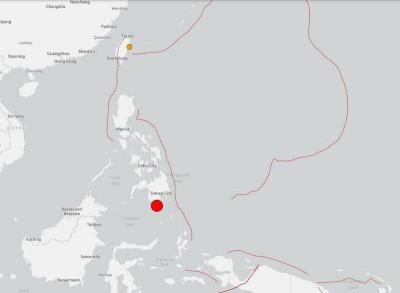
A magnitude 7.8 earthquake struck off the southern coast of Mindanao in the Philippines at 7:38am today, prompting the US Tsunami Warning System to issue an alert for neighboring countries, including Taiwan. The system issued a purple alert indicating a "tsunami threat." The potential threat zone includes Taiwan, the Philippines, Papua New Guinea, Yap and Palau. Philippine authorities were assessing the damage from the quake, with the office of civil defense seeking to verifying initial reports that 15 people had been killed and 129 injured in the region, mostly from falling debris. Arlene Hollero, disaster chief of Maasim town in the Philippines' Sarangani Province,

‘GRAY ZONE’ PRESSURE: Beijing’s activities are intended to create the deceitful impression that China has jurisdiction over the area around Taiwan, the CGA said Taiwan’s rights over its territorial waters and exclusive economic zone must not be violated by any country, the Mainland Affairs Council said yesterday, adding that it will not accept any unprovoked actions. The council issued the remarks in response to the China Coast Guard conducting maritime enforcement drills near eastern Taiwan and claiming to fully exercise China’s maritime administrative law enforcement authority. The Coast Guard Administration (CGA) has been closely monitoring the situation and is taking concrete steps to defend the nation’s sovereignty and secure its waters, the council said. China has no sovereign rights over the waters off eastern

RESILIENCE: Taiwan plays a key role in semiconductors, energy, information infrastructure and advanced manufacturing, AIT Director Raymond Greene said Taiwan’s continued investment in deterrence and resilience remains vital, especially in uncrewed systems and other emerging technologies, American Institute in Taiwan (AIT) Director Raymond Greene said yesterday. Greene made the remarks at the annual National Strategic Summit on Supply Chain Resilience held by the Research Institute for Democracy, Society and Emerging Technology (DSET), a government-backed think tank. As Taiwan last year became the US’ fourth-largest trading partner and supply chain security is becoming more important, cooperation in emerging technologies continues to deepen between the two countries, he said. The US is committed to accelerating innovation, building key infrastructure, strengthening cooperation

RIGHT DIRECTION: Taiwan’s efforts to prevent forced labor include a proposal to ‘fully prohibit’ employers from withholding workers’ documents, an official said Taiwan is to establish a mechanism to restrict imports of goods linked to forced labor, the Executive Yuan said yesterday, after the US proposed imposing additional tariffs on Taiwanese goods over labor concerns. “The Ministry of Labor and the Ministry of Economic Affairs are to establish an interministerial review procedure,” Executive Yuan spokesperson Michelle Lee (李慧芝) said at a news briefing in Taipei. “The government is to use the Foreign Trade Act [貿易法] as the legal basis to restrict imports of goods produced with forced labor” and bring its supply chain governance more in line with international standards on human rights, resilience


 RSS
RSS