


The Democratic Progressive Party (DPP) caucus yesterday said it would demand the resignation of Premier Chang Chun-hsiung (
The caucus made the call amid sharp rises in the price of staples such as wheat flour, vegetables, fruit and gasoline. The price of some items has gone up by 200 percent.
The DPP caucus also requested that the Economics Ministry unveil price-control measures and that the Justice Ministry arrest anyone responsible for artificial price hikes, also within a month.

PHOTO: CNA
If the government fails to stabilize commodity prices within one month, Chang, Minister of Economic Affairs Steve Chen (
In response to the demands, Cabinet Secretary-General Chen Chin-jun (
Chen said fuel prices would not go any higher, adding that a cross-ministerial taskforce would meet today to discuss the price of oil and consumer goods.
"There is room for lower oil prices in future," Chen told a press conference later yesterday. "Current fuel prices are at their highest level and will not go beyond the latest adjustment on Nov. 2."
Asked whether the administration could promise there would not be any fuel price increases even if international oil prices went up, Chen said the Executive Yuan would "work toward that goal."
Chen said the state-run CPC Corporation, Taiwan (
Council for Economic Planning and Development Chairwoman Ho Mei-yueh (
The Directorate General of Budget, Accounting and Statistics said that the consumer price index (CPI) last month was 5.34 percent, the highest since October 1994.
Ho said the high CPI was mostly attributable to the 78 percent increase in the price of vegetables and the 8 percent rise in the price of fruits caused by a series of typhoons this summer.
In related news, the Ministry of Justice said yesterday that prosecutors nationwide had been probing businesses that had illegally brought up commodity prices.
Vice Minister of Justice Lee Chin-yung (
Prosecutors would visit various markets and storehouses to determine who was behind the unusual rises in commodity prices, Lee said.
Lee said businesspeople who bid up commodity prices could be prosecuted for Offenses Against Agriculture, Industry, and Commerce (
Fair Trade Commission Chairman Tang Jinn-chuan (
Meanwhile, the statistics bureau said yesterday that inflation had accelerated to a 13-year high last month on food and energy costs, increasing the likelihood of an interest-rate increase.
Consumer prices climbed 5.34 percent from a year earlier, the bureau said. That was more than the 3.26 percent median estimate in a Bloomberg News survey of 10 economists. Prices rose 3.08 percent in September.
"A string of typhoons this summer caused food prices to rise and that was exacerbated by high oil prices," said Vickie Hsieh (
The central bank will decide next month on whether to raise the benchmark from 3.25 percent after 13 straight quarterly increases. Higher oil, commodity and food costs are driving up prices across Asia, with China's inflation at close to a decade high.
The yield on Taiwan's benchmark 10 year bond closed 5.2 basis points higher at 2.755 percent.
Core consumer prices, which exclude food and energy, rose 2.27 percent after climbing 1.94 percent in September. Food accounts for a quarter of the nation's consumer-price index and fuel makes up almost 13 percent.
Vegetable prices contributed about half of the 5.34 percent increase in the overall rate, the statistics bureau said.
Increased prices for global commodities such as wheat, corn and soya beans also boosted food costs, said Wu Chao-ming (
Import prices increased 8.85 percent from a year earlier, while wholesale prices rose 5.69 percent.
The inflation rate for the first 10 months was 1.35 percent and is unlikely to exceed 2 percent for the full year, Wu said. In August, the government predicted consumer prices would rise 1.48 percent this year.
Policy makers will "stay vigilant and continue monetary tightening," said Cheng Cheng-mount(
On Friday, crude oil closed at US$95.93 a barrel in New York, the highest level since trading began in 1983. In China, where food prices have pushed up inflation, the September rate was 6.2 percent.
Additional reporting by DPA
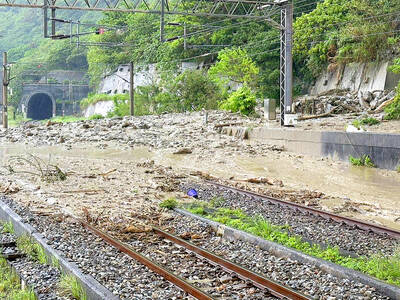
ROLLER-COASTER RIDE: More than five earthquakes ranging from magnitude 4.4 to 5.5 on the Richter scale shook eastern Taiwan in rapid succession yesterday afternoon Back-to-back weather fronts are forecast to hit Taiwan this week, resulting in rain across the nation in the coming days, the Central Weather Administration said yesterday, as it also warned residents in mountainous regions to be wary of landslides and rockfalls. As the first front approached, sporadic rainfall began in central and northern parts of Taiwan yesterday, the agency said, adding that rain is forecast to intensify in those regions today, while brief showers would also affect other parts of the nation. A second weather system is forecast to arrive on Thursday, bringing additional rain to the whole nation until Sunday, it
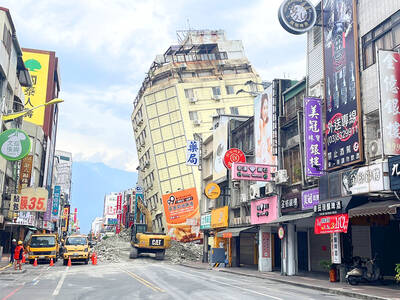
LANDSLIDES POSSIBLE: The agency advised the public to avoid visiting mountainous regions due to more expected aftershocks and rainfall from a series of weather fronts A series of earthquakes over the past few days were likely aftershocks of the April 3 earthquake in Hualien County, with further aftershocks to be expected for up to a year, the Central Weather Administration (CWA) said yesterday. Based on the nation’s experience after the quake on Sept. 21, 1999, more aftershocks are possible over the next six months to a year, the agency said. A total of 103 earthquakes of magnitude 4 on the local magnitude scale or higher hit Hualien County from 5:08pm on Monday to 10:27am yesterday, with 27 of them exceeding magnitude 5. They included two, of magnitude

CONDITIONAL: The PRC imposes secret requirements that the funding it provides cannot be spent in states with diplomatic relations with Taiwan, Emma Reilly said China has been bribing UN officials to obtain “special benefits” and to block funding from countries that have diplomatic ties with Taiwan, a former UN employee told the British House of Commons on Tuesday. At a House of Commons Foreign Affairs Committee hearing into “international relations within the multilateral system,” former Office of the UN High Commissioner for Human Rights (OHCHR) employee Emma Reilly said in a written statement that “Beijing paid bribes to the two successive Presidents of the [UN] General Assembly” during the two-year negotiation of the Sustainable Development Goals. Another way China exercises influence within the UN Secretariat is

Taiwan’s first drag queen to compete on the internationally acclaimed RuPaul’s Drag Race, Nymphia Wind (妮妃雅), was on Friday crowned the “Next Drag Superstar.” Dressed in a sparkling banana dress, Nymphia Wind swept onto the stage for the final, and stole the show. “Taiwan this is for you,” she said right after show host RuPaul announced her as the winner. “To those who feel like they don’t belong, just remember to live fearlessly and to live their truth,” she said on stage. One of the frontrunners for the past 15 episodes, the 28-year-old breezed through to the final after weeks of showcasing her unique


 RSS
RSS