


President Chen Shui-bian's (
Grand Justice Lai Ying-jaw (
Grand Justice Hsieh Tsai-chuan (
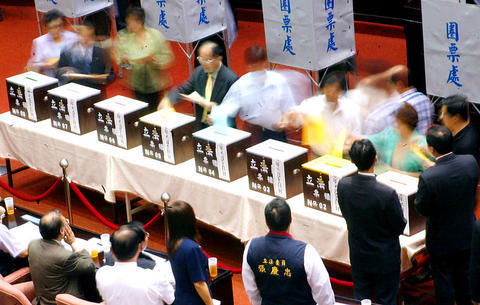
PHOTO: CNA
Hsieh obtained less support than Lai did as many Democratic Progressive Party (DPP) lawmakers were dissatisfied with his opinion on a constitutional interpretation that declared the National Communications Commission (NCC) unconstitutional.
The Council of Grand Justices in July declared that the NCC's makeup, reflecting the proportion of seats held in the legislature by each party, is unconstitutional.
"Caucus members were not required to vote for Hsieh [because of the NCC matter]. We merely told them to support the president's nominees," DPP legislative caucus whip Wang Tuoh (
The nominees needed an affirmative vote from more than half of the 217 lawmakers to be approved. The DPP and its pan-green ally the Taiwan Solidarity Union together hold just 96 legislative seats.
Hsu Chih-hsiung (
The Chinese Nationalist Party (KMT), the People First Party (PFP) and Non-partisan Solidarity Union all rejected the four nominees, who have close associations with the pan-green camp.
The pan-blue camp, holding 119 seats, cast a total of only 46 votes for the eight grand justice nominees in a bid to reduce the chance of its lawmakers voting against the caucus decision to boycott the four nominees.
The four rejected nominees also did not win the full support of the pan-green camp, with Hsu, Yeh Jiung-rong, Liu Shing-i, and Yeh Sai-ying only garnering 93, 92, 94 and 94 votes respectively. The lost votes were from TSU legislators.
PFP legislative caucus whip Fu Kun-chi (傅崑萁) said that the four nominees were voted down on the grounds that they have "strong ideological beliefs" that made them "unqualified" to have the power of interpreting the Constitution.
As stipulated in Additional Article No. 5 of the Constitution, of the 15 grand justices nominated by the president in 2003, eight members, including the president and the vice president of the Judicial Yuan, received four-year terms. The remaining grand justices received eight-year terms.
The eight grand justice nominees were named late last month to succeed the eight grand justices whose terms expire on Sunday.
After the nomination list was sent to the legislature, the pan-blue camp said it would throw out at least half of the nominees to avoid a situation in which all 15 grand justices would be nominated by one president in 2011.
KMT Legislator Lin Hung-chih (
"Voting down the four nominees leaves their nomination to the next president," he said.
Lin Feng-jeng (林峰正), executive-general of an alliance composed of civil groups to monitor the confirmation process, said the pan-blue camp was putting party politics over legal expertise.
"The duty of the grand justices is not only to provide constitutional interpretations on political issues but also to safeguard human rights. It's a pity that the legislature voted down the four nominees who hold relatively progressive views on human rights," he said.
The four grand justice nominees who passed the confirmation vote were Lin Hsi-yao (林錫堯), chief prosecutor at the Supreme Court Prosecutors' Office, Chih Chi-ming (池啟明), a justice of the Supreme Court, Tsai Ching-you (蔡清遊), president of the Fuchien High Court Kinmen Branch and Lee Chen-shan (
The Presidential Office issued a statement after the vote saying the president was grateful for the legislative approval of four nominees, but added that Chen was worried about the performance of the grand justices since four nominees had been rejected.
ROLLER-COASTER RIDE: More than five earthquakes ranging from magnitude 4.4 to 5.5 on the Richter scale shook eastern Taiwan in rapid succession yesterday afternoon Back-to-back weather fronts are forecast to hit Taiwan this week, resulting in rain across the nation in the coming days, the Central Weather Administration said yesterday, as it also warned residents in mountainous regions to be wary of landslides and rockfalls. As the first front approached, sporadic rainfall began in central and northern parts of Taiwan yesterday, the agency said, adding that rain is forecast to intensify in those regions today, while brief showers would also affect other parts of the nation. A second weather system is forecast to arrive on Thursday, bringing additional rain to the whole nation until Sunday, it

CONDITIONAL: The PRC imposes secret requirements that the funding it provides cannot be spent in states with diplomatic relations with Taiwan, Emma Reilly said China has been bribing UN officials to obtain “special benefits” and to block funding from countries that have diplomatic ties with Taiwan, a former UN employee told the British House of Commons on Tuesday. At a House of Commons Foreign Affairs Committee hearing into “international relations within the multilateral system,” former Office of the UN High Commissioner for Human Rights (OHCHR) employee Emma Reilly said in a written statement that “Beijing paid bribes to the two successive Presidents of the [UN] General Assembly” during the two-year negotiation of the Sustainable Development Goals. Another way China exercises influence within the UN Secretariat is

CHINA REACTS: The patrol and reconnaissance plane ‘transited the Taiwan Strait in international airspace,’ the 7th Fleet said, while Taipei said it saw nothing unusual The US 7th Fleet yesterday said that a US Navy P-8A Poseidon flew through the Taiwan Strait, a day after US and Chinese defense heads held their first talks since November 2022 in an effort to reduce regional tensions. The patrol and reconnaissance plane “transited the Taiwan Strait in international airspace,” the 7th Fleet said in a news release. “By operating within the Taiwan Strait in accordance with international law, the United States upholds the navigational rights and freedoms of all nations.” In a separate statement, the Ministry of National Defense said that it monitored nearby waters and airspace as the aircraft

Taiwan’s first drag queen to compete on the internationally acclaimed RuPaul’s Drag Race, Nymphia Wind (妮妃雅), was on Friday crowned the “Next Drag Superstar.” Dressed in a sparkling banana dress, Nymphia Wind swept onto the stage for the final, and stole the show. “Taiwan this is for you,” she said right after show host RuPaul announced her as the winner. “To those who feel like they don’t belong, just remember to live fearlessly and to live their truth,” she said on stage. One of the frontrunners for the past 15 episodes, the 28-year-old breezed through to the final after weeks of showcasing her unique


 RSS
RSS