


The top US intelligence official is citing spying by China and Russia as he tries to persuade Congress not to roll back an anti-terrorism law that enhances the government's ability to intercept foreign calls and e-mail.
Mike McConnell, the director of national intelligence, says the two countries are aggressively spying on sensitive US facilities, intelligence systems and development projects and their efforts are approaching Cold War levels.
"Foreign intelligence information concerning the plans, activities and intentions of foreign powers and their agents is critical to protect the nation and preserve our security," McConnell stated in testimony prepared for a Tuesday congressional hearing.
Congress passed the law in effect to supersede or modify the three-decades-old Foreign Intelligence Surveillance Act, which administration officials have said tied their hands in combating terrorism. Spying on traditional adversaries, such as China and Russia, was not discussed as a significant reason for the more relaxed surveillance conditions.
At the White House, press secretary Dana Perino urged in a statement that the law, passed on a six-month basis, be made permanent. She said it was necessary to protect "us from those who wish to do us harm."
By telling Congress not to succumb to pressure to relax the new Protect America Act, McConnell is trying not only to hold the line against what some, mainly Democrats, see as excesses in the law, but also is pressing to strengthen it.
Congress hastily adopted the measure last August based on McConnell's warnings of a dire gap in US intelligence. Some senior Democrats were hesitant then and remain so now.
"The right to privacy is too important to be sacrificed in a last-minute rush before a congressional recess, which is what happened," Democratic Representative John Conyers, the House Judiciary Committee's chairman, said on Tuesday.
Democrats worry that the law could open business records, library files, personal mail, and homes to searches by intelligence and law enforcement officers without court orders.
Speaking of the controversy over the law, the Justice Department and the White House issued a "myth and facts" paper on Tuesday that was meant to allay misgivings of civil liberties advocates and privacy groups that believe it gives the government broader powers than intended.
Democratic Representative Jerrold Nadler, chairman of the Judiciary subcommittee on the Constitution, Civil Rights and Civil Liberties, called the effort a troubling "charm offensive."
"Let's have some truth in advertising. The act gives the president almost unfettered power to spy, without judicial approval, not only on foreigners but on Americans," Nadler said.
The law eased some of the restrictions on government eavesdropping contained in the Foreign Intelligence Surveillance Act. Many are now having second thoughts as the complicated law -- intended to ease the government's interception of foreign calls and e-mails -- has come under attack by civil liberties and privacy advocates who contend it gives the government broader powers than intended.
McConnell says the Protect America Act gave the government the freedom to listen in on calls and e-mails that may help identify "sleeper cells" of terrorists in the US, according to an advance copy of his written statement to the House Judiciary Committee.
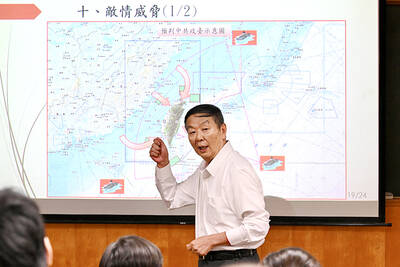
RETHINK? The defense ministry and Navy Command Headquarters could take over the indigenous submarine project and change its production timeline, a source said Admiral Huang Shu-kuang’s (黃曙光) resignation as head of the Indigenous Submarine Program and as a member of the National Security Council could affect the production of submarines, a source said yesterday. Huang in a statement last night said he had decided to resign due to national security concerns while expressing the hope that it would put a stop to political wrangling that only undermines the advancement of the nation’s defense capabilities. Taiwan People’s Party Legislator Vivian Huang (黃珊珊) yesterday said that the admiral, her older brother, felt it was time for him to step down and that he had completed what he

Taiwan has experienced its most significant improvement in the QS World University Rankings by Subject, data provided on Sunday by international higher education analyst Quacquarelli Symonds (QS) showed. Compared with last year’s edition of the rankings, which measure academic excellence and influence, Taiwanese universities made great improvements in the H Index metric, which evaluates research productivity and its impact, with a notable 30 percent increase overall, QS said. Taiwanese universities also made notable progress in the Citations per Paper metric, which measures the impact of research, achieving a 13 percent increase. Taiwanese universities gained 10 percent in Academic Reputation, but declined 18 percent
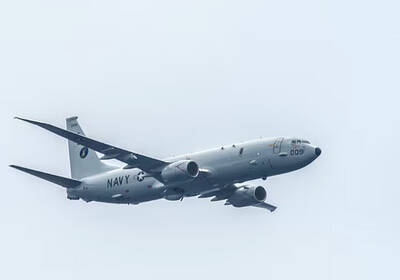
CHINA REACTS: The patrol and reconnaissance plane ‘transited the Taiwan Strait in international airspace,’ the 7th Fleet said, while Taipei said it saw nothing unusual The US 7th Fleet yesterday said that a US Navy P-8A Poseidon flew through the Taiwan Strait, a day after US and Chinese defense heads held their first talks since November 2022 in an effort to reduce regional tensions. The patrol and reconnaissance plane “transited the Taiwan Strait in international airspace,” the 7th Fleet said in a news release. “By operating within the Taiwan Strait in accordance with international law, the United States upholds the navigational rights and freedoms of all nations.” In a separate statement, the Ministry of National Defense said that it monitored nearby waters and airspace as the aircraft

UNDER DISCUSSION: The combatant command would integrate fast attack boat and anti-ship missile groups to defend waters closest to the coastline, a source said The military could establish a new combatant command as early as 2026, which would be tasked with defending Taiwan’s territorial waters 24 nautical miles (44.4km) from the nation’s coastline, a source familiar with the matter said yesterday. The new command, which would fall under the Naval Command Headquarters, would be led by a vice admiral and integrate existing fast attack boat and anti-ship missile groups, along with the Naval Maritime Surveillance and Reconnaissance Command, said the source, who asked to remain anonymous. It could be launched by 2026, but details are being discussed and no final timetable has been announced, the source


 RSS
RSS