


Taiwan will donate US$1.1 million in financial aid to help Nicaragua combat poverty, Nicaraguan President Daniel Ortega Saavedra announced on Sunday when President Chen Shu-bian (陳水扁) arrived on the final leg of his trip to the nation's Central American allies.
Ortega made the announcement during a rally in Matagalpa. Chen is the first foreign president taken to visit the birthplace of the Sandinista National Liberation Front (FSLN).
The Sandinistas ruled Nicaragua from 1979 to 1990. In 1984 there were democratic elections in which they won the majority of the votes but they lost power in the 1990 election.
Ortega made his political comeback in elections last November, having led Nicaragua through a revolution and a civil war before being voted out in 1990. He took office again in January.
Ortega had said during his presidential campaign last year that he would switch diplomatic recognition from Taipei to Beijing if elected.
But after his victory in the election and after Chen attended his inauguration in January, Ortega changed his mind and vowed that Nicaragua would maintain formal diplomatic relations with Taiwan.
Recently, however, Ortega expressed the hope that Nicaragua could maintain "good relations with both sides of the Taiwan Strait."
Chen, who arrived on Sunday morning, was greeted with full military honors at the airport. Ortega, who loves cars, drove Chen to Matagalpa in his Mercedez-Benz SUV.
While a rally for the two leaders was scheduled to start at 2:45pm, Chen and Ortega did not arrive until 5pm, leaving supporters and reporters waiting in the rain after baking in the scorching sun.
While Chen and Ortega were enjoying their road trip, the Taiwanese press corps encountered pickpockets and sexual harassment.
Two male TV reporters almost had their wallets stolen and one female TV reporter complained about improper physical contact from a strange man.
Another female reporter, however, was pleased when a man bought her a quesillo, a typical Nicaraguan dish. Literally translated, it means "little cheese."
At the rally, Chen told the crowd of about 5,000 that Nicaragua was the first Central American country he visited after becoming president in 2000. He also announced that Taiwan would donate 660 radios and thermometers to Nicaraguan women.
Calling Ortega his "best friend" and "dear brother," Chen said that they had much in common. Both studied law, served jail terms for their involvement in democratic movements and drove authoritarian regimes out of power.
"It is my hope during this state visit that we can increase the bonds of cooperation between the two countries," said the president, who was accompanied by a large delegation, including business executives.
Ortega asked his Taiwanese counterpart to provide "long-term" investment in his country's agricultural sector.
Ortega joined the Sandinista movement in 1963. He rose rapidly through its ranks and was a leading player in the guerrilla war against dictator Anastasio Somoza. He was imprisoned for seven years.
Ortega revealed that Taiwan would donate US$1.1 million to a hunger fighting program -- "Hambre Cero en Nicaragua" (Zero Hunger in Nicaragua).
In addition to Taiwan, the US$150 million program is sponsored by international organizations such as the UN, the World Bank and the World Food Program. An estimated 75,000 families will benefit from the five-year program.
Under the program, each family will receive property worth US$2,000. They include a pregnant cow, a pregnant sow, five hens, one rooster and construction materials for pig and cow pens.
According to the World Bank, about 46 percent of Nicaraguans live in poverty and 15 percent live in abject poverty.
Saying that free trade with the US was unfair, Ortega told the crowd that he was glad that the trade between Taiwan and Nicaragua was fair because Taiwan engages in long-term investment to help improve his country's economy.
Taiwan-invested textile plants in Nicaragua employ about 30,000 Nicaraguan citizens.
Two-way trade between Taiwan and Nicaragua topped US$46 million in 2005, with textiles, zippers, kitchenware, plastic products and knitwear making up the bulk of Taiwan's exports to Nicaragua, and frozen beef, coffee, scrap metals, timber and cotton fabrics forming the bulk of its imports from the Central American country.
Ortega described the Central America Free Trade Agreement (CAFTA) signed with the US as "fraud" and encouraged Taiwanese businesses to invest in his country and Central America. He also urged Central American countries to cooperate with each other to create a win-win situation.
Taiwan and Nicaragua signed a FTA in June last year and the Nicaraguan National Assembly approved the pact in December the same year. In addition to the deal with Nicaragua, Taiwan has signed FTAs with Panama, Guatemala, Nicaragua, Honduras and El Salvador, with some pending legislative approval.
Chen's stay in Nicaragua will include a scheduled visit to a hospital that specializes in heart diseases and which faces financial difficulties.
The president is scheduled to wrap up his visit today and head home via Alaska.
Additional reporting by CNA and AFP
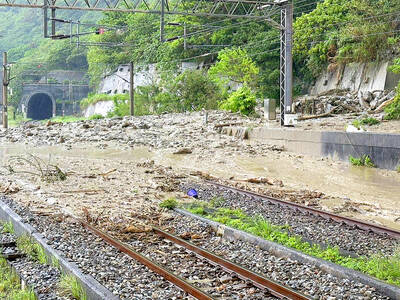
ROLLER-COASTER RIDE: More than five earthquakes ranging from magnitude 4.4 to 5.5 on the Richter scale shook eastern Taiwan in rapid succession yesterday afternoon Back-to-back weather fronts are forecast to hit Taiwan this week, resulting in rain across the nation in the coming days, the Central Weather Administration said yesterday, as it also warned residents in mountainous regions to be wary of landslides and rockfalls. As the first front approached, sporadic rainfall began in central and northern parts of Taiwan yesterday, the agency said, adding that rain is forecast to intensify in those regions today, while brief showers would also affect other parts of the nation. A second weather system is forecast to arrive on Thursday, bringing additional rain to the whole nation until Sunday, it
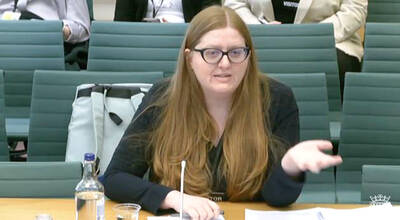
CONDITIONAL: The PRC imposes secret requirements that the funding it provides cannot be spent in states with diplomatic relations with Taiwan, Emma Reilly said China has been bribing UN officials to obtain “special benefits” and to block funding from countries that have diplomatic ties with Taiwan, a former UN employee told the British House of Commons on Tuesday. At a House of Commons Foreign Affairs Committee hearing into “international relations within the multilateral system,” former Office of the UN High Commissioner for Human Rights (OHCHR) employee Emma Reilly said in a written statement that “Beijing paid bribes to the two successive Presidents of the [UN] General Assembly” during the two-year negotiation of the Sustainable Development Goals. Another way China exercises influence within the UN Secretariat is
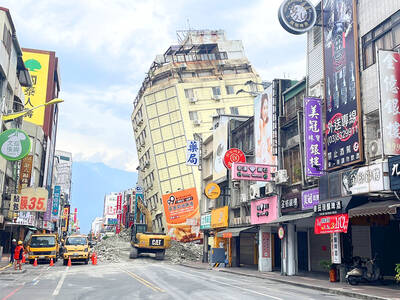
LANDSLIDES POSSIBLE: The agency advised the public to avoid visiting mountainous regions due to more expected aftershocks and rainfall from a series of weather fronts A series of earthquakes over the past few days were likely aftershocks of the April 3 earthquake in Hualien County, with further aftershocks to be expected for up to a year, the Central Weather Administration (CWA) said yesterday. Based on the nation’s experience after the quake on Sept. 21, 1999, more aftershocks are possible over the next six months to a year, the agency said. A total of 103 earthquakes of magnitude 4 on the local magnitude scale or higher hit Hualien County from 5:08pm on Monday to 10:27am yesterday, with 27 of them exceeding magnitude 5. They included two, of magnitude
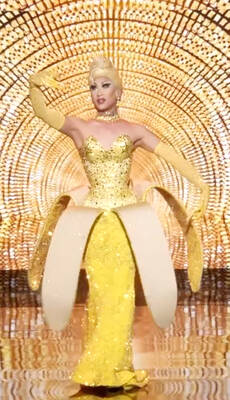
Taiwan’s first drag queen to compete on the internationally acclaimed RuPaul’s Drag Race, Nymphia Wind (妮妃雅), was on Friday crowned the “Next Drag Superstar.” Dressed in a sparkling banana dress, Nymphia Wind swept onto the stage for the final, and stole the show. “Taiwan this is for you,” she said right after show host RuPaul announced her as the winner. “To those who feel like they don’t belong, just remember to live fearlessly and to live their truth,” she said on stage. One of the frontrunners for the past 15 episodes, the 28-year-old breezed through to the final after weeks of showcasing her unique


 RSS
RSS