


Rupert Murdoch has sealed a deal to buy Wall Street Journal publisher Dow Jones & Co for US$5 billion, ending a century of family ownership and adding a new crown jewel to his global media empire, News Corp.
The companies said in the wee hours of yesterday morning that they signed a definitive merger agreement after the deal won sufficient support to pass from a deeply divided Bancroft family, which has controlled the newspaper publisher for generations.
Murdoch is getting one of the great trophies of US journalism and a newspaper that is considered required reading among the business and power elite.
The deal will also expand Murdoch's already massive global media and entertainment empire News Corp, which owns the Fox broadcast network, Fox News Channel, the Twentieth Century Fox movie and TV studio, MySpace, newspapers in Australia and the UK, and several satellite TV broadcasters.
Dow Jones and News Corp said in a statement that Bancroft family members and trustees representing 37 percent of the company's shareholder vote have agreed to support the deal. Combined with the 29 percent of the vote held by public shareholders, who are very likely to support Murdoch, the deal is now assured of passing.
The companies said a member of the Bancroft family or another mutually acceptable person would be appointed to News Corp's board of directors as part of the agreement.
The Bancroft family, descended over several generations from an early owner of Dow Jones, Clarence Barron, clashed long and hard over whether to sell to Murdoch, with several members saying they feared the quality and independence of the paper would suffer under his watch.
Some family members actively sought alternatives to Murdoch -- without success.
The Bancroft family initially rebuffed Murdoch in early May, but then agreed to reconsider. Last week, they heard exhaustive presentations on Murdoch's plans but remained divided.
Wrangling continued past a Monday deadline for them to signal their intentions, and on Tuesday the break came when a holdout trust agreed to support the deal, apparently after Dow Jones agreed to pay the family's advisers' fees, the Journal reported.
Murdoch had long been interested in owning Dow Jones, but it was widely assumed that the Bancroft family would not sell. In the end, his price of US$60 per share -- a good 65 percent over the level of Dow Jones' shares before his offer became public -- proved too rich to turn down.
The companies' statement put the value of the deal at US$5.6 billion, but it was not clear if that figure also included the assumption of debt, and the companies did not provide a breakdown of how they arrived at that figure. Dow Jones' most recent financial filing shows it has 83.8 million shares outstanding, valuing the company at US$5 billion at Murdoch's price of US$60 per share.
Murdoch has said he would invest in the Journal's Washington bureau and digital operations and expand its domestic readership, taking on the two other national US newspapers, the New York Times and Gannett Co's USA Today. He has also said he would expand the Journal's presence overseas, where it would go up against other business publications including Pearson PLC's Financial Times.
Murdoch also plans to launch a business-themed cable news channel in the US later this year to rival General Electric Co's highly profitable CNBC network. Murdoch hopes Dow Jones' news resources and brand name help jump-start that channel, but he would have to negotiate out of a deal CNBC has to use Dow Jones news through 2012.
A union representing Journal reporters and other Dow Jones employees has objected to Murdoch's bid, saying he would downgrade the quality of the paper's coverage and tilt its stories to suit his business interests. Former board member James Ottaway Jr also opposed ownership by Murdoch.
Murdoch countered with a promise not to interfere with the paper's newsroom and has agreed to set up a five-member board, whose initial members would be jointly chosen by both News Corp and Dow Jones, with the power to approve the hiring or fire senior editorial officials.
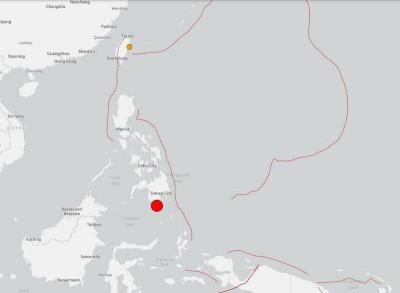
A magnitude 7.8 earthquake struck off the southern coast of Mindanao in the Philippines at 7:38am today, prompting the US Tsunami Warning System to issue an alert for neighboring countries, including Taiwan. The system issued a purple alert indicating a "tsunami threat." The potential threat zone includes Taiwan, the Philippines, Papua New Guinea, Yap and Palau. Philippine authorities were assessing the damage from the quake, with the office of civil defense seeking to verifying initial reports that 15 people had been killed and 129 injured in the region, mostly from falling debris. Arlene Hollero, disaster chief of Maasim town in the Philippines' Sarangani Province,
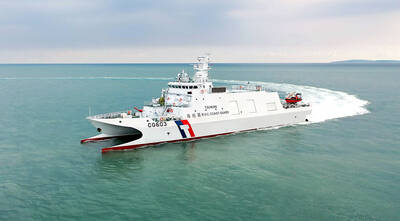
‘GRAY ZONE’ PRESSURE: Beijing’s activities are intended to create the deceitful impression that China has jurisdiction over the area around Taiwan, the CGA said Taiwan’s rights over its territorial waters and exclusive economic zone must not be violated by any country, the Mainland Affairs Council said yesterday, adding that it will not accept any unprovoked actions. The council issued the remarks in response to the China Coast Guard conducting maritime enforcement drills near eastern Taiwan and claiming to fully exercise China’s maritime administrative law enforcement authority. The Coast Guard Administration (CGA) has been closely monitoring the situation and is taking concrete steps to defend the nation’s sovereignty and secure its waters, the council said. China has no sovereign rights over the waters off eastern

RESILIENCE: Taiwan plays a key role in semiconductors, energy, information infrastructure and advanced manufacturing, AIT Director Raymond Greene said Taiwan’s continued investment in deterrence and resilience remains vital, especially in uncrewed systems and other emerging technologies, American Institute in Taiwan (AIT) Director Raymond Greene said yesterday. Greene made the remarks at the annual National Strategic Summit on Supply Chain Resilience held by the Research Institute for Democracy, Society and Emerging Technology (DSET), a government-backed think tank. As Taiwan last year became the US’ fourth-largest trading partner and supply chain security is becoming more important, cooperation in emerging technologies continues to deepen between the two countries, he said. The US is committed to accelerating innovation, building key infrastructure, strengthening cooperation

RIGHT DIRECTION: Taiwan’s efforts to prevent forced labor include a proposal to ‘fully prohibit’ employers from withholding workers’ documents, an official said Taiwan is to establish a mechanism to restrict imports of goods linked to forced labor, the Executive Yuan said yesterday, after the US proposed imposing additional tariffs on Taiwanese goods over labor concerns. “The Ministry of Labor and the Ministry of Economic Affairs are to establish an interministerial review procedure,” Executive Yuan spokesperson Michelle Lee (李慧芝) said at a news briefing in Taipei. “The government is to use the Foreign Trade Act [貿易法] as the legal basis to restrict imports of goods produced with forced labor” and bring its supply chain governance more in line with international standards on human rights, resilience


 RSS
RSS