


Russian President Vladimir Putin sprang a diplomatic surprise on Thursday in his dispute with the US over the siting of a US missile defense system in Europe, suggesting instead that it could be placed in the former Soviet republic of Azerbaijan.
The Russian leader, who raised the prospect of a new cold war with the West in his hawkish speech on the eve of the summit, claimed he had already secured the agreement of the Azerbaijani government to the proposal.
The offer was not immediately rejected by a startled George Bush following bilateral talks between the two leaders at the G8 summit.
The US proposal for a missile defense system, including interceptor and radar, sited in the former Warsaw pact countries of Poland and the Czech Republic, has prompted fury in Moscow. Putin has threatened to train his nuclear arsenal on Europe as a reprisal, as well as withdraw from arms control treaties.
But on Thursday, Putin said he would drop his objections to Bush's plan if the interceptors and radar were in the former Soviet republic. He argued that a system based in Azerbaijan would be more effective in combating missiles aimed at Europe and the US by so-called rogue states such as Iran.
He said the siting in Azerbaijan would protect the whole of Europe, and also ensure that any missiles shot down did not fall on mainland Europe but into the sea. Azerbaijan shares a 431km border with Iran. Information from the Russian radar would be relayed in real time to the US, and presumably Europe.
Putin added that, as part of the proposed deal, the US would be required to share technology, something the US has broadly offered to do.
Bush called it "an interesting suggestion" and said the US and Russia would begin negotiations to pursue the idea. There is public resistance to the proposals from some in Poland and the Czech Republic, so the idea of switching the system elsewhere has its attractions.
Meanwhile, NATO Secretary General Jaap de Hoop Scheffer welcomed Russia's offer yesterday, calling it a break with "anachronistic" rhetoric.
However, Scheffer said that it was too early to tell if the proposal for a joint base in Azerbaijan could be integrated into the US missile shield, parts of which Washington currently wants built in the Czech Republic and Poland.
"I hope that what we are seeing ... is a signal that everybody will start talking to everybody once again on this important subject of missile defense," he told a security and defense conference in Brussels.
"We need to get on with the addressing together the 21st century security challenges, rather than resurrecting those from the past," he said after Russian President Vladimir Putin made the offer at the G8 summit.
Scheffer took particular aim at Putin's threat that missiles could be pointed at Europe if Washington goes ahead with the defense shield project, which has raised deep concern in Russia.
"Warnings that Russian missiles might once again be targeted at Europe are unhelpful, unwelcome and, frankly, anachronistic," he said.
"I think it is always useful if the two presidents, Bush and Putin, are constructively talking to each other on this subject," Scheffer said. "Let's see how the debate further develops."
Azerbaijan has welcomed the plan, but Scheffer said it was too soon to know whether it could work or would be accepted.
"I am not a technician but I do think that the geographical location ... is of course different to other choices the United States has made," he said.
"It's a bit early to judge if an Azeri radar could do and could be the answer to the threats. I think it's a bit close to the `rogue states' we are discussing," he said.
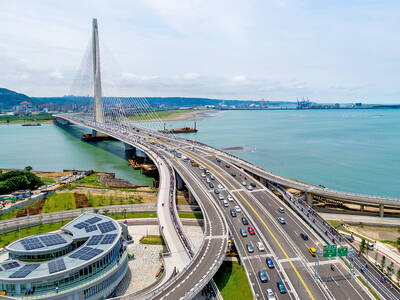
The Ministry of Transportation and Communications yesterday inaugurated the Danjiang Bridge across the Tamsui River in New Taipei City, saying that the structure would be an architectural icon and traffic artery for Taiwan. Feted as a major engineering achievement, the Danjiang Bridge is 920m long, 211m tall at the top of its pylon, and is the longest single-pylon asymmetric cable-stayed bridge in the world, the government’s Web site for the structure said. It was designed by late Iraqi-British architect Zaha Hadid. The structure, with a maximum deck of 70m, accommodates road and light rail traffic, and affords a 200m navigation channel for boats,
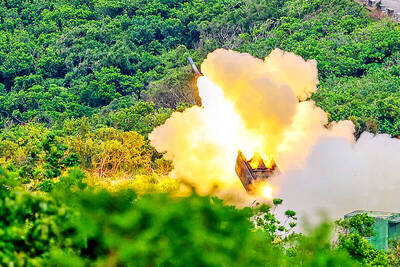
PRECISION STRIKES: The most significant reason to deploy HIMARS to outlying islands is to establish a ‘dead zone’ that the PLA would not dare enter, a source said A High Mobility Artillery Rocket System (HIMARS) would be deployed to Penghu County and Dongyin Island (東引) in Lienchiang County (Matsu) to force the Chinese military to retreat at least 100km from the coastline, a military source said yesterday. Taiwan has been procuring HIMARS and Army Tactical Missile Systems (ATACMS) from the US in batches. Once all batches have been delivered, Taiwan would possess 111 HIMARS units and 504 ATACMS, which have a range of 300km. Considering that “offense is the best defense,” the military plans to forward-deploy the systems to outlying islands such as Penghu and Dongyin so that

Taiwan Semiconductor Manufacturing Co (TSMC, 台積電), the world’s largest foundry service provider, yesterday said that global semiconductor revenue is projected to hit US$1.5 trillion in 2030, after the figure exceeds US$1 trillion this year, as artificial intelligence (AI) demand boosts consumption of token and compute power. “We are still at the beginning of the AI revolution, but we already see a significant impact across the whole semiconductor ecosystem,” TSMC deputy cochief operating officer Kevin Zhang (張曉強) said at the company’s annual technology symposium in Hsinchu City. “It is fair to say that in the past decade, smartphones and other mobile devices were

‘CLEAR MESSAGE’: The bill would set up an interagency ‘tiger team’ to review sanctions tools and other economic options to help deter any Chinese aggression toward Taiwan US Representative Young Kim has introduced a bill to deter Chinese aggression against Taiwan, calling for an interagency “tiger team” to preplan coordinated sanctions and economic measures in response to possible Chinese military or political action against Taiwan. “[Chinese President] Xi Jinping [習近平] has directed the People’s Liberation Army to be ready to invade Taiwan by 2027. China has a plan. America should have one too,” Kim said in a news release on Thursday last week. She introduced the “Deter PRC [People’s Republic of China] aggression against Taiwan act” to “ensure the US has a coordinated sanctions strategy ready should


 RSS
RSS