


Taiwanese plant breeders can now protect their new creations with patents in the EU after a lengthy consultation process, Council of Agriculture (COA) officials said yesterday.
The COA and breeders hailed the rule change as a boon for Taiwan's plant breeding sector.
Breeders can already apply for plant patents in some countries such as the US through bilateral agreements. But painful experiences that led to the loss of rights to valuable varieties have made breeders more aware of the importance of patent protection,officials said.
Taiwanese had been denied the right to apply for plant patents in the EU because Taiwan is not a member of Union International Pour La Protection des Obtentions Vegetales (UPOV).
"Taiwan could not obtain membership in UPOV as we are not a United Nations member," said Lin Chih-hung (林志鴻), a section manager at the council's international cooperation department. "But we managed to obtain the right to apply for patents in the EU as we are a member of the World Trade Organization."
There was little political interference in the process, he said.
"Taiwanese breeders had to sell the golden goose before," Chang Ming-lang (
Lin and Chang said the Netherlands had been a major help in brokering the agreements.
"It was a win-win situation for the Netherlands," Chang said. "Now the EU will respect our plant patent rights and we will reciprocate."
Until now, orchid breeder John Feng (
"Now I will be able to keep selling young plants of popular varieties for the life of the patent," he said.
Patents for plants are valid for 20 years, while those for fruit trees are enforced for 25 years.
Feng said he was glad his orchids would be legally protected in the European market.
"Copying is rampant in Taiwan and China," he said. "If there is a profit to be had, somebody will surely make a copy."
Taiwan has experienced its most significant improvement in the QS World University Rankings by Subject, data provided on Sunday by international higher education analyst Quacquarelli Symonds (QS) showed. Compared with last year’s edition of the rankings, which measure academic excellence and influence, Taiwanese universities made great improvements in the H Index metric, which evaluates research productivity and its impact, with a notable 30 percent increase overall, QS said. Taiwanese universities also made notable progress in the Citations per Paper metric, which measures the impact of research, achieving a 13 percent increase. Taiwanese universities gained 10 percent in Academic Reputation, but declined 18 percent

Chinese President Xi Jinping (習近平) yesterday met with former president Ma Ying-jeou (馬英九) at the Great Hall of the People in Beijing, with Xi’s opening statement once more emphasizing that people on both sides of the Taiwan Strait are Chinese and that foreign intervention cannot change their inevitable unification. Xi said that 5,000 years of history of zhonghua minzu (中華民族, ethnic Chinese group) have seen their ancestors move to Taiwan to establish new lives, while also documenting them fighting side-by-side against foreign forces and finally freeing Taiwan. “Both sides are Chinese,” and there are no issues that cannot be worked through, he
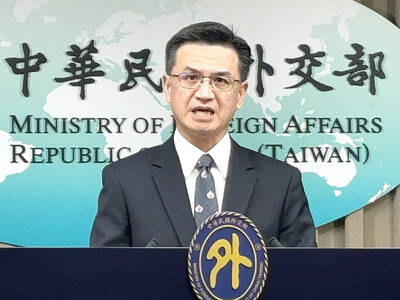
BULLY TACTICS: Beijing has continued its incursions into Taiwan’s airspace even as Xi Jinping talked about Taiwan being part of the Chinese family and nation China should stop its coercion of Taiwan and respect mainstream public opinion in Taiwan about sovereignty if its expression of goodwill is genuine, the Ministry of Foreign Affairs (MOFA) said yesterday. Ministry spokesman Jeff Liu (劉永健) made the comment in response to media queries about a meeting between former president Ma Ying-jeou (馬英九) and Chinese President Xi Jinping (習近平) the previous day. Ma voiced support for the so-called “1992 consensus,” while Xi said that although the two sides of the Taiwan Strait have “different systems,” this does not change the fact that they are “part of the same country,” and that “external

UNDER DISCUSSION: The combatant command would integrate fast attack boat and anti-ship missile groups to defend waters closest to the coastline, a source said The military could establish a new combatant command as early as 2026, which would be tasked with defending Taiwan’s territorial waters 24 nautical miles (44.4km) from the nation’s coastline, a source familiar with the matter said yesterday. The new command, which would fall under the Naval Command Headquarters, would be led by a vice admiral and integrate existing fast attack boat and anti-ship missile groups, along with the Naval Maritime Surveillance and Reconnaissance Command, said the source, who asked to remain anonymous. It could be launched by 2026, but details are being discussed and no final timetable has been announced, the source


 RSS
RSS