


Tens of thousands of protesters streamed to a central Tel Aviv square after sundown on Thursday, demanding the resignation of Israeli Prime Minister Ehud Olmert because of a scathing inquiry report about the way he ordered and handled last summer's bloody, costly but inconclusive war in Lebanon.
Olmert remained defiant, hoping to beat back a rising wave of calls to step down. A day after popular Foreign Minister Tzipi Livni joined the chorus, Olmert's aides felt she had not dealt him a mortal political blow. But they admitted that a large-scale public protest campaign could bring him down.
Thursday's turnout appeared to top 100,000, though police refused to estimate the crowd's size.
It was made up of a cross-section of Israelis -- moderates and hard-liners, secular and religious, young and old, a rare mix symbolizing the widespread dissatisfaction with Olmert. Organizers claimed success, though it remained to be seen whether the outpouring of anger would be enough to oust the prime minister.
"Failures, Go Home!" read the banner behind the podium, referring to Olmert and Defense Minister Amir Peretz. Organizers decided not to allow politicians to address the crowd, to give the gathering a grass-roots nature, said Uzi Dayan, a retired general and a main speaker.
Also addressing the gathering was Moshe Muskal, 50, from the central Israeli town of Mazkeret Batya. His son, Rafnael, was killed during the war.
"I am glad that the public is not passive or despairing," he said after he spoke.
He said the soldiers "fulfilled their mission fully. Our mission is to make our country a little bit better."
The protesters came from all over Israel, including 35 who walked about 70km to Tel Aviv from the southern town of Sderot, a frequent target of rockets from Palestinian militants in Gaza.
Israel went to war against Hezbollah guerrillas in Lebanon on July 12 after guerrillas crossed into Israel, killed three soldiers and captured two others.
For many Israelis, the 34-day war was a failure because it didn't achieve the two main goals Olmert set -- returning the soldiers and crushing Hezbollah, which fired nearly 4,000 rockets at northern Israel. The conflict killed 158 Israelis and more than 1,000 Lebanese.

Taiwan has experienced its most significant improvement in the QS World University Rankings by Subject, data provided on Sunday by international higher education analyst Quacquarelli Symonds (QS) showed. Compared with last year’s edition of the rankings, which measure academic excellence and influence, Taiwanese universities made great improvements in the H Index metric, which evaluates research productivity and its impact, with a notable 30 percent increase overall, QS said. Taiwanese universities also made notable progress in the Citations per Paper metric, which measures the impact of research, achieving a 13 percent increase. Taiwanese universities gained 10 percent in Academic Reputation, but declined 18 percent

Chinese President Xi Jinping (習近平) yesterday met with former president Ma Ying-jeou (馬英九) at the Great Hall of the People in Beijing, with Xi’s opening statement once more emphasizing that people on both sides of the Taiwan Strait are Chinese and that foreign intervention cannot change their inevitable unification. Xi said that 5,000 years of history of zhonghua minzu (中華民族, ethnic Chinese group) have seen their ancestors move to Taiwan to establish new lives, while also documenting them fighting side-by-side against foreign forces and finally freeing Taiwan. “Both sides are Chinese,” and there are no issues that cannot be worked through, he
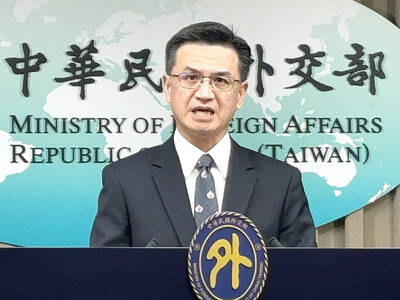
BULLY TACTICS: Beijing has continued its incursions into Taiwan’s airspace even as Xi Jinping talked about Taiwan being part of the Chinese family and nation China should stop its coercion of Taiwan and respect mainstream public opinion in Taiwan about sovereignty if its expression of goodwill is genuine, the Ministry of Foreign Affairs (MOFA) said yesterday. Ministry spokesman Jeff Liu (劉永健) made the comment in response to media queries about a meeting between former president Ma Ying-jeou (馬英九) and Chinese President Xi Jinping (習近平) the previous day. Ma voiced support for the so-called “1992 consensus,” while Xi said that although the two sides of the Taiwan Strait have “different systems,” this does not change the fact that they are “part of the same country,” and that “external
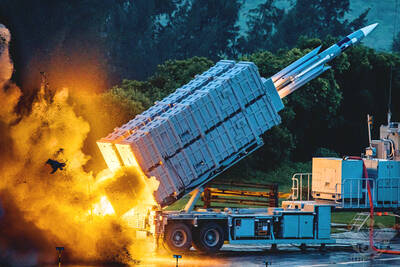
UNDER DISCUSSION: The combatant command would integrate fast attack boat and anti-ship missile groups to defend waters closest to the coastline, a source said The military could establish a new combatant command as early as 2026, which would be tasked with defending Taiwan’s territorial waters 24 nautical miles (44.4km) from the nation’s coastline, a source familiar with the matter said yesterday. The new command, which would fall under the Naval Command Headquarters, would be led by a vice admiral and integrate existing fast attack boat and anti-ship missile groups, along with the Naval Maritime Surveillance and Reconnaissance Command, said the source, who asked to remain anonymous. It could be launched by 2026, but details are being discussed and no final timetable has been announced, the source


 RSS
RSS