


A Tokyo businessman was sentenced to life in prison yesterday for a wave of brutal assaults on women, but was cleared over the abduction and killing of British bar hostess Lucie Blackman.
Joji Obara, a wealthy former property developer, was convicted of raping nine women. One of them, Australian Carita Ridgway -- a 21-year-old bar hostess like Blackman -- died.
Blackman's mother Jane Steare said after the verdict her "worst fears have come true."
Obara, 54, had been on trial since 2000 on charges that he preyed on young women working in the nightlife industry of the famously safe Japanese capital.
"It is natural for the victims to seek severe punishment. These were extremely selfish acts based on his abnormal sexual habits," Judge Tsutomu Tochigi said.
"The accused treated the victims as sex objects," he said.
But the Tokyo District Court acquitted Obara of all charges related to Blackman's death.
"There is nothing to prove that he was involved in the rape and her death. The court cannot prove he was single-handedly involved in her death," the judge said. "What is clear is that the victim acted together with the accused and then vanished and, following that, she was found dead."
Wearing a black jacket and glasses, his hair greying and thinning, Obara looked ahead attentively and occasionally nodded as the verdict was read.
Obara, who denied all the charges, was found guilty of attacks on five Japanese women as well as four foreigners -- an Australian, a Briton, a Canadian and a Ukrainian.
Blackman's father Tim watched silently in court, with an interpreter writing down messages on a paper.
Lucie Blackman vanished while she was working in bars in the seedy Roppongi district to save money for a holiday in Australia. Her dismembered body was found seven months later in a seaside cave on Tokyo's outskirts.
The case triggered a storm of media coverage in Britain and even a personal appeal by Prime Minister Tony Blair.
"I'm heartbroken, just heartbroken. I just can't believe this verdict," Steare said from England.
She did not fly to Japan because she could not face seeing Obara across a court room.
She faulted her ex-husband for accepting condolence money from one of Obara's friends, alleging [the money] influenced the decision.
Victim Carita Ridgway's mother voiced relief that the payout did not affect Obara's conviction over her daughter's death.
"Carita's family feel a deep sense of anger, betrayal and disappointment in relation to the 1992 police investigation into Carita's death," mother Annette Foster told reporters in Tokyo.
The judge said that Obara drugged Ridgway with chloroform, a colorless drug used as an anaesthetic in the 19th century. She died of hepatitis at a Tokyo hospital in February 1992.
Obara was not charged with murder, which would have made him eligible for the death penalty.
His lawyer, Yasuo Shionoya, said they were filing an appeal and that Obara feels "very sorry" over Blackman.
"He understands that Lucie was found in a sad situation, but please read the court's decision -- this was not Mr Obara's crime," he said.
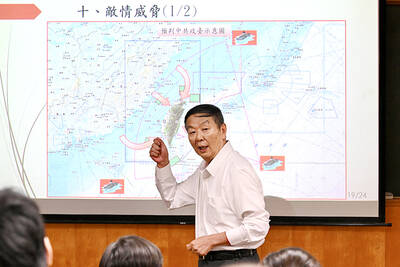
RETHINK? The defense ministry and Navy Command Headquarters could take over the indigenous submarine project and change its production timeline, a source said Admiral Huang Shu-kuang’s (黃曙光) resignation as head of the Indigenous Submarine Program and as a member of the National Security Council could affect the production of submarines, a source said yesterday. Huang in a statement last night said he had decided to resign due to national security concerns while expressing the hope that it would put a stop to political wrangling that only undermines the advancement of the nation’s defense capabilities. Taiwan People’s Party Legislator Vivian Huang (黃珊珊) yesterday said that the admiral, her older brother, felt it was time for him to step down and that he had completed what he
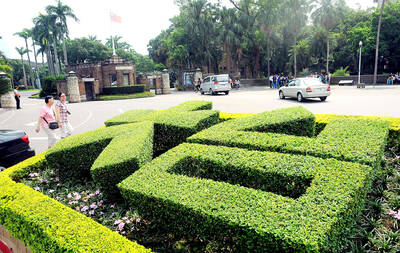
Taiwan has experienced its most significant improvement in the QS World University Rankings by Subject, data provided on Sunday by international higher education analyst Quacquarelli Symonds (QS) showed. Compared with last year’s edition of the rankings, which measure academic excellence and influence, Taiwanese universities made great improvements in the H Index metric, which evaluates research productivity and its impact, with a notable 30 percent increase overall, QS said. Taiwanese universities also made notable progress in the Citations per Paper metric, which measures the impact of research, achieving a 13 percent increase. Taiwanese universities gained 10 percent in Academic Reputation, but declined 18 percent
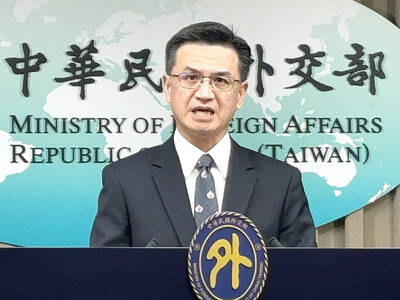
BULLY TACTICS: Beijing has continued its incursions into Taiwan’s airspace even as Xi Jinping talked about Taiwan being part of the Chinese family and nation China should stop its coercion of Taiwan and respect mainstream public opinion in Taiwan about sovereignty if its expression of goodwill is genuine, the Ministry of Foreign Affairs (MOFA) said yesterday. Ministry spokesman Jeff Liu (劉永健) made the comment in response to media queries about a meeting between former president Ma Ying-jeou (馬英九) and Chinese President Xi Jinping (習近平) the previous day. Ma voiced support for the so-called “1992 consensus,” while Xi said that although the two sides of the Taiwan Strait have “different systems,” this does not change the fact that they are “part of the same country,” and that “external

UNDER DISCUSSION: The combatant command would integrate fast attack boat and anti-ship missile groups to defend waters closest to the coastline, a source said The military could establish a new combatant command as early as 2026, which would be tasked with defending Taiwan’s territorial waters 24 nautical miles (44.4km) from the nation’s coastline, a source familiar with the matter said yesterday. The new command, which would fall under the Naval Command Headquarters, would be led by a vice admiral and integrate existing fast attack boat and anti-ship missile groups, along with the Naval Maritime Surveillance and Reconnaissance Command, said the source, who asked to remain anonymous. It could be launched by 2026, but details are being discussed and no final timetable has been announced, the source


 RSS
RSS