


Admiral Dennis Blair, the former commander-in-chief of US forces in the Pacific, on Tuesday called for an expansion in the level and intensity of US-Chinese military dialogue, with a greater focus on Taiwan, as a way to ease tensions in the Taiwan Strait and reduce the chance of a military confrontation between the US and China.
Blair said the level of military-to-military contact between Washington and Beijing was well below the bilateral contacts in other areas -- including trade and political issues -- impeding greater understanding between the two.
Blair made his comments at a press conference to introduce a new report by a task force of the Council on Foreign Relations, of which he is co-chairman, on US-China relations.
In addition to being the former US Pacific commander, Blair is the head of the US official delegation that observes Taiwan's annual Han Kuang military exercises -- a position he has held for the past five years.
In that, he has become one of the most respected, if not always the least controversial, advisers to the Taiwanese military and his advice is valued by the Ministry of National Defense.
Blair told reporters he would be leaving for Taiwan on Saturday to observe the latest exercises next week.
The report, representing the views of the centralist elite of the US foreign policy establishment, essentially recommended that the US retain its core policy on cross-strait issues as it strives to improve US ties with Beijing by further integrating China into the international community.
"The report is solidly behind the three communiques and the Taiwan [Relations] Act. There's no change whatsoever in that," said Carla Hills, the task force's other co-chairman and a former US trade representative.
Calling for higher-level US-China talks, Blair said that dialogue at the right levels "can dispel the misconceptions on both sides," adding that he thought "Taiwan should be part of that dialogue."
"A war between China and Taiwan that involves the United States is a lose-lose-lose," he said.
Asked about the US commitment in case of a Chinese attack on Taiwan, Blair said: "The US should have a `dual assurance, dual deterrence' policy, in which we let the Chinese know clearly that a peaceful solution to the Taiwan issue is what the United States will support [and] that it will use force if necessary to carry out its obligations."
At the same time, he would "tell the Taiwanese that moves towards independence are not supported by the United States and will not be supported necessarily by force."
The report itself frames the US obligations in somewhat different terms as those enunciated by Blair.
The US should "make it clear to Beijing that the United States is prepared to live up to its security-related obligations under the Taiwan Relations Act," a law which commits Washington to supply Taiwan with sufficient defensive weapons, while maintaining a readiness to counter any Chinese military attack on Taiwan.
But the task force also recommends that the US tell China "it does not rule out using force to thwart any Chinese attempt to compel unification through force."
This would seem to urge a return to a policy of "strategic ambiguity" toward the US commitment to defend Taiwan in existence before US President George W. Bush's April 2001 statement in a TV interview to do "whatever it took" to help Taiwan defend itself against a Chinese military action.
Among other things, the report rejected the idea, mooted several times in recent years, of a new, fourth "communique" to update the three that form part of the US' basic cross-strait polity. Such a communique is "likely to cause more problems than [it would] solve," the task force said.
It also rejected ideas that the US could play an active role as a mediator of Taiwan-China issues, but added that Washington could act as a "facilitator" if both sides so desired.
The report bemoaned the willingness of both Washington and Beijing to resort to military action in the Strait.
"Claims by both Washington and Beijing of a right to resort to force to prevent an unwanted outcome in the Taiwan Strait naturally puts limits on US-China bilateral military relations, even on issues and missions of common concern, and encourage each side to prepare for a worst-case scenario," it said.
"Conflicting military objectives of this magnitude create their own powerful dynamic of mistrust and could even lead to a conflict neither intended nor desired by either side," it said.
"Until some level of political accommodation is reached in cross-strait relations, even on an interim basis, Washington and Beijing have to continue to manage their differences on Taiwan rather than resolve them," the report concluded.
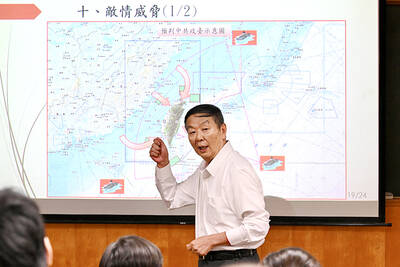
RETHINK? The defense ministry and Navy Command Headquarters could take over the indigenous submarine project and change its production timeline, a source said Admiral Huang Shu-kuang’s (黃曙光) resignation as head of the Indigenous Submarine Program and as a member of the National Security Council could affect the production of submarines, a source said yesterday. Huang in a statement last night said he had decided to resign due to national security concerns while expressing the hope that it would put a stop to political wrangling that only undermines the advancement of the nation’s defense capabilities. Taiwan People’s Party Legislator Vivian Huang (黃珊珊) yesterday said that the admiral, her older brother, felt it was time for him to step down and that he had completed what he
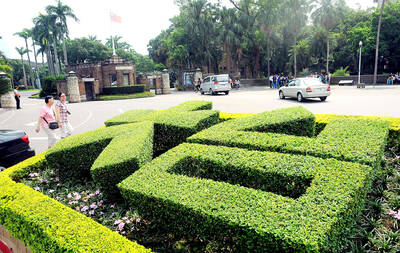
Taiwan has experienced its most significant improvement in the QS World University Rankings by Subject, data provided on Sunday by international higher education analyst Quacquarelli Symonds (QS) showed. Compared with last year’s edition of the rankings, which measure academic excellence and influence, Taiwanese universities made great improvements in the H Index metric, which evaluates research productivity and its impact, with a notable 30 percent increase overall, QS said. Taiwanese universities also made notable progress in the Citations per Paper metric, which measures the impact of research, achieving a 13 percent increase. Taiwanese universities gained 10 percent in Academic Reputation, but declined 18 percent
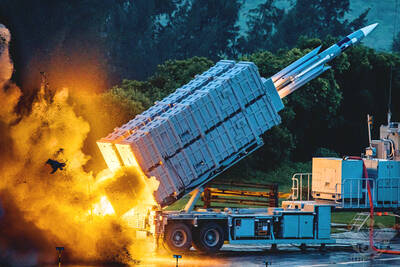
UNDER DISCUSSION: The combatant command would integrate fast attack boat and anti-ship missile groups to defend waters closest to the coastline, a source said The military could establish a new combatant command as early as 2026, which would be tasked with defending Taiwan’s territorial waters 24 nautical miles (44.4km) from the nation’s coastline, a source familiar with the matter said yesterday. The new command, which would fall under the Naval Command Headquarters, would be led by a vice admiral and integrate existing fast attack boat and anti-ship missile groups, along with the Naval Maritime Surveillance and Reconnaissance Command, said the source, who asked to remain anonymous. It could be launched by 2026, but details are being discussed and no final timetable has been announced, the source
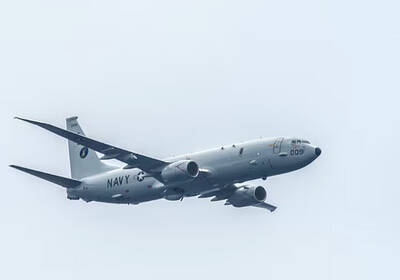
CHINA REACTS: The patrol and reconnaissance plane ‘transited the Taiwan Strait in international airspace,’ the 7th Fleet said, while Taipei said it saw nothing unusual The US 7th Fleet yesterday said that a US Navy P-8A Poseidon flew through the Taiwan Strait, a day after US and Chinese defense heads held their first talks since November 2022 in an effort to reduce regional tensions. The patrol and reconnaissance plane “transited the Taiwan Strait in international airspace,” the 7th Fleet said in a news release. “By operating within the Taiwan Strait in accordance with international law, the United States upholds the navigational rights and freedoms of all nations.” In a separate statement, the Ministry of National Defense said that it monitored nearby waters and airspace as the aircraft


 RSS
RSS