


A once-outspoken Chinese lawyer convicted on subversion charges said he was subjected to harsh treatment by authorities and confessed in order to protect his family, according to recently released letters and a taped telephone conversation.
The letters and recording of Gao Zhisheng (高智晟), released by a fellow activist, offer the most detailed account of his treatment since the fiery critic of the Communist government was arrested in August last year, convicted and held in a type of house arrest.
In one letter, Gao says he was once forced to sit in an iron chair for 109 hours straight. At other times during his five-month detention, he said he was handcuffed or forced to sit cross-legged for hundreds of hours and had strong lights shone on him.
In another letter and in the phone conversation, Gao described the harassment his wife and two children received from security agents and the mental anguish that caused him. He wrote that his family was being deprived of proper lives.
"Their spirits are being broken," he said.
He also said he agreed to a public confession in exchange for 5,000 yuan (US$650) to give to his family for living expenses.
Police did not immediately respond to requests for comment. Gao's descriptions of mistreatment are consistent with those of criminal suspects and other political dissidents.
Gao could not be reached for comment. His telephone numbers have been disconnected.
Hu Jia (胡佳), the activist who released to journalists Gao's letters and the recorded telephone conversation, said Gao was coming to terms with having confessed to subversion.
"He compromised himself to save his wife, son, daughter and other family members who were being constantly harassed or threatened by security agents," Hu said in a telephone interview yesterday.
"One person who saw him immediately after he was released from prison saw bruises covering Gao's legs from the beatings he received," he said.
Gao became a prominent critic of the government's civil rights lapses between 2002 and last year, taking on cases involving property-rights violations and religious persecution. He was detained last August during a crackdown on activist Chinese lawyers.
He was convicted in December in a one-day trial based on nine articles posted on Web sites abroad, the official Xinhua news agency reported at that time.
In the first accounting of the charges against Gao, Xinhua said the articles "defamed and made rumors about China's current government and social system, conspiring to topple the regime."
Gao was sentenced to three years in prison but the sentence was suspended. Under the terms of his release, he was allowed to go home but could be returned to prison if he breaks the law during the next five years.
Earlier this month, Hu said he taped a conversation with Gao, who used a temporary mobile phone and number to contact him.
In the recording, which Hu released to journalists, Gao said there were at least 100 plainclothes agents surrounding his home and that his telephone had been cut off.
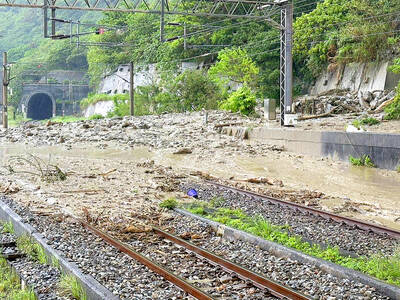
ROLLER-COASTER RIDE: More than five earthquakes ranging from magnitude 4.4 to 5.5 on the Richter scale shook eastern Taiwan in rapid succession yesterday afternoon Back-to-back weather fronts are forecast to hit Taiwan this week, resulting in rain across the nation in the coming days, the Central Weather Administration said yesterday, as it also warned residents in mountainous regions to be wary of landslides and rockfalls. As the first front approached, sporadic rainfall began in central and northern parts of Taiwan yesterday, the agency said, adding that rain is forecast to intensify in those regions today, while brief showers would also affect other parts of the nation. A second weather system is forecast to arrive on Thursday, bringing additional rain to the whole nation until Sunday, it
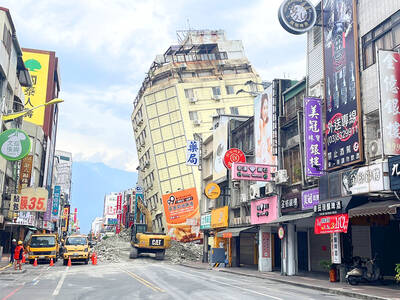
LANDSLIDES POSSIBLE: The agency advised the public to avoid visiting mountainous regions due to more expected aftershocks and rainfall from a series of weather fronts A series of earthquakes over the past few days were likely aftershocks of the April 3 earthquake in Hualien County, with further aftershocks to be expected for up to a year, the Central Weather Administration (CWA) said yesterday. Based on the nation’s experience after the quake on Sept. 21, 1999, more aftershocks are possible over the next six months to a year, the agency said. A total of 103 earthquakes of magnitude 4 on the local magnitude scale or higher hit Hualien County from 5:08pm on Monday to 10:27am yesterday, with 27 of them exceeding magnitude 5. They included two, of magnitude

CONDITIONAL: The PRC imposes secret requirements that the funding it provides cannot be spent in states with diplomatic relations with Taiwan, Emma Reilly said China has been bribing UN officials to obtain “special benefits” and to block funding from countries that have diplomatic ties with Taiwan, a former UN employee told the British House of Commons on Tuesday. At a House of Commons Foreign Affairs Committee hearing into “international relations within the multilateral system,” former Office of the UN High Commissioner for Human Rights (OHCHR) employee Emma Reilly said in a written statement that “Beijing paid bribes to the two successive Presidents of the [UN] General Assembly” during the two-year negotiation of the Sustainable Development Goals. Another way China exercises influence within the UN Secretariat is

Taiwan’s first drag queen to compete on the internationally acclaimed RuPaul’s Drag Race, Nymphia Wind (妮妃雅), was on Friday crowned the “Next Drag Superstar.” Dressed in a sparkling banana dress, Nymphia Wind swept onto the stage for the final, and stole the show. “Taiwan this is for you,” she said right after show host RuPaul announced her as the winner. “To those who feel like they don’t belong, just remember to live fearlessly and to live their truth,” she said on stage. One of the frontrunners for the past 15 episodes, the 28-year-old breezed through to the final after weeks of showcasing her unique


 RSS
RSS