


Citigroup Inc announced yesterday that it would buy out the Bank of Overseas Chinese (BOOC,華僑銀行) for NT$14.1 billion (US$426 million), or NT$11.8 per share, via a cash-out merger. This will make it the biggest foreign bank in Taiwan by assets.
The two parties inked a pact yesterday for the long-rumored deal. They expect the merger to be completed in the second half of this year after obtaining approval from shareholders and financial regulators in Taiwan and the US, the joint statement read.
BOOC is scheduled to hold its annual general meeting on June 15. The lender will be delisted from the over-the-counter market and renamed Citi.
The final price is subject to certain closing adjustments, the statement said.
It could fall somewhere between NT$11.5 and NT$11.8 after taking employees' compensation expenses into account, said Wayne Pai (
The transaction brings more than a million clients to Citi Taiwan, boosting its branch network six-fold to 66 nationwide from 11 and its assets by US$8.5 billion to a total of US$22.8 billion, the bank said.
"This is a perfect combination of Citi's global products and BOOC's local network and small and medium enterprise customer base," Citi Taiwan country officer Morris Li (利明献) told a press conference yesterday.
Wealth management and capital market are the major focus for Citi in Taiwan, Li said.
Citi was in talks with several local rivals when the deal was initiated in 2005 and only Pai agreed with the 100-percent takeover that eventually led to the acquisition, he said.
The deal is the second foreign buyout of a local lender in Taiwan, following Standard Chartered Bank's takeover of Hsinchu International Bank (新竹國際商銀). This boosted the British bank's number of outlets across the nation from three to 86.
These transactions come at a time when the government is pushing consolidation of the nation's fragmented banking sector in the hope that some local banks will be taken over by foreign rivals to stimulate international competitiveness.
"It's not easy for any bank to expand their branch network in Taiwan, and buying existing banks is the quickest way to achieve that,'' said Eddy Yang, chief executive of Taiwan Ratings Corp, a local credit rating venture with Standard & Poor's Ratings Services.
Li said Citi would constantly review its expansion strategy when he was asked whether Citi would rely on further mergers and acquisitions for growth as a number of small-sized lenders are suffering from deteriorating financial profiles due to consumer credit abuse.
In 2000, Citigroup paid NT$23 billion for 15 percent of Taiwan's Fubon Group, now known as Fubon Financial Holding Co (富邦金控). It began selling down the holding in 2004, saying it wanted to pursue its own strategy, and now has 11 branches in Taiwan.
Citigroup is trying to expand consumer banking nationwide to compete with overseas rivals including Standard Chartered.
The executive said there are no plans for any redundancies in the first year of the takeover of the local lender.
They will communicate closely with BOOC's employees from the beginning of integration to the end, Li said.
"I am confident and optimistic about completion of the integration work," he said.
To ease employees' concerns, the local lender will set up a roadshow for branches nationwide to ensure agreements on seniority settlement and compensation schemes would stay unchanged, BOOC chairman Mike Chang (張嵩峨) said.
Employees were not unduly worried, according to BOOC's labor union. The union said it may not react strongly as long as the management and Citi can act in compliance with existing agreements.
BOOC closed up 2.22 percent at NT$11.50 on the GRETAI Securities Market yesterday following the announcement.
additional reporting by Bloomberg

Chinese President Xi Jinping (習近平) yesterday met with former president Ma Ying-jeou (馬英九) at the Great Hall of the People in Beijing, with Xi’s opening statement once more emphasizing that people on both sides of the Taiwan Strait are Chinese and that foreign intervention cannot change their inevitable unification. Xi said that 5,000 years of history of zhonghua minzu (中華民族, ethnic Chinese group) have seen their ancestors move to Taiwan to establish new lives, while also documenting them fighting side-by-side against foreign forces and finally freeing Taiwan. “Both sides are Chinese,” and there are no issues that cannot be worked through, he
Taiwan has experienced its most significant improvement in the QS World University Rankings by Subject, data provided on Sunday by international higher education analyst Quacquarelli Symonds (QS) showed. Compared with last year’s edition of the rankings, which measure academic excellence and influence, Taiwanese universities made great improvements in the H Index metric, which evaluates research productivity and its impact, with a notable 30 percent increase overall, QS said. Taiwanese universities also made notable progress in the Citations per Paper metric, which measures the impact of research, achieving a 13 percent increase. Taiwanese universities gained 10 percent in Academic Reputation, but declined 18 percent
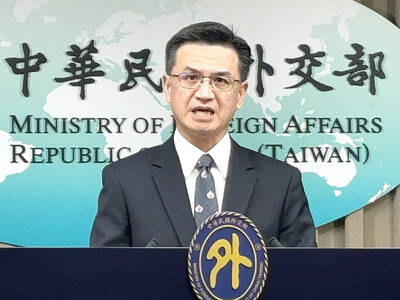
BULLY TACTICS: Beijing has continued its incursions into Taiwan’s airspace even as Xi Jinping talked about Taiwan being part of the Chinese family and nation China should stop its coercion of Taiwan and respect mainstream public opinion in Taiwan about sovereignty if its expression of goodwill is genuine, the Ministry of Foreign Affairs (MOFA) said yesterday. Ministry spokesman Jeff Liu (劉永健) made the comment in response to media queries about a meeting between former president Ma Ying-jeou (馬英九) and Chinese President Xi Jinping (習近平) the previous day. Ma voiced support for the so-called “1992 consensus,” while Xi said that although the two sides of the Taiwan Strait have “different systems,” this does not change the fact that they are “part of the same country,” and that “external

UNDER DISCUSSION: The combatant command would integrate fast attack boat and anti-ship missile groups to defend waters closest to the coastline, a source said The military could establish a new combatant command as early as 2026, which would be tasked with defending Taiwan’s territorial waters 24 nautical miles (44.4km) from the nation’s coastline, a source familiar with the matter said yesterday. The new command, which would fall under the Naval Command Headquarters, would be led by a vice admiral and integrate existing fast attack boat and anti-ship missile groups, along with the Naval Maritime Surveillance and Reconnaissance Command, said the source, who asked to remain anonymous. It could be launched by 2026, but details are being discussed and no final timetable has been announced, the source


 RSS
RSS