


Grass Mountain Chateau, the first official residence of dictator Chiang Kai-shek (蔣介石) in Taiwan, was damaged by a fire early yesterday morning, prompting suspicions among pan-blue camp members that the blaze may be related to the Democratic Progressive Party's recent anti-Chiang campaign.
The main exhibition hall spanning about 660m2 and all the exhibits inside were destroyed in the fire. The building's wooden structure, combined with water shortages, heavy fog and its remote location in Yangmingshan(陽明山), made it difficult to save the villa, said the Taipei City Fire Department.
Fire Department Commissioner Hsiung Kuang-hua (熊光華) said preliminary investigations showed that the restaurant was most seriously damaged, while the cause of the fire has yet to be determined.

PHOTO: CNA
"We will continue the investigation in cooperation with Beitou police and Yangmingshan National Park," Hsiung said.
The chateau, located in Yangmingshan National Park, was built in 1920 as a vacation home for Japan's Prince Hirohito and later became a summer retreat and the first of 27 residences for Chiang Kai-shek after he retreated with the Chinese Nationalist Party (KMT) to Taiwan in 1949.
The Taipei City Government took over administration of the chateau after Chiang died in 1975, registering the building as a monument because of its historical significance in 2002, and turned it into an arts salon and a museum for valuable items belonging to Chiang and his wife Madame Chiang (蔣宋美齡).
Taipei Mayor Hau Lung-bin (郝龍斌) yesterday expressed regret over the fire, but declined to connect the fire with the DPP's recent efforts to remove reminders of Chiang Kai-shek's legacy.
"The cause of the fire is still under investigation. We don't want to make any assumptions, but at the same time we won't exclude any possibility," Hau said yesterday while inspecting the chateau.
Hau ordered police to beef up patrols of all public monuments related to Chiang, while urging politicians not to use monuments as political tools.
`Sensitive time'
"The fire has come at a sensitive time. Historical figures can be criticized, but monuments should not be used as tools for political purposes," he said. "Both pan-blue and pan-green politicians should put their efforts into preserving monuments."
Lee Yung-ping (李永萍), commissioner of Taipei City's Department of Cultural Affairs, said that most of the exhibits were replicas, and added the department would begin a reconstruction project to restore the building.
KMT Legislator John Chiang (蔣孝嚴) -- grandson of Chiang Kai-shek -- said the incident should be taken seriously given the historical significance of the residence.
"Given the current atmosphere of the anti-Chiang campaign, one can't help but wonder whether there is a connection [between the fire and the campaign,]" he said.
"If it proves to be arson, then the incident should be regarded as an act of weakness on behalf of the arsonist and could be terrifying because it has contributed to social instability," he said. "As a member of the Chiang family and a legislator, I condemn [whoever was responsible for the incident]," he said.
KMT legislative caucus whip Kuo Su-chun (郭素春) said the fact that the fire had occurred while the DPP was pushing its anti-Chiang campaign inevitably stirred up speculation that someone supporting the campaign could have torched the residence.
The DPP shrugged off the speculation, with DPP Chairman Yu Shyi-kun saying it was still too early to draw any conclusions about the cause of the fire as the police had not concluded their investigation.
He said he did not want to comment on the matter, but added that the whole incident had been over-complicated and politicized.
DPP Legislator Wang Shu-hui (
Police, meanwhile, were investigating whether the fire was related to a separate incident of vandalism at another Chiang residence in Taoyuan County's Dasi Township (大溪), after red paint and the words "228 Incident culprit" were discovered on its walls on Saturday morning.
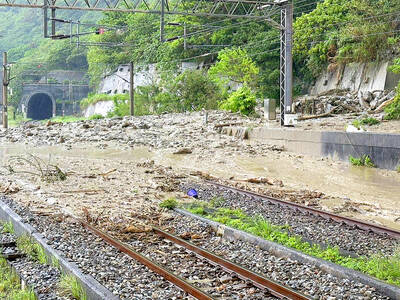
ROLLER-COASTER RIDE: More than five earthquakes ranging from magnitude 4.4 to 5.5 on the Richter scale shook eastern Taiwan in rapid succession yesterday afternoon Back-to-back weather fronts are forecast to hit Taiwan this week, resulting in rain across the nation in the coming days, the Central Weather Administration said yesterday, as it also warned residents in mountainous regions to be wary of landslides and rockfalls. As the first front approached, sporadic rainfall began in central and northern parts of Taiwan yesterday, the agency said, adding that rain is forecast to intensify in those regions today, while brief showers would also affect other parts of the nation. A second weather system is forecast to arrive on Thursday, bringing additional rain to the whole nation until Sunday, it

CONDITIONAL: The PRC imposes secret requirements that the funding it provides cannot be spent in states with diplomatic relations with Taiwan, Emma Reilly said China has been bribing UN officials to obtain “special benefits” and to block funding from countries that have diplomatic ties with Taiwan, a former UN employee told the British House of Commons on Tuesday. At a House of Commons Foreign Affairs Committee hearing into “international relations within the multilateral system,” former Office of the UN High Commissioner for Human Rights (OHCHR) employee Emma Reilly said in a written statement that “Beijing paid bribes to the two successive Presidents of the [UN] General Assembly” during the two-year negotiation of the Sustainable Development Goals. Another way China exercises influence within the UN Secretariat is
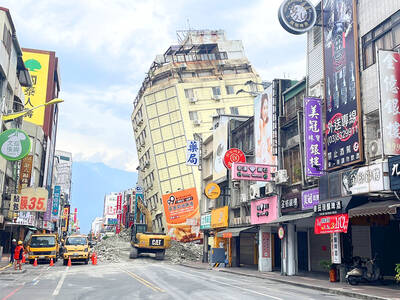
LANDSLIDES POSSIBLE: The agency advised the public to avoid visiting mountainous regions due to more expected aftershocks and rainfall from a series of weather fronts A series of earthquakes over the past few days were likely aftershocks of the April 3 earthquake in Hualien County, with further aftershocks to be expected for up to a year, the Central Weather Administration (CWA) said yesterday. Based on the nation’s experience after the quake on Sept. 21, 1999, more aftershocks are possible over the next six months to a year, the agency said. A total of 103 earthquakes of magnitude 4 on the local magnitude scale or higher hit Hualien County from 5:08pm on Monday to 10:27am yesterday, with 27 of them exceeding magnitude 5. They included two, of magnitude

Taiwan’s first drag queen to compete on the internationally acclaimed RuPaul’s Drag Race, Nymphia Wind (妮妃雅), was on Friday crowned the “Next Drag Superstar.” Dressed in a sparkling banana dress, Nymphia Wind swept onto the stage for the final, and stole the show. “Taiwan this is for you,” she said right after show host RuPaul announced her as the winner. “To those who feel like they don’t belong, just remember to live fearlessly and to live their truth,” she said on stage. One of the frontrunners for the past 15 episodes, the 28-year-old breezed through to the final after weeks of showcasing her unique


 RSS
RSS