


An international global warming conference approved a report on climate change yesterday, chairman Rajendra Pachauri said, after a contentious marathon session that saw angry exchanges between diplomats and scientists who drafted the report.
"We have an approved accord. It has been a complex exercise," Pachauri told reporters after an all-night meeting of the International Panel on Climate Change.
Several scientists objected to the editing of the final draft by government negotiators, but in the end agreed to compromises. However, some scientists vowed never to take part in the process again.
"The authors lost," one scientist said. "A lot of authors are not going to engage in the IPCC process anymore. I have had it with them," he said on condition of anonymity because the proceedings were supposed to remain confidential.
A reporter, however, witnessed part of the final meeting.
The climax of five days of negotiations was reached when the delegates removed parts of a key chart highlighting devastating effects of climate change that kick in with every rise of 1oC. There was also a tussle over the level of confidence attached to key statements.
The US, China and Saudi Arabia raised the most objections to the phrasing, most often seeking to tone down the certainty of some of the more dire projections.
The final report is the clearest and most comprehensive scientific statement to date on the impact of global warming mainly caused by human-induced carbon dioxide pollution. It predicts that up to 30 percent of species face an increased risk of extinction if global temperatures rise 2oC above the average of the 1980s and 1990s.
Areas that now suffer a shortage of rain will become even drier, adding to the risks of hunger and disease, and the world will face heightened threats of flooding, severe storms and the erosion of coastlines, it said.
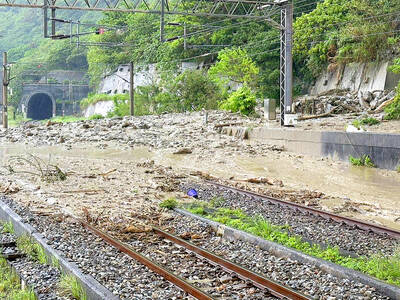
ROLLER-COASTER RIDE: More than five earthquakes ranging from magnitude 4.4 to 5.5 on the Richter scale shook eastern Taiwan in rapid succession yesterday afternoon Back-to-back weather fronts are forecast to hit Taiwan this week, resulting in rain across the nation in the coming days, the Central Weather Administration said yesterday, as it also warned residents in mountainous regions to be wary of landslides and rockfalls. As the first front approached, sporadic rainfall began in central and northern parts of Taiwan yesterday, the agency said, adding that rain is forecast to intensify in those regions today, while brief showers would also affect other parts of the nation. A second weather system is forecast to arrive on Thursday, bringing additional rain to the whole nation until Sunday, it

LANDSLIDES POSSIBLE: The agency advised the public to avoid visiting mountainous regions due to more expected aftershocks and rainfall from a series of weather fronts A series of earthquakes over the past few days were likely aftershocks of the April 3 earthquake in Hualien County, with further aftershocks to be expected for up to a year, the Central Weather Administration (CWA) said yesterday. Based on the nation’s experience after the quake on Sept. 21, 1999, more aftershocks are possible over the next six months to a year, the agency said. A total of 103 earthquakes of magnitude 4 on the local magnitude scale or higher hit Hualien County from 5:08pm on Monday to 10:27am yesterday, with 27 of them exceeding magnitude 5. They included two, of magnitude

CONDITIONAL: The PRC imposes secret requirements that the funding it provides cannot be spent in states with diplomatic relations with Taiwan, Emma Reilly said China has been bribing UN officials to obtain “special benefits” and to block funding from countries that have diplomatic ties with Taiwan, a former UN employee told the British House of Commons on Tuesday. At a House of Commons Foreign Affairs Committee hearing into “international relations within the multilateral system,” former Office of the UN High Commissioner for Human Rights (OHCHR) employee Emma Reilly said in a written statement that “Beijing paid bribes to the two successive Presidents of the [UN] General Assembly” during the two-year negotiation of the Sustainable Development Goals. Another way China exercises influence within the UN Secretariat is

Taiwan’s first drag queen to compete on the internationally acclaimed RuPaul’s Drag Race, Nymphia Wind (妮妃雅), was on Friday crowned the “Next Drag Superstar.” Dressed in a sparkling banana dress, Nymphia Wind swept onto the stage for the final, and stole the show. “Taiwan this is for you,” she said right after show host RuPaul announced her as the winner. “To those who feel like they don’t belong, just remember to live fearlessly and to live their truth,” she said on stage. One of the frontrunners for the past 15 episodes, the 28-year-old breezed through to the final after weeks of showcasing her unique


 RSS
RSS