


Iranian President Mahmoud Ahmadinejad kept up the heat yesterday, refusing again to stop sensitive nuclear work, as he headed for a dramatic confrontation over broadening UN sanctions against Iran.
"The Iranian nation possesses the nuclear fuel cycle and will not go back on that," he told a rally in central Yazd Province, cited by the semi-official Fars news agency.
"Don't think you can block the Iranian nation's pathway with these sittings and meetings," Ahmadinejad told world powers, which fear that Iran's nuclear program could be diverted towards the development of weapons .
Six major world powers on Thursday agreed on a package of broader UN sanctions against Iran as Tehran stood firm in its refusal to suspend its controversial nuclear work.
UN ambassadors from the six countries announced a deal on a new sanctions resolution that was submitted to the UN Security Council's 10 non-permanent members ahead of a vote expected next week.
The compromise text emerged after 10 days of hard-nosed bargaining by the council's five veto-wielding permanent members -- Britain, China, France, Russia and the US -- plus Germany.
"Yes, we have an agreement," Russian Ambassador Vitaly Churkin told reporters after a final round of talks on how to rein in Iran's suspected efforts to develop a nuclear bomb.
The agreement virtually ensures that measures to broaden existing sanctions and impose some new ones will be approved by the 15-member council when the draft is put to a vote, likely next week.
"It's a good, balanced, incremental step," US Acting Ambassador Alejandro Wolff said.
In Washington, the White House said US President George W. Bush hoped for a vote "soon."
News of the agreement set the stage for a dramatic confrontation with Ahmadinejad, who formally asked to attend the council meeting when the sanctions come up for a vote.
"He [Ahmadinejad] wants to come when the resolution is being adopted," said South African Ambassador Dumisani Kumalo, who chairs the council this month. Kumalo earlier said a vote could come next week.
A defiant Ahmadinejad, who insists Tehran's nuclear program is for strictly peaceful purposes, earlier on Thursday dismissed the new sanctions package and slammed the council.
"Today the enemies of the Iranian people are seeking to use the Security Council to prevent the progress and development of Iran. But the Security Council has no legitimacy among the peoples of the world," he said during the speech in Yazd.
Ahmadinejad's defiance was echoed -- albeit in a more measured way -- by the foreign policy adviser of supreme leader Ayatollah Ali Khomenei who said Iran would continue its nuclear drive and played down the effect of more sanctions.
Ali Akbar Velayati, a highly influential former foreign minister, said Iran would not "repeat the experience of suspending its uranium enrichment activities as the United States would not be satisfied by this and would then bring up other questions."
The new UN draft resolution builds on the sanctions imposed by the Security Council in December after Tehran spurned repeated UN demands to freeze uranium enrichment, a possible pathway to nuclear weapons.
Those measures included a ban on the sale of nuclear and ballistic missile-related materials to the Islamic republic and a freeze on financial assets of Iranians involved in illicit atomic and ballistic missile work.
The new draft would bar Iran from exporting arms and would urge all states to restrict the sale or transfer "of any battle tanks, armored combat vehicles, large-caliber artillery systems, combat aircraft, attack helicopters, warships, missiles" and other arms.
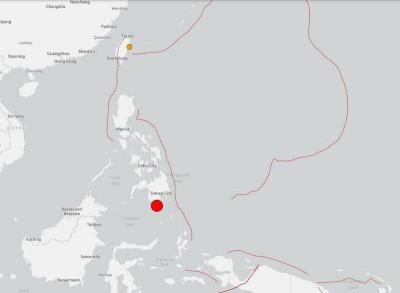
A magnitude 7.8 earthquake struck off the southern coast of Mindanao in the Philippines at 7:38am today, prompting the US Tsunami Warning System to issue an alert for neighboring countries, including Taiwan. The system issued a purple alert indicating a "tsunami threat." The potential threat zone includes Taiwan, the Philippines, Papua New Guinea, Yap and Palau. Philippine authorities were assessing the damage from the quake, with the office of civil defense seeking to verifying initial reports that 15 people had been killed and 129 injured in the region, mostly from falling debris. Arlene Hollero, disaster chief of Maasim town in the Philippines' Sarangani Province,
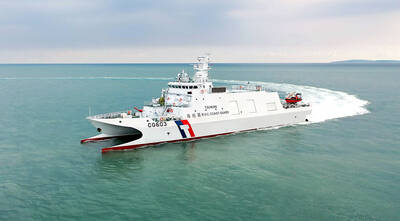
‘GRAY ZONE’ PRESSURE: Beijing’s activities are intended to create the deceitful impression that China has jurisdiction over the area around Taiwan, the CGA said Taiwan’s rights over its territorial waters and exclusive economic zone must not be violated by any country, the Mainland Affairs Council said yesterday, adding that it will not accept any unprovoked actions. The council issued the remarks in response to the China Coast Guard conducting maritime enforcement drills near eastern Taiwan and claiming to fully exercise China’s maritime administrative law enforcement authority. The Coast Guard Administration (CGA) has been closely monitoring the situation and is taking concrete steps to defend the nation’s sovereignty and secure its waters, the council said. China has no sovereign rights over the waters off eastern
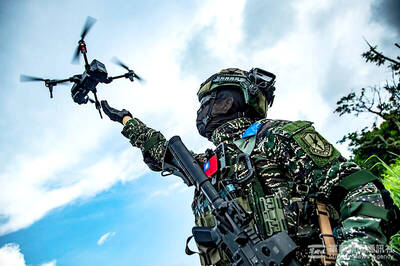
RESILIENCE: Taiwan plays a key role in semiconductors, energy, information infrastructure and advanced manufacturing, AIT Director Raymond Greene said Taiwan’s continued investment in deterrence and resilience remains vital, especially in uncrewed systems and other emerging technologies, American Institute in Taiwan (AIT) Director Raymond Greene said yesterday. Greene made the remarks at the annual National Strategic Summit on Supply Chain Resilience held by the Research Institute for Democracy, Society and Emerging Technology (DSET), a government-backed think tank. As Taiwan last year became the US’ fourth-largest trading partner and supply chain security is becoming more important, cooperation in emerging technologies continues to deepen between the two countries, he said. The US is committed to accelerating innovation, building key infrastructure, strengthening cooperation

RIGHT DIRECTION: Taiwan’s efforts to prevent forced labor include a proposal to ‘fully prohibit’ employers from withholding workers’ documents, an official said Taiwan is to establish a mechanism to restrict imports of goods linked to forced labor, the Executive Yuan said yesterday, after the US proposed imposing additional tariffs on Taiwanese goods over labor concerns. “The Ministry of Labor and the Ministry of Economic Affairs are to establish an interministerial review procedure,” Executive Yuan spokesperson Michelle Lee (李慧芝) said at a news briefing in Taipei. “The government is to use the Foreign Trade Act [貿易法] as the legal basis to restrict imports of goods produced with forced labor” and bring its supply chain governance more in line with international standards on human rights, resilience


 RSS
RSS