


Just four days after its unveiling, the Cabinet's 12-year compulsory education plan snowballed into a public relations nightmare yesterday, as a communication breakdown between education ministry and school officials and an on-camera outburst by Minister of Education Tu Cheng-sheng (杜正勝) threatened to derail one of the most far-reaching education proposals in the nation's recent history.
On Tuesday, Premier Su Tseng-chang (蘇貞昌) and Tu announced plans to add three years to the current nine of compulsory education and scrap the Basic Competence Test. Middle school graduates' performance on the test determines which high schools they can attend. Education officials claim the test puts undue pressure on students and contributes to an unhealthy focus on rote memorization in primary education.
Originally billing the plan as a long-overdue policy to better educate the young, education experts watched in horror yesterday as the education ministry appeared to fumble crucial details of the plan, inviting a flurry of criticism. The brouhaha hit fever pitch yesterday after Tu lost his cool in a press conference with ultra-marathon runner Kevin Lin (林義傑) -- who recently completed a 111-day jog across the Sahara Desert -- by his side.
Visibly annoyed by reporters seeking clarification of the plan, Tu lashed out at the press for not posing questions to Lin about his marathon.
"Here we have a national hero in our midst, and you don't want to ask him any questions?" Tu said. "How rude!"
But the star athlete could not divert media attention from Tu as his underlings failed to mollify a growing number of critics who say the plan is half-baked and showcases the education ministry's incompetence.
"Nobody is clear on this plan. How students will advance from middle to high schools, how district-related student quotas will determine which students can go to which schools, and how the Basic Competence Test will be phased out, are all unanswered questions," said Joanna Feng (馮喬蘭), executive director of the Humanistic Education Foundation.
"It's anybody's guess why the plan was unveiled so soon, when crucial details are still up in the air," Feng said.
But Taiwan Solidarity Union (TSU) lawmakers did more than just guess yesterday; virtually the entire party showed up at a press conference to fire off allegations that Tu is using the plan to score political points for Su in the run-up to next year's presidential election, a charge Su denied.
Su announced his candidacy last week.
Calling for Tu's resignation, TSU Legislator Tseng Tsahn-deng (曾燦燈) said the education minister went public with the plan before sorting out vital details in order to punctuate Su's candidacy announcement and give him a boost going into the presidential race.
Lawmakers from the pan-blue camp also heaped scorn on the plan, calling it the "Lafayette scandal of education."
At the heart of the controversy is the ministry's shifting position with regard to its replacing the Basic Competence Test with diversified admission criteria.
On Tuesday, education officials said they would de-emphasize student test performances in 36 "elite" schools nationwide, using scores as merely a cut-off criterion rather than the final determinant in the high school application process.
However, on Wednesday, officials admitted that "elite" wasn't an official category for high schools, poking holes in their plan to de-emphasize the importance of test scores in prestigious schools. Nonetheless, they added the test would be totally scrapped in such schools within three years.
On Thursday, a ministry press release said that an official distinction between "elite" and "non-elite" wouldn't be made after all, and that high schools could phase out the test at their own pace.
Questions abound as the principal of the nation's top girls' high school, Taipei First Girls High School -- which is likely to be directly affected by the plan -- slammed the ministry for not communicating with her.
"We're getting all of our information [about the plan] from the media," said Chou Yun-wei (
How schools like Taipei First Girls High School would recruit students under the plan was a mystery to her, she added.
For Taipei restaurateur Juno Tseng (
"If schools will be looking for extra abilities and talent beyond a test score, what does that mean for low-income families who cannot afford to send their kids to cram schools, art and music programs, or private tutors?" she said.
"How are they going to compete? And will getting rid of the test really lessen the pressure on kids, or just create more?" she added.
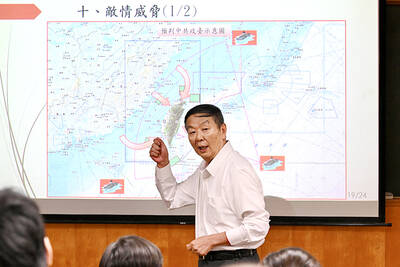
RETHINK? The defense ministry and Navy Command Headquarters could take over the indigenous submarine project and change its production timeline, a source said Admiral Huang Shu-kuang’s (黃曙光) resignation as head of the Indigenous Submarine Program and as a member of the National Security Council could affect the production of submarines, a source said yesterday. Huang in a statement last night said he had decided to resign due to national security concerns while expressing the hope that it would put a stop to political wrangling that only undermines the advancement of the nation’s defense capabilities. Taiwan People’s Party Legislator Vivian Huang (黃珊珊) yesterday said that the admiral, her older brother, felt it was time for him to step down and that he had completed what he
Taiwan has experienced its most significant improvement in the QS World University Rankings by Subject, data provided on Sunday by international higher education analyst Quacquarelli Symonds (QS) showed. Compared with last year’s edition of the rankings, which measure academic excellence and influence, Taiwanese universities made great improvements in the H Index metric, which evaluates research productivity and its impact, with a notable 30 percent increase overall, QS said. Taiwanese universities also made notable progress in the Citations per Paper metric, which measures the impact of research, achieving a 13 percent increase. Taiwanese universities gained 10 percent in Academic Reputation, but declined 18 percent
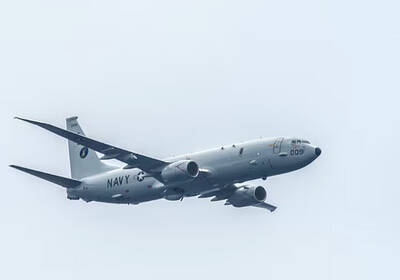
CHINA REACTS: The patrol and reconnaissance plane ‘transited the Taiwan Strait in international airspace,’ the 7th Fleet said, while Taipei said it saw nothing unusual The US 7th Fleet yesterday said that a US Navy P-8A Poseidon flew through the Taiwan Strait, a day after US and Chinese defense heads held their first talks since November 2022 in an effort to reduce regional tensions. The patrol and reconnaissance plane “transited the Taiwan Strait in international airspace,” the 7th Fleet said in a news release. “By operating within the Taiwan Strait in accordance with international law, the United States upholds the navigational rights and freedoms of all nations.” In a separate statement, the Ministry of National Defense said that it monitored nearby waters and airspace as the aircraft

UNDER DISCUSSION: The combatant command would integrate fast attack boat and anti-ship missile groups to defend waters closest to the coastline, a source said The military could establish a new combatant command as early as 2026, which would be tasked with defending Taiwan’s territorial waters 24 nautical miles (44.4km) from the nation’s coastline, a source familiar with the matter said yesterday. The new command, which would fall under the Naval Command Headquarters, would be led by a vice admiral and integrate existing fast attack boat and anti-ship missile groups, along with the Naval Maritime Surveillance and Reconnaissance Command, said the source, who asked to remain anonymous. It could be launched by 2026, but details are being discussed and no final timetable has been announced, the source


 RSS
RSS