


China's parliament will consider abolishing the system of "re-education through labor," state media reported yesterday, but cautioned that scrapping the punishment could still meet stiff opposition.
Re-education through labor empowers police to sentence petty criminals to up to four years' confinement without going through the courts, a system that critics say undermines rule of law and rights activists say targets political prisoners.
"According to the annual legislative plan released on Tuesday ... the proposed law on correction of illegal acts is among the 20 draft laws or amendments to be discussed this year," the China Daily reported.
A plan to change the system of re-education through labor, or laojiao, has been listed in the legislative plan for the annual session of the largely rubber-stamp parliament since 2005.
The China Daily noted that the draft law has been stalled because of disagreements. It said there were still ``lots of disagreements'' this year.
The announcement that it is being considered again contradicts comments made last month by China's top security chief, Luo Gan (
But the China Daily said in an editorial that China could not afford "foot-dragging" on the issue, saying keeping re-education through labor was not in the country's interest.
"The system's inadequate concern for civil rights as well as lack of jurisprudence protection have made it increasingly out of step with the country's progress in protecting human rights," the editorial said.
Laojiao also gave police "unrestrained latitude" in deciding the term of re-education and the lack of oversight made suspects vulnerable, it said.
Analysts said the draft changes being circulated to the "law on correction of illegal acts" still allowed for deprivation of liberty without the benefits of a trial and might only signal procedural improvements rather than wholesale change.
"It is a positive step if it is a step toward abolition of administrative detention," said Nicholas Bequelin, a Hong Kong-based researcher at Human Rights Watch.
"But there is also the risk that this new law would entrench the system of administrative detention, which in that case would be problematic," he said.
Human rights campaigners, including the UN's special rapporteur on torture, Manfred Nowak, have long said laojiao should be abolished, saying it targets political activists, ethnic minorities and religious believers and allows for the inhuman and degrading treatment of political prisoners.
Even if Beijing does move to scrap re-education through labor, it retains a labor camp system known as "reform through labor", or laogai, where political activists have also been imprisoned.

Chinese President Xi Jinping (習近平) yesterday met with former president Ma Ying-jeou (馬英九) at the Great Hall of the People in Beijing, with Xi’s opening statement once more emphasizing that people on both sides of the Taiwan Strait are Chinese and that foreign intervention cannot change their inevitable unification. Xi said that 5,000 years of history of zhonghua minzu (中華民族, ethnic Chinese group) have seen their ancestors move to Taiwan to establish new lives, while also documenting them fighting side-by-side against foreign forces and finally freeing Taiwan. “Both sides are Chinese,” and there are no issues that cannot be worked through, he
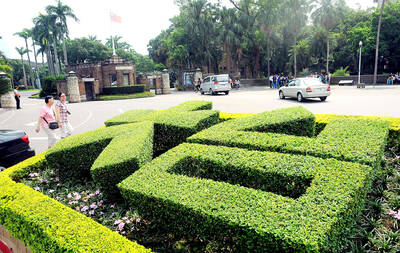
Taiwan has experienced its most significant improvement in the QS World University Rankings by Subject, data provided on Sunday by international higher education analyst Quacquarelli Symonds (QS) showed. Compared with last year’s edition of the rankings, which measure academic excellence and influence, Taiwanese universities made great improvements in the H Index metric, which evaluates research productivity and its impact, with a notable 30 percent increase overall, QS said. Taiwanese universities also made notable progress in the Citations per Paper metric, which measures the impact of research, achieving a 13 percent increase. Taiwanese universities gained 10 percent in Academic Reputation, but declined 18 percent
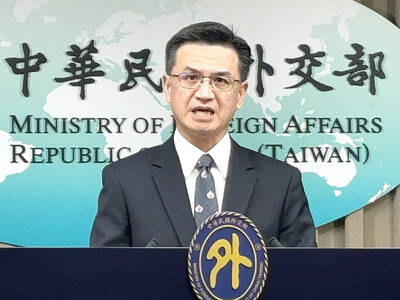
BULLY TACTICS: Beijing has continued its incursions into Taiwan’s airspace even as Xi Jinping talked about Taiwan being part of the Chinese family and nation China should stop its coercion of Taiwan and respect mainstream public opinion in Taiwan about sovereignty if its expression of goodwill is genuine, the Ministry of Foreign Affairs (MOFA) said yesterday. Ministry spokesman Jeff Liu (劉永健) made the comment in response to media queries about a meeting between former president Ma Ying-jeou (馬英九) and Chinese President Xi Jinping (習近平) the previous day. Ma voiced support for the so-called “1992 consensus,” while Xi said that although the two sides of the Taiwan Strait have “different systems,” this does not change the fact that they are “part of the same country,” and that “external

UNDER DISCUSSION: The combatant command would integrate fast attack boat and anti-ship missile groups to defend waters closest to the coastline, a source said The military could establish a new combatant command as early as 2026, which would be tasked with defending Taiwan’s territorial waters 24 nautical miles (44.4km) from the nation’s coastline, a source familiar with the matter said yesterday. The new command, which would fall under the Naval Command Headquarters, would be led by a vice admiral and integrate existing fast attack boat and anti-ship missile groups, along with the Naval Maritime Surveillance and Reconnaissance Command, said the source, who asked to remain anonymous. It could be launched by 2026, but details are being discussed and no final timetable has been announced, the source


 RSS
RSS