


In a potential policy shift, the US said on Tuesday it would join a conference with Iraq's neighbors which could see senior US officials hold direct talks with foes Iran and Syria.
President George W. Bush's administration had previously rebuffed calls from Congress, regional allies and the independent Iraq Study Group last year for a regional forum and discussions with its two arch foes on stabilizing Iraq.
Secretary of State Condoleezza Rice said a landmark conference, expected early next month, will follow lower-level talks with regional powers plus the five permanent members of the UN Security Council in Baghdad this month.
State Department spokesman Sean McCormack insisted there had been no change in US policy toward Iran, but repeatedly refused to rule out direct talks with the Iranians on the sidelines of the regional talks.
Iraqi officials said the first gathering, this month, would focus on ending sectarian violence and foreign support for rival militia and insurgents.
It will involve ambassadors and other envoys from Iran, Jordan, Kuwait, Saudi Arabia, Syria and Turkey as well as Egypt, Bahrain, the Arab League and the Organization of the Islamic Conference plus the five Security Council powers -- Britain, China, France, Russia and the US.
"This initial meeting will be followed, perhaps as early as the first half of April, by a ministerial level meeting with the same invitees, plus the G8," Rice told the Senate Appropriations Committee.
Analysts said that the tone and strategy of the Bush administration's regional diplomacy appeared to be shifting.
But even as the administration showed signs of flexibility, top intelligence chiefs laid out US grievances against Tehran in Iraq.
The head of the US Defense Intelligence Agency, Lieutenant General Michael Maples, said that Washington had evidence that Iraqi extremists were being trained in Iran in the use of armor-piercing explosives.
The new director of national intelligence, Michael McConnell, reaffirmed US charges that the Iranian Revolutionary Guards-Quds Force was supplying Iraqi extremists with weapons.
In other developments, Democratic leaders in the House of Representatives are backing away from a plan to scale back US involvement in the Iraq war by withholding money in the budget.
Instead, party officials said on Tuesday, leaders were weighing a proposal that would attempt to embarrass Bush into abandoning his war strategy.
Under a plan discussed privately, Democrats would probably grant Bush's entire US$93.4 billion request for war spending this year but require that any troops sent into battle that do not meet certain standards or lack appropriate equipment receive a presidential waiver and that Congress be given notifice of the shortcoming.
The compromise is an attempt to please members who want to end the war immediately by cutting funding and others who do not want to appear as though they are turning their back on the troops.
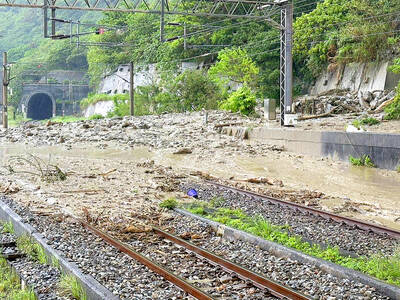
ROLLER-COASTER RIDE: More than five earthquakes ranging from magnitude 4.4 to 5.5 on the Richter scale shook eastern Taiwan in rapid succession yesterday afternoon Back-to-back weather fronts are forecast to hit Taiwan this week, resulting in rain across the nation in the coming days, the Central Weather Administration said yesterday, as it also warned residents in mountainous regions to be wary of landslides and rockfalls. As the first front approached, sporadic rainfall began in central and northern parts of Taiwan yesterday, the agency said, adding that rain is forecast to intensify in those regions today, while brief showers would also affect other parts of the nation. A second weather system is forecast to arrive on Thursday, bringing additional rain to the whole nation until Sunday, it
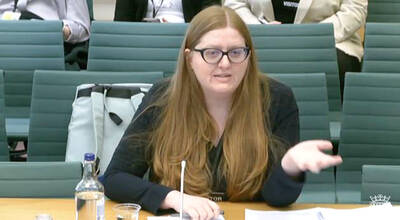
CONDITIONAL: The PRC imposes secret requirements that the funding it provides cannot be spent in states with diplomatic relations with Taiwan, Emma Reilly said China has been bribing UN officials to obtain “special benefits” and to block funding from countries that have diplomatic ties with Taiwan, a former UN employee told the British House of Commons on Tuesday. At a House of Commons Foreign Affairs Committee hearing into “international relations within the multilateral system,” former Office of the UN High Commissioner for Human Rights (OHCHR) employee Emma Reilly said in a written statement that “Beijing paid bribes to the two successive Presidents of the [UN] General Assembly” during the two-year negotiation of the Sustainable Development Goals. Another way China exercises influence within the UN Secretariat is

LANDSLIDES POSSIBLE: The agency advised the public to avoid visiting mountainous regions due to more expected aftershocks and rainfall from a series of weather fronts A series of earthquakes over the past few days were likely aftershocks of the April 3 earthquake in Hualien County, with further aftershocks to be expected for up to a year, the Central Weather Administration (CWA) said yesterday. Based on the nation’s experience after the quake on Sept. 21, 1999, more aftershocks are possible over the next six months to a year, the agency said. A total of 103 earthquakes of magnitude 4 on the local magnitude scale or higher hit Hualien County from 5:08pm on Monday to 10:27am yesterday, with 27 of them exceeding magnitude 5. They included two, of magnitude

Taiwan’s first drag queen to compete on the internationally acclaimed RuPaul’s Drag Race, Nymphia Wind (妮妃雅), was on Friday crowned the “Next Drag Superstar.” Dressed in a sparkling banana dress, Nymphia Wind swept onto the stage for the final, and stole the show. “Taiwan this is for you,” she said right after show host RuPaul announced her as the winner. “To those who feel like they don’t belong, just remember to live fearlessly and to live their truth,” she said on stage. One of the frontrunners for the past 15 episodes, the 28-year-old breezed through to the final after weeks of showcasing her unique


 RSS
RSS