


Italy's president was holding crisis talks with political leaders yesterday to see if Romano Prodi, who resigned as prime minister after nine months in power, can still head a government or must be replaced.
Prodi stepped down on Wednesday evening after an embarrassing parliamentary defeat of his government's proposed foreign policy program, including its plan to keep Italian troops in Afghanistan. He is staying on in a caretaker role.
"Comrades, all go home," crowed the headline in right-wing daily Il Giornale run by the brother of former prime minister Silvio Berlusconi.
Under Italy's Constitution, President Giorgio Napolitano now must find a way out of the impasse.
He was spending yesterday in consultations with party and parliamentary leaders -- a process one newspaper called a "Russian roulette" for Prodi, as the unpredictable result will determine his political future. There are three main scenarios:
If Napolitano finds enough support for Prodi among center-left parties, he could ask him to either form a new government or go to parliament with his present Cabinet for a confidence vote; a victory would allow him to remain in office.
If support for Prodi is not strong enough for him to carry on as prime minister, Napolitano could ask someone else, possibly Interior Minister Giuliano Amato, to form a caretaker government of experts with cross-party backing.
If no agreement is found on who should be prime minister, Napolitano would be forced to dissolve parliament and call early elections.
Many observers say that Napolitano would be unlikely to call early elections since they would be far ahead of their 2011 schedule and would be held using the current electoral law, which many political forces want to reform before a new vote.
Analysts said any Prodi government would be extremely weak and vulnerable to bitter infighting among its allies, who disagree on just about everything from Italy's military missions abroad to gay rights.
"Even if there is another Prodi government it would be hanging by a thread and would not last long, as the reasons for tension abound," said Gianfranco Pasquino, political science professor at the Bologna center of John Hopkins University.
Prodi, 67, was heading the 61st Italian government since 1945.
After his election last April, he enjoyed a brief honeymoon but his popularity soon plummeted as he pushed through a deficit-cutting 2007 budget to bring Italy in line with EU requirements.
Despite continued bickering within his coalition, his resignation came as a surprise.
The vote in the Senate was only intended as a motion of support for the government's foreign policy, but Foreign Minister Massimo D'Alema turned it into a test of the executive's strength, giving Prodi little choice once the motion failed to pass. Prodi only has a one-seat majority in the Senate, and the revolt of two senators in his coalition was enough to put the government in a corner.
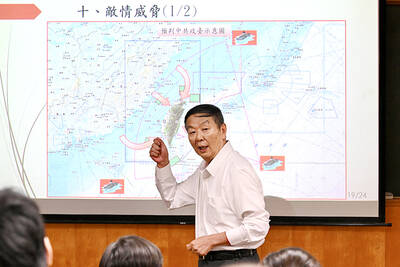
RETHINK? The defense ministry and Navy Command Headquarters could take over the indigenous submarine project and change its production timeline, a source said Admiral Huang Shu-kuang’s (黃曙光) resignation as head of the Indigenous Submarine Program and as a member of the National Security Council could affect the production of submarines, a source said yesterday. Huang in a statement last night said he had decided to resign due to national security concerns while expressing the hope that it would put a stop to political wrangling that only undermines the advancement of the nation’s defense capabilities. Taiwan People’s Party Legislator Vivian Huang (黃珊珊) yesterday said that the admiral, her older brother, felt it was time for him to step down and that he had completed what he
Taiwan has experienced its most significant improvement in the QS World University Rankings by Subject, data provided on Sunday by international higher education analyst Quacquarelli Symonds (QS) showed. Compared with last year’s edition of the rankings, which measure academic excellence and influence, Taiwanese universities made great improvements in the H Index metric, which evaluates research productivity and its impact, with a notable 30 percent increase overall, QS said. Taiwanese universities also made notable progress in the Citations per Paper metric, which measures the impact of research, achieving a 13 percent increase. Taiwanese universities gained 10 percent in Academic Reputation, but declined 18 percent
UNDER DISCUSSION: The combatant command would integrate fast attack boat and anti-ship missile groups to defend waters closest to the coastline, a source said The military could establish a new combatant command as early as 2026, which would be tasked with defending Taiwan’s territorial waters 24 nautical miles (44.4km) from the nation’s coastline, a source familiar with the matter said yesterday. The new command, which would fall under the Naval Command Headquarters, would be led by a vice admiral and integrate existing fast attack boat and anti-ship missile groups, along with the Naval Maritime Surveillance and Reconnaissance Command, said the source, who asked to remain anonymous. It could be launched by 2026, but details are being discussed and no final timetable has been announced, the source
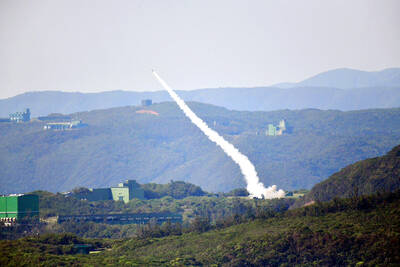
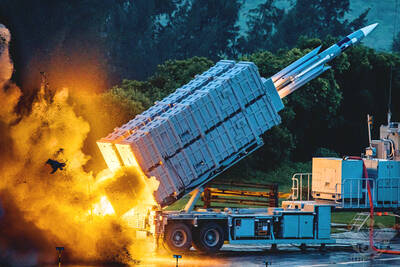
SHOT IN THE ARM: The new system can be integrated with Avenger and Stinger missiles to bolster regional air defense capabilities, a defense ministry report said Domestically developed Land Sword II (陸射劍二) missiles were successfully launched and hit target drones during a live-fire exercise at the Jiupeng Military Base in Pingtung County yesterday. The missiles, developed by the Chungshan Institute of Science and Technology (CSIST), were originally scheduled to launch on Tuesday last week, after the Tomb Sweeping Day holiday long weekend, but were postponed to yesterday due to weather conditions. Local residents and military enthusiasts gathered outside the base to watch the missile tests, with the first one launching at 9:10am. The Land Sword II system, which is derived from the Sky Sword II (天劍二) series, was turned


 RSS
RSS