


Advanced Semiconductor Engineering (ASE, 日月光半導體), the world's top chip packager, said yesterday that the private equity fund consortium led by Carlyle Group agreed to terminate an exclusive deal with chairman Jason Chang (張虔生) as part of a potential buy-out bid.
The Carlyle Group agreed to terminate the exclusivity, expense reimbursement and breakup fee arrangements with Chang, effective immediately, ASE said in a filing to the Taiwan Stock Exchange.
Kaohsiung-based ASE said that it was still assessing the feasibility of the NT$179.27 billion (US$5.45 billion) bid from the Washington-based private equity investor.
"This does not mean Chang is in talks with any new bidders, or seeking new buyers," ASE spokesman Freddie Liu (劉詩亮) told the Taipei Times. "The company's taskforce is still evaluating Carlyle's offer."
Last November, Chang announced that he would sell an 18.4 percent-stake in ASE owned by himself and his family at NT$39 per share if the Taiwanese company agreed to sell all of its outstanding shares to Carlyle.
"The price might not be attractive for Chang now, as the stock price rallied after the buy-out offer was unveiled," said Eric Chen (
ASE shares jumped 5.77 percent since the announcement was made in late November, outperforming the benchmark TAIEX index's 5.14 percent gain during the same period. The stock closed at NT$37.55 on Wednesday.
The closing price of ASE represented a 3.86 percent premium to Carlyle's offer.
It was too early to say if the buy-out bid would fail, but "the end of Carlyle's exclusivity [deal] could push the private equity fund consortium to raise its offer now as the door is open to other interested parties," Chen said.
He said that if the buyout talks failed, ASE would not delist from the TAIEX.
ASE has NT$173 billion in market value, compared with the TAIEX's NT$19.31 trillion.
ASE would lose an opportunity if the deal fails, but it would not heavily impact on the industry as the management team would stay in Taiwan, Minister of Economic Affairs Steve Chen (
As far as he was aware, the buyout was proceeding, Chen said. The termination of an exclusivity deal was merely avoiding a conflict of interest, he said.
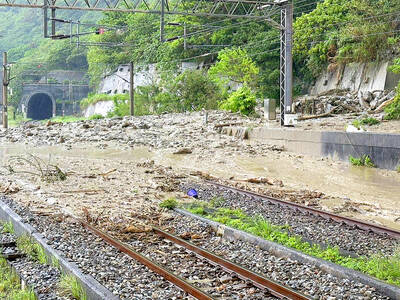
ROLLER-COASTER RIDE: More than five earthquakes ranging from magnitude 4.4 to 5.5 on the Richter scale shook eastern Taiwan in rapid succession yesterday afternoon Back-to-back weather fronts are forecast to hit Taiwan this week, resulting in rain across the nation in the coming days, the Central Weather Administration said yesterday, as it also warned residents in mountainous regions to be wary of landslides and rockfalls. As the first front approached, sporadic rainfall began in central and northern parts of Taiwan yesterday, the agency said, adding that rain is forecast to intensify in those regions today, while brief showers would also affect other parts of the nation. A second weather system is forecast to arrive on Thursday, bringing additional rain to the whole nation until Sunday, it

CONDITIONAL: The PRC imposes secret requirements that the funding it provides cannot be spent in states with diplomatic relations with Taiwan, Emma Reilly said China has been bribing UN officials to obtain “special benefits” and to block funding from countries that have diplomatic ties with Taiwan, a former UN employee told the British House of Commons on Tuesday. At a House of Commons Foreign Affairs Committee hearing into “international relations within the multilateral system,” former Office of the UN High Commissioner for Human Rights (OHCHR) employee Emma Reilly said in a written statement that “Beijing paid bribes to the two successive Presidents of the [UN] General Assembly” during the two-year negotiation of the Sustainable Development Goals. Another way China exercises influence within the UN Secretariat is
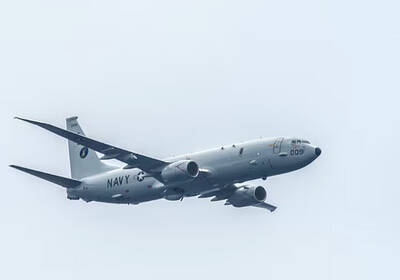
CHINA REACTS: The patrol and reconnaissance plane ‘transited the Taiwan Strait in international airspace,’ the 7th Fleet said, while Taipei said it saw nothing unusual The US 7th Fleet yesterday said that a US Navy P-8A Poseidon flew through the Taiwan Strait, a day after US and Chinese defense heads held their first talks since November 2022 in an effort to reduce regional tensions. The patrol and reconnaissance plane “transited the Taiwan Strait in international airspace,” the 7th Fleet said in a news release. “By operating within the Taiwan Strait in accordance with international law, the United States upholds the navigational rights and freedoms of all nations.” In a separate statement, the Ministry of National Defense said that it monitored nearby waters and airspace as the aircraft

Taiwan’s first drag queen to compete on the internationally acclaimed RuPaul’s Drag Race, Nymphia Wind (妮妃雅), was on Friday crowned the “Next Drag Superstar.” Dressed in a sparkling banana dress, Nymphia Wind swept onto the stage for the final, and stole the show. “Taiwan this is for you,” she said right after show host RuPaul announced her as the winner. “To those who feel like they don’t belong, just remember to live fearlessly and to live their truth,” she said on stage. One of the frontrunners for the past 15 episodes, the 28-year-old breezed through to the final after weeks of showcasing her unique


 RSS
RSS