


A curtain of secrecy descended on the case of fugitive Rebar Group chairman Wang You-theng (王又曾) in Los Angeles on Tuesday when a US federal immigration judge ordered his deportation hearing closed and forbade anybody involved in the case from disclosing any related information.
Within minutes of the beginning of Wang's first appearance in court since he was interdicted on his entry into Los Angeles airport on Feb. 2, Judge Rose Peters issued a "do not disclose order" at the request of Wang's lawyer, Franklin Nelson.
As a result, neither US government spokesmen nor lawyers taking part in the case can say anything publicly or privately about the case as long as the no-disclosure order is retained.
Comprehensive
The order would extend, for instance, to disclosure of the date of Wang's next appearance in the court, located within an immigration detention center in San Pedro Island south of Los Angeles. It is believed that the next hearing will take place on March 6 or March 7.
Tuesday's hearing, called a "calendar hearing," basically dealt with procedural matters and was scheduled to last only five to 10 minutes.
The prosecution and defense will not begin to argue the merits of the case until the "individual hearing" in March.
Wang's wife, Wang Chin She-ying (王金世英), a US citizen traveling on a US passport, did not attend Tuesday's hearing, a spokesperson for the Immigration and Customs Enforcement office of the Department of Homeland Security, Virginia Kice, told reporters.
Four people
Shawn Chou, a lawyer working with the Taiwan press corps, told the Taipei Times that Kice had said only four people were in attendance: Peters, Nelson, Wang attorney Tiffany Tai (
Calls by the Taipei Times to Wang's lawyers were not returned.
Officials from the Taipei Economic and Cultural Representative Office (TECRO) in Washington could offer no information on the case. A late cable from the Taiwan office in Los Angeles to Washington offered scant information, senior TECRO officials said.
They did say that no lawyers representing Taiwan were present at the hearing, despite speculation by reporters at the scene that an Asian woman at the detention center at the time of the hearing might have been a Taiwanese lawyer surnamed Lin, Chou said.
It was not clear why the judge ordered the hearing closed.
Kice told reporters that hearings could be ordered closed if they dealt with asylum requests, sensitive information the parties did not want disclosed, or matters of national security. It was hard to see which reason could be used in Wang's case.
Asylum usually pertains to an oppressive or authoritarian regime from which a detainee seeks to escape persecution or death while the Wang case appears to raise no national security issues.
However, Chou said that his "guess" was that "Mr Wang filed some sort of protective relief, or asylum motion," adding that this was "puzzling to outsiders."
The closing of the hearing was a huge disappointment to Taiwan-ese reporters. Over the Presi-dent's Day holiday weekend, Kice and Lynn Tso (左敏琳), a reporter for TVBS, had worked out a pool system in which six media representatives would attend the hearing and report back to journalists who could not gain entry.
But when the reporters appeared at 7:40am, 20 minutes before the 8am start time, Kice told them that Nelson had called her at 9pm the night before asking for the hearing be closed to the press.
Kice said she believed that such a decision should be made by a judge.
Kice went into the court, but returned a few minutes after the hearing began to tell the reporters that they would be barred from the hearing.
She said that the prosecution did not raise an objection to Nelson's "non-disclosure" motion.
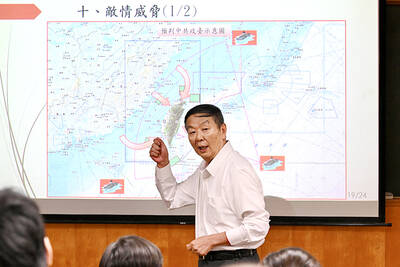
RETHINK? The defense ministry and Navy Command Headquarters could take over the indigenous submarine project and change its production timeline, a source said Admiral Huang Shu-kuang’s (黃曙光) resignation as head of the Indigenous Submarine Program and as a member of the National Security Council could affect the production of submarines, a source said yesterday. Huang in a statement last night said he had decided to resign due to national security concerns while expressing the hope that it would put a stop to political wrangling that only undermines the advancement of the nation’s defense capabilities. Taiwan People’s Party Legislator Vivian Huang (黃珊珊) yesterday said that the admiral, her older brother, felt it was time for him to step down and that he had completed what he
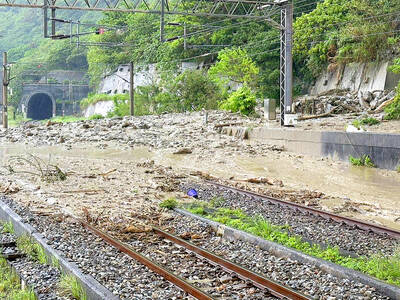
ROLLER-COASTER RIDE: More than five earthquakes ranging from magnitude 4.4 to 5.5 on the Richter scale shook eastern Taiwan in rapid succession yesterday afternoon Back-to-back weather fronts are forecast to hit Taiwan this week, resulting in rain across the nation in the coming days, the Central Weather Administration said yesterday, as it also warned residents in mountainous regions to be wary of landslides and rockfalls. As the first front approached, sporadic rainfall began in central and northern parts of Taiwan yesterday, the agency said, adding that rain is forecast to intensify in those regions today, while brief showers would also affect other parts of the nation. A second weather system is forecast to arrive on Thursday, bringing additional rain to the whole nation until Sunday, it

CONDITIONAL: The PRC imposes secret requirements that the funding it provides cannot be spent in states with diplomatic relations with Taiwan, Emma Reilly said China has been bribing UN officials to obtain “special benefits” and to block funding from countries that have diplomatic ties with Taiwan, a former UN employee told the British House of Commons on Tuesday. At a House of Commons Foreign Affairs Committee hearing into “international relations within the multilateral system,” former Office of the UN High Commissioner for Human Rights (OHCHR) employee Emma Reilly said in a written statement that “Beijing paid bribes to the two successive Presidents of the [UN] General Assembly” during the two-year negotiation of the Sustainable Development Goals. Another way China exercises influence within the UN Secretariat is
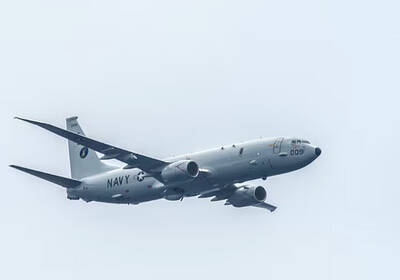
CHINA REACTS: The patrol and reconnaissance plane ‘transited the Taiwan Strait in international airspace,’ the 7th Fleet said, while Taipei said it saw nothing unusual The US 7th Fleet yesterday said that a US Navy P-8A Poseidon flew through the Taiwan Strait, a day after US and Chinese defense heads held their first talks since November 2022 in an effort to reduce regional tensions. The patrol and reconnaissance plane “transited the Taiwan Strait in international airspace,” the 7th Fleet said in a news release. “By operating within the Taiwan Strait in accordance with international law, the United States upholds the navigational rights and freedoms of all nations.” In a separate statement, the Ministry of National Defense said that it monitored nearby waters and airspace as the aircraft


 RSS
RSS