


Legislative Speaker Wang Jin-pyng (
Wang mentioned the possibility when approached by reporters for comment on a story published by the Chinese-language United Daily News yesterday.
The report said Wang had decided to compete in the Chinese Nationalist Party's (KMT) primary for the 2008 presidential election.
It quoted an anonymous source as saying that Wang had recently reduced the number of public events he attended because he had started preparing for his campaign.
"There are many options open to me," Wang said yesterday. "What I am thinking about is what else I can do for the nation and what do people expect from me?"
When asked by reporters whether running for the presidency was one of those choices, Wang did not dismiss the idea but stressed that it was among the possibilities, which also included staying in the legislature.
He said that grassroots supporters were showing increasing support for him running in the primary and that he had also taken their support as a factor in a decision.
KMT Chairman Ma Ying-jeou (馬英九) yesterday declined to comment.
He stressed that there would be only one pair representing the party in the 2008 presidential election.
"No matter who represents the KMT in the presidential election, we will hold negotiations before the presidential primary," Ma said while meeting with KMT members in Taipei County.
The KMT is scheduled to formally announce the details of its presidential primary via a bulletin on April 2 and announce its presidential candidate on May 25. The candidate will be chosen by means of a public poll and a member vote. The public poll and member vote count for 70 percent and 30 percent respectively.
"The KMT will elect one pair of candidates to run for the presidential election and try to rediscover happiness and social harmony for the people," Ma added.
KMT Secretary-General Wu Den-yih (吳敦義) said the party would follow the regulations and elect the candidate with the biggest opportunity of winning the election.
"If there are more than two candidates who express the intention to enter the primary, we will first negotiate with them, and hold a primary if the negotiations don't work out," Wu said yesterday.
Wu declined to comment on the possibility of a "Wang-Ma" or "Ma-Wang" ticket, and echoed Ma's remarks that the situation would be clearer come April.
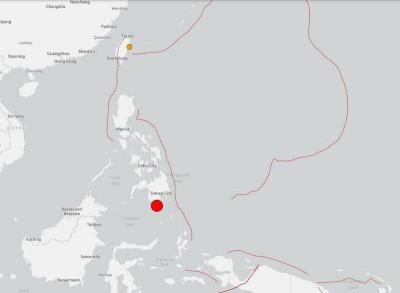
A magnitude 7.8 earthquake struck off the southern coast of Mindanao in the Philippines at 7:38am today, prompting the US Tsunami Warning System to issue an alert for neighboring countries, including Taiwan. The system issued a purple alert indicating a "tsunami threat." The potential threat zone includes Taiwan, the Philippines, Papua New Guinea, Yap and Palau. Philippine authorities were assessing the damage from the quake, with the office of civil defense seeking to verifying initial reports that 15 people had been killed and 129 injured in the region, mostly from falling debris. Arlene Hollero, disaster chief of Maasim town in the Philippines' Sarangani Province,
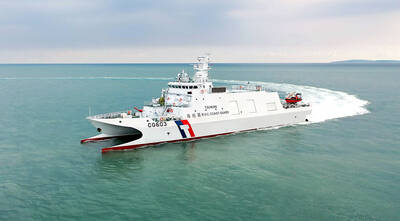
‘GRAY ZONE’ PRESSURE: Beijing’s activities are intended to create the deceitful impression that China has jurisdiction over the area around Taiwan, the CGA said Taiwan’s rights over its territorial waters and exclusive economic zone must not be violated by any country, the Mainland Affairs Council said yesterday, adding that it will not accept any unprovoked actions. The council issued the remarks in response to the China Coast Guard conducting maritime enforcement drills near eastern Taiwan and claiming to fully exercise China’s maritime administrative law enforcement authority. The Coast Guard Administration (CGA) has been closely monitoring the situation and is taking concrete steps to defend the nation’s sovereignty and secure its waters, the council said. China has no sovereign rights over the waters off eastern

RESILIENCE: Taiwan plays a key role in semiconductors, energy, information infrastructure and advanced manufacturing, AIT Director Raymond Greene said Taiwan’s continued investment in deterrence and resilience remains vital, especially in uncrewed systems and other emerging technologies, American Institute in Taiwan (AIT) Director Raymond Greene said yesterday. Greene made the remarks at the annual National Strategic Summit on Supply Chain Resilience held by the Research Institute for Democracy, Society and Emerging Technology (DSET), a government-backed think tank. As Taiwan last year became the US’ fourth-largest trading partner and supply chain security is becoming more important, cooperation in emerging technologies continues to deepen between the two countries, he said. The US is committed to accelerating innovation, building key infrastructure, strengthening cooperation

RIGHT DIRECTION: Taiwan’s efforts to prevent forced labor include a proposal to ‘fully prohibit’ employers from withholding workers’ documents, an official said Taiwan is to establish a mechanism to restrict imports of goods linked to forced labor, the Executive Yuan said yesterday, after the US proposed imposing additional tariffs on Taiwanese goods over labor concerns. “The Ministry of Labor and the Ministry of Economic Affairs are to establish an interministerial review procedure,” Executive Yuan spokesperson Michelle Lee (李慧芝) said at a news briefing in Taipei. “The government is to use the Foreign Trade Act [貿易法] as the legal basis to restrict imports of goods produced with forced labor” and bring its supply chain governance more in line with international standards on human rights, resilience


 RSS
RSS