


Military police guarding the mausoleum of former dictator Chiang Kai-shek (蔣介石) at the Tzuhu Presidential Burial Place (慈湖陵寢) could be withdrawn if Democratic Progressive Party (DPP) Chairman Yu Shyi-kun has his way.
Yu plans to make a proposal during the party's Central Standing Committee meeting today that the Cabinet should withdraw the guards, a DPP spokesman said.
The proposal is considered to be part of the rectification campaign the party initiated on May 11, 2002, which includes removing any words related to China in the titles of state-run enterprises and replacing them with "Taiwan."

PHOTO: CNA
Over the past five years, the party has been engaged in various efforts to counter the influence that Chiang has had in the country, including urging the Ministry of Defense to remove statues of him from military bases and proposing the relocation of the Chiang Kai-shek Memorial Hall.
The party's Central Standing Committee urged the government last week to quicken the process of correcting the titles of state-owned corporations.
Super Meng (孟義超), director of the DPP's Department of Culture and Information, said yesterday that using national resources to manage the mausoleums did not conform to the principle of transitional justice.
Therefore, the soldiers should be withdrawn and the employment of security guards left to the Chiang family, he said.
Yu is expected to put forth the proposal after Academia Historica President Chang Hsien-yen (
In a report published by the 228 Memorial Foundation last year, Chang said that Chiang should be held responsible for the 1947 incident.
In the 228 Incident, conflict between anti-contraband officers and local people led to clashes. Military forces were called in from China, escalating the incident into a nationwide crackdown during which tens of thousands of people were arrested or killed.
Vice President Annette Lu (
"This year is the 60th anniversary of the 228 Incident," she said.
"If historical research confirms that Chiang Kai-shek was the prime culprit in the crime, we will have to reconsider spending money on protecting his mausoleum," Lu said.
However, Lu added that she disapproved of taking "drastic measures."
She did not elaborate.
Lee Hung-hsi (李鴻禧), convener of the government's New Constitution Workshop and a mentor of President Chen Shui-bian (陳水扁), said that removing the guards was "essential during the nation's pursuit of transitional justice."
"We cannot hold Chiang Kai-shek responsible for the 228 Incident on the one hand while on the other hand regarding him as the nation's savior," he said.
Minister of National Defense Lee Jye (
"I will simply carry out government policy," he said. "The military belongs to the country, not to any specific political party or any specific individual."
Chinese Nationalist Party (KMT) Legislator John Chiang (
John Chiang, a son of the late president Chiang Ching-kuo (蔣經國), said he would go to Tzuhu today to pay homage to his relatives.
"If the budget for managing the mausoleum is slashed, I hope the government of Taoyuan County will be able to lend a hand," he said.
"My family at one point planned to remove the remains to the Wuchihshan Military Cemetery [in Taipei County], but we decided to not to make the move under the DPP government," he said.
"Lee Jye had told me previously that the ministry respected our [family's] decision and that the Tzuhu and Tahsi (
also see story:
Editorial: Good riddance to a tyrant
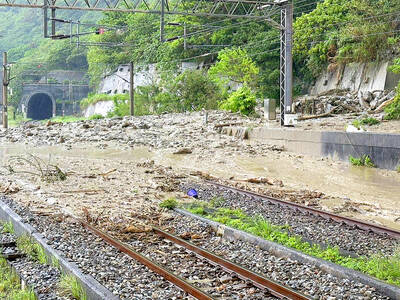
ROLLER-COASTER RIDE: More than five earthquakes ranging from magnitude 4.4 to 5.5 on the Richter scale shook eastern Taiwan in rapid succession yesterday afternoon Back-to-back weather fronts are forecast to hit Taiwan this week, resulting in rain across the nation in the coming days, the Central Weather Administration said yesterday, as it also warned residents in mountainous regions to be wary of landslides and rockfalls. As the first front approached, sporadic rainfall began in central and northern parts of Taiwan yesterday, the agency said, adding that rain is forecast to intensify in those regions today, while brief showers would also affect other parts of the nation. A second weather system is forecast to arrive on Thursday, bringing additional rain to the whole nation until Sunday, it

CONDITIONAL: The PRC imposes secret requirements that the funding it provides cannot be spent in states with diplomatic relations with Taiwan, Emma Reilly said China has been bribing UN officials to obtain “special benefits” and to block funding from countries that have diplomatic ties with Taiwan, a former UN employee told the British House of Commons on Tuesday. At a House of Commons Foreign Affairs Committee hearing into “international relations within the multilateral system,” former Office of the UN High Commissioner for Human Rights (OHCHR) employee Emma Reilly said in a written statement that “Beijing paid bribes to the two successive Presidents of the [UN] General Assembly” during the two-year negotiation of the Sustainable Development Goals. Another way China exercises influence within the UN Secretariat is
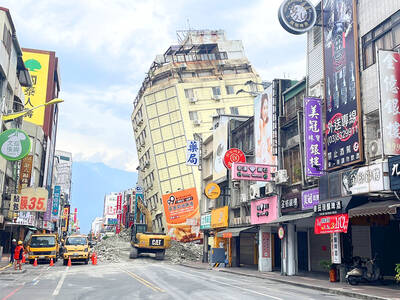
LANDSLIDES POSSIBLE: The agency advised the public to avoid visiting mountainous regions due to more expected aftershocks and rainfall from a series of weather fronts A series of earthquakes over the past few days were likely aftershocks of the April 3 earthquake in Hualien County, with further aftershocks to be expected for up to a year, the Central Weather Administration (CWA) said yesterday. Based on the nation’s experience after the quake on Sept. 21, 1999, more aftershocks are possible over the next six months to a year, the agency said. A total of 103 earthquakes of magnitude 4 on the local magnitude scale or higher hit Hualien County from 5:08pm on Monday to 10:27am yesterday, with 27 of them exceeding magnitude 5. They included two, of magnitude

Taiwan’s first drag queen to compete on the internationally acclaimed RuPaul’s Drag Race, Nymphia Wind (妮妃雅), was on Friday crowned the “Next Drag Superstar.” Dressed in a sparkling banana dress, Nymphia Wind swept onto the stage for the final, and stole the show. “Taiwan this is for you,” she said right after show host RuPaul announced her as the winner. “To those who feel like they don’t belong, just remember to live fearlessly and to live their truth,” she said on stage. One of the frontrunners for the past 15 episodes, the 28-year-old breezed through to the final after weeks of showcasing her unique


 RSS
RSS