


President Chen Shui-bian (
Chen said that this underscored the importance of ratifying the nation's official title.
"It is clear that Taiwan and China are different," he told the press corps during a late night press conference.
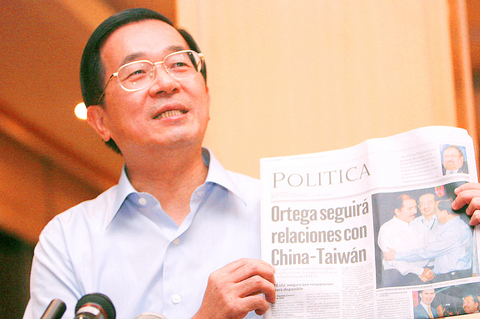
PHOTO: CNA
Chen said that during conversations with Ortega on Tuesday, the latter used the name "Republic of China (Taiwan)" and then changed to the "Republic of Taiwan."
"We did not advertise this," Chen said, adding that how the nation is called in print and verbally can at times differ.
While the name "Taiwan" is the preferred choice, it was safer not to advertise Ortega's choice of words, as media outlets with bad intentions could have emphasized the incident to create problems, he said.
Holding a copy of a local newspaper on Wednesday, Chen said that the Nicaraguan press had used the short form of "China-Taiwan" in the headline to save space but that the story itself referred to Taiwan as "Republic of China (Taiwan)" or simply "Taiwan."
While discussing the value of "presidential diplomacy," Chen said that his trip to Nicaragua was important in his administration's effort to consolidate diplomatic relations with the Central American ally.
He denied that the purpose of his visit was "checkbook diplomacy," saying that relations with allies can be strengthened by various other means.
Describing Ortega's changing appellations for the nation as "colloquial," Minister of Foreign Affairs James Huang (
"It did not have any political meaning, nor was it an attempt to belittle Taiwan or an unfriendly gesture," he said. "We know our allies are under a lot of pressure from China and we don't want to return our allies' kindness with ingratitude."
Huang praised the master of ceremonies for doing a good job by adding "Taiwan" after "China," adding that the term "Republic of" was removed to "create a relaxed and unofficial atmosphere," which was compounded by the fact that there was no dress code during the event.
The event, which was scheduled to start at 3pm, was delayed by more than two hours because of the late arrival of Venezuelan President Hugo Chavez, who earlier that day had attended his own swearing-in ceremony for another six-year term.
While the media focused on the interactions between Chen and Chavez, Chen said he thought the exchange between him and Mike Leavitt, US President George W. Bush's special envoy to the event, held a special significance.
Chen said he asked Leavitt to convey his appreciation to Bush for his administration's support for Taiwan's bid to join the World Health Assembly (WHA) in an observer capacity. He also thanked Bush for approving his stopovers during the trip.
also see story:
Leftists hail Ortega's swearing-in
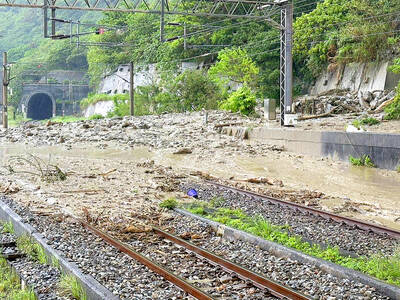
ROLLER-COASTER RIDE: More than five earthquakes ranging from magnitude 4.4 to 5.5 on the Richter scale shook eastern Taiwan in rapid succession yesterday afternoon Back-to-back weather fronts are forecast to hit Taiwan this week, resulting in rain across the nation in the coming days, the Central Weather Administration said yesterday, as it also warned residents in mountainous regions to be wary of landslides and rockfalls. As the first front approached, sporadic rainfall began in central and northern parts of Taiwan yesterday, the agency said, adding that rain is forecast to intensify in those regions today, while brief showers would also affect other parts of the nation. A second weather system is forecast to arrive on Thursday, bringing additional rain to the whole nation until Sunday, it
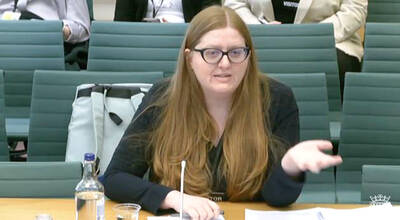
CONDITIONAL: The PRC imposes secret requirements that the funding it provides cannot be spent in states with diplomatic relations with Taiwan, Emma Reilly said China has been bribing UN officials to obtain “special benefits” and to block funding from countries that have diplomatic ties with Taiwan, a former UN employee told the British House of Commons on Tuesday. At a House of Commons Foreign Affairs Committee hearing into “international relations within the multilateral system,” former Office of the UN High Commissioner for Human Rights (OHCHR) employee Emma Reilly said in a written statement that “Beijing paid bribes to the two successive Presidents of the [UN] General Assembly” during the two-year negotiation of the Sustainable Development Goals. Another way China exercises influence within the UN Secretariat is
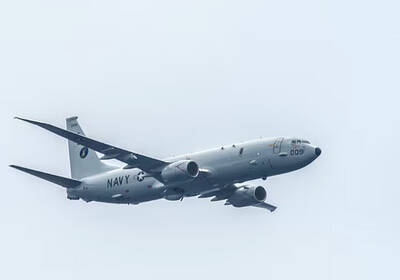
CHINA REACTS: The patrol and reconnaissance plane ‘transited the Taiwan Strait in international airspace,’ the 7th Fleet said, while Taipei said it saw nothing unusual The US 7th Fleet yesterday said that a US Navy P-8A Poseidon flew through the Taiwan Strait, a day after US and Chinese defense heads held their first talks since November 2022 in an effort to reduce regional tensions. The patrol and reconnaissance plane “transited the Taiwan Strait in international airspace,” the 7th Fleet said in a news release. “By operating within the Taiwan Strait in accordance with international law, the United States upholds the navigational rights and freedoms of all nations.” In a separate statement, the Ministry of National Defense said that it monitored nearby waters and airspace as the aircraft
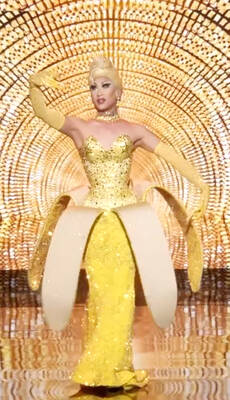
Taiwan’s first drag queen to compete on the internationally acclaimed RuPaul’s Drag Race, Nymphia Wind (妮妃雅), was on Friday crowned the “Next Drag Superstar.” Dressed in a sparkling banana dress, Nymphia Wind swept onto the stage for the final, and stole the show. “Taiwan this is for you,” she said right after show host RuPaul announced her as the winner. “To those who feel like they don’t belong, just remember to live fearlessly and to live their truth,” she said on stage. One of the frontrunners for the past 15 episodes, the 28-year-old breezed through to the final after weeks of showcasing her unique


 RSS
RSS