


US President George W. Bush told Americans he would send over 20,000 more US troops to halt Iraq's collapse into civil war but many Iraqis -- and the president's opponents in Congress -- doubted the increase could do much good.
Many saw the surge in troops as a desperate move that would only increase the US' failures in Iraq and could deepen the sectarian divides in the war-fractured country, leading to more bloodshed.
"To step back now would force a collapse of the Iraqi government, tear that country apart and result in mass killings on an unimaginable scale," Bush said in a televised address, responding to calls for him to start a gradual withdrawal.
As voters questioned the value of adding to the 3,000 US troops killed in Iraq, Bush said the Iraqi government must keep promises to rein in militants on all sides to retain US backing -- restating a condition some analysts see as pre-emptively shifting responsibility for any future failure to end bloodshed.
"America's commitment is not open-ended," said Bush, whose own term, indelibly marked by the Iraq war, ends in two years.
"If the Iraqi government does not follow through on its promises it will lose the support of the American people," he said, making a rare acknowledgment of past errors. "The year ahead will demand more patience, sacrifice and resolve."
Iraqi Prime Minister Nuri al-Maliki has vowed to lead the new Baghdad security operation and indicated it would strike not only insurgents from former president Saddam Hussein's once dominant Sunni minority but also militias loyal to fellow Shiites -- a key demand of Washington and Sunnis, who say Iran is backing Shiite gunmen.
Responses to the latest plan highlighted sectarian divides, with Sunnis hoping for the best and many Shiites increasingly resentful of the presence of the US who overthrew Saddam.
Bush renewed complaints about the role of Syria and Shiite Iran in Iraq and US troops raided an Iranian consular office in the Iraqi Kurdish city of Arbil overnight, arresting five Iranians in the second such operation in the past month.
OPPOSITION
Bush's Democratic opponents, now controlling Congress, vowed to resist but are unlikely to block a four-month phased increase.
"We are in a hole in Iraq and the president says that the way out is to dig deeper. Does that make sense?" Democrat Senator Barbara Mikulski said.
"Bush is a prisoner of his own dreams," a leading clerical official for Iraqi Sunnis said.
"The American president is ignoring the dangerous political reality in Iraq," Mohammed Bashar al-Fhaidi told al-Arabiya television, saying Shiite leaders were pursuing a sectarian course to shut out the Sunnis. "Those ruling today have taken the path of exclusion."
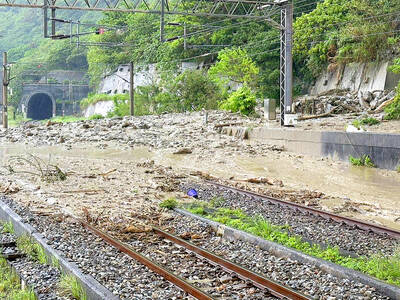
ROLLER-COASTER RIDE: More than five earthquakes ranging from magnitude 4.4 to 5.5 on the Richter scale shook eastern Taiwan in rapid succession yesterday afternoon Back-to-back weather fronts are forecast to hit Taiwan this week, resulting in rain across the nation in the coming days, the Central Weather Administration said yesterday, as it also warned residents in mountainous regions to be wary of landslides and rockfalls. As the first front approached, sporadic rainfall began in central and northern parts of Taiwan yesterday, the agency said, adding that rain is forecast to intensify in those regions today, while brief showers would also affect other parts of the nation. A second weather system is forecast to arrive on Thursday, bringing additional rain to the whole nation until Sunday, it
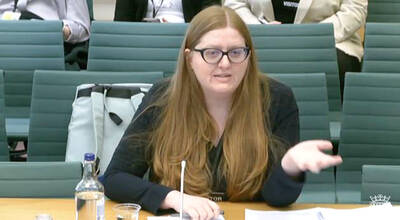
CONDITIONAL: The PRC imposes secret requirements that the funding it provides cannot be spent in states with diplomatic relations with Taiwan, Emma Reilly said China has been bribing UN officials to obtain “special benefits” and to block funding from countries that have diplomatic ties with Taiwan, a former UN employee told the British House of Commons on Tuesday. At a House of Commons Foreign Affairs Committee hearing into “international relations within the multilateral system,” former Office of the UN High Commissioner for Human Rights (OHCHR) employee Emma Reilly said in a written statement that “Beijing paid bribes to the two successive Presidents of the [UN] General Assembly” during the two-year negotiation of the Sustainable Development Goals. Another way China exercises influence within the UN Secretariat is
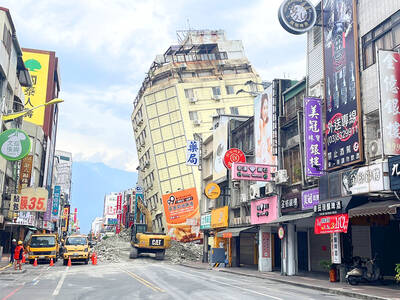
LANDSLIDES POSSIBLE: The agency advised the public to avoid visiting mountainous regions due to more expected aftershocks and rainfall from a series of weather fronts A series of earthquakes over the past few days were likely aftershocks of the April 3 earthquake in Hualien County, with further aftershocks to be expected for up to a year, the Central Weather Administration (CWA) said yesterday. Based on the nation’s experience after the quake on Sept. 21, 1999, more aftershocks are possible over the next six months to a year, the agency said. A total of 103 earthquakes of magnitude 4 on the local magnitude scale or higher hit Hualien County from 5:08pm on Monday to 10:27am yesterday, with 27 of them exceeding magnitude 5. They included two, of magnitude

Taiwan’s first drag queen to compete on the internationally acclaimed RuPaul’s Drag Race, Nymphia Wind (妮妃雅), was on Friday crowned the “Next Drag Superstar.” Dressed in a sparkling banana dress, Nymphia Wind swept onto the stage for the final, and stole the show. “Taiwan this is for you,” she said right after show host RuPaul announced her as the winner. “To those who feel like they don’t belong, just remember to live fearlessly and to live their truth,” she said on stage. One of the frontrunners for the past 15 episodes, the 28-year-old breezed through to the final after weeks of showcasing her unique


 RSS
RSS