


Staff Reporters
The Cabinet's decision to allow the nation's chipmakers to apply to manufacture chips in China using more advanced technology drew criticism from the pan-green camp yesterday, while the pan-blue camp applauded the announcement.
Former president Lee Teng-hui (李登輝) criticized the government loosening regulations on investment in China as "dealing with problems on an ad hoc basis."
"After [manufacturing] technologies Taiwan has developed over the past 50 years are taken to factories in China, they [Chinese manufacturers] will acquire [the technology] one day," Lee said during a lecture at the Lee Teng-hui Academy yesterday.
"Once they learn the skills, some traditional [Taiwanese] industries will not be able to survive [in China] and have to come back to Taiwan," Lee added.
Lee told the academy that he was against the policy, adding that the nation could lose its "substance and opportunity" as capital will be taken to China rather than coming to Taiwan.
Lee's fierce criticism came after the Ministry of Economic Affairs (MOEA) and the Mainland Affairs Council announced on Friday that Taiwanese chipmakers would be able to apply for permission to make chips with 0.18-micron processing technology in China instead of continuing to use the old 0.25-micron processing technology.
The new policy will influence Taiwanese chip manufacturers' investments in China, such as those by the world's biggest chipmaker, Taiwan Semiconductor Manufacturing Co.
The policy was first proposed by former premier Frank Hsieh (謝長廷) during his term as premier last year, but was not approved by the government at the time.
Hsieh yesterday said he could not comment on the news because he was not the premier anymore.
He said, however, that the policy had not been approved by the government in the past because he was "not fully authorized" by the president, without elaborating.
The Taiwan Solidarity Union (TSU) did not welcome the change in policy.
TSU Legislator Huang Chung-yung (黃宗源) said the party was against the policy because the government does not have sound measures to protect manufacturing technologies taken to China.
He said he feared unemployment could worsen if Taiwanese chipmakers' supply chains also move to China, adding that the caucus could boycott related budgets proposed by the MOEA.
TSU Legislator Lo Chih-ming (羅志明) said he felt President Chen Shui-bian (陳水扁) and Premier Su Tseng-chang (蘇貞昌) were "dancing the tango."
"Otherwise, Chen would not have slated Su to oversee that policy change," he said.
Chinese Nationalist Party Lawmaker Tseng Yung-chuan (曾永權) called the policy a "late justice," saying that the government's earlier strict policy of investment in China was a "failure."
He urged the government to accelerate the relaxing of other regulations for Taiwanese investment in China as it would be beneficial to the nation.
Premier Su Tseng-chang (蘇貞昌) yesterday defended the Cabinet's decision, saying that the new policy would help local manufacturers retire or renew their old equipment.
"This policy will encourage more local chip manufacturers to keep their roots in Taiwan while they will be making money all over the world," Su said when approached by the press for comments yesterday.
The policy was "carefully discussed before it was announced," he said, adding that Taiwan is the world's leading chipmaker and that the government intends to keep it that way.
Asked whether the government would lift the ban prohibiting investment in China in excess of 40 percent of a company's total value, Su replied that there had been no new developments on that issue.
Minister of Economic Affairs Steve Chen (
"In the high-tech industry, Taiwan is still a leader and we shall not worry about the problem because it isn't yet a problem," he said. "This policy fits the development needs of chip manufacturers and those of Taiwanese companies, which want to make more money."
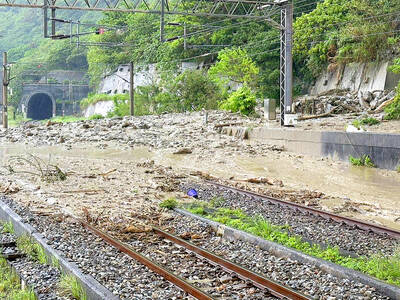
ROLLER-COASTER RIDE: More than five earthquakes ranging from magnitude 4.4 to 5.5 on the Richter scale shook eastern Taiwan in rapid succession yesterday afternoon Back-to-back weather fronts are forecast to hit Taiwan this week, resulting in rain across the nation in the coming days, the Central Weather Administration said yesterday, as it also warned residents in mountainous regions to be wary of landslides and rockfalls. As the first front approached, sporadic rainfall began in central and northern parts of Taiwan yesterday, the agency said, adding that rain is forecast to intensify in those regions today, while brief showers would also affect other parts of the nation. A second weather system is forecast to arrive on Thursday, bringing additional rain to the whole nation until Sunday, it

CONDITIONAL: The PRC imposes secret requirements that the funding it provides cannot be spent in states with diplomatic relations with Taiwan, Emma Reilly said China has been bribing UN officials to obtain “special benefits” and to block funding from countries that have diplomatic ties with Taiwan, a former UN employee told the British House of Commons on Tuesday. At a House of Commons Foreign Affairs Committee hearing into “international relations within the multilateral system,” former Office of the UN High Commissioner for Human Rights (OHCHR) employee Emma Reilly said in a written statement that “Beijing paid bribes to the two successive Presidents of the [UN] General Assembly” during the two-year negotiation of the Sustainable Development Goals. Another way China exercises influence within the UN Secretariat is
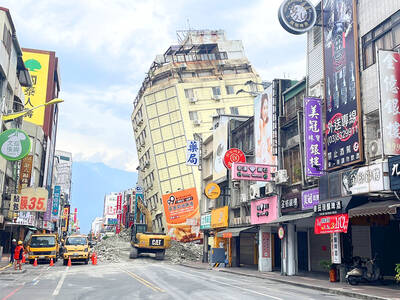
LANDSLIDES POSSIBLE: The agency advised the public to avoid visiting mountainous regions due to more expected aftershocks and rainfall from a series of weather fronts A series of earthquakes over the past few days were likely aftershocks of the April 3 earthquake in Hualien County, with further aftershocks to be expected for up to a year, the Central Weather Administration (CWA) said yesterday. Based on the nation’s experience after the quake on Sept. 21, 1999, more aftershocks are possible over the next six months to a year, the agency said. A total of 103 earthquakes of magnitude 4 on the local magnitude scale or higher hit Hualien County from 5:08pm on Monday to 10:27am yesterday, with 27 of them exceeding magnitude 5. They included two, of magnitude

Taiwan’s first drag queen to compete on the internationally acclaimed RuPaul’s Drag Race, Nymphia Wind (妮妃雅), was on Friday crowned the “Next Drag Superstar.” Dressed in a sparkling banana dress, Nymphia Wind swept onto the stage for the final, and stole the show. “Taiwan this is for you,” she said right after show host RuPaul announced her as the winner. “To those who feel like they don’t belong, just remember to live fearlessly and to live their truth,” she said on stage. One of the frontrunners for the past 15 episodes, the 28-year-old breezed through to the final after weeks of showcasing her unique


 RSS
RSS