


Lebanon's political rift deepened yesterday as a protest led by the Shiite militant group Hezbollah entered its third day, with the Western-backed government vowing to resist calls to resign.
The open-ended rally aims to bring down Prime Minister Fuad Siniora's government, which was deserted by six pro-Syrian ministers last month amid accusations of corruption and impotence after the July-August war with Israel.
Siniora and other leading lawmakers in the anti-Syrian parliament majority have pledged to maintain their elected posts as the deadlock tightens in Lebanon's fierce power struggle between pro- and anti-Syrian camps.
"Protest is no solution. I am going to stay as long as I am prime minister by the will of the majority," Siniora told reporters.
"We have to have hope," he added. "We don't know how long it [the protest] will last."
Several hundred opposition protesters from various Shiite and Christian factions camped on the doorstep of the government for a second straight night, following a mass protest on Friday calling for a new national unity government.
Thousands of people have been attending the rallies during the daytime hours, with fewer opting to sleep overnight in tents set up by Hezbollah-led organizers. Hundreds of thousands took part in Friday's march.
Traffic ground to a halt early yesterday in the center of the capital and many roads were closed as organizers staged the annual Beirut Marathon in spite of the protest.
Druze chief and anti-Syrian Member of Parliament Walid Jumblatt reiterated the government's call for a return to talks over Lebanon's tense political deadlock.
"We will be patient. When they are convinced there is no other way, when they make up their mind that only dialogue can lead to a breakthrough, then we will be ready for talks," he said.
The Siniora government has received strong public backing from Western and some Arab states, and Arab League chief Amr Mussa was set to hold talks in Beirut later yesterday to offer his services as a mediator.
The Saudi ambassador mediated between the two sides late on Friday and brokered the reopening of some access roads to Siniora's offices.
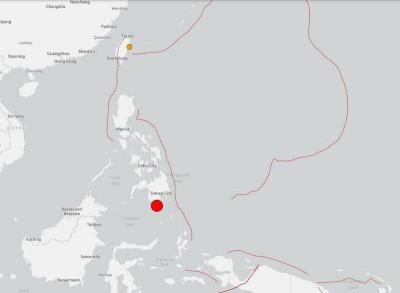
A magnitude 7.8 earthquake struck off the southern coast of Mindanao in the Philippines at 7:38am today, prompting the US Tsunami Warning System to issue an alert for neighboring countries, including Taiwan. The system issued a purple alert indicating a "tsunami threat." The potential threat zone includes Taiwan, the Philippines, Papua New Guinea, Yap and Palau. Philippine authorities were assessing the damage from the quake, with the office of civil defense seeking to verifying initial reports that 15 people had been killed and 129 injured in the region, mostly from falling debris. Arlene Hollero, disaster chief of Maasim town in the Philippines' Sarangani Province,

‘GRAY ZONE’ PRESSURE: Beijing’s activities are intended to create the deceitful impression that China has jurisdiction over the area around Taiwan, the CGA said Taiwan’s rights over its territorial waters and exclusive economic zone must not be violated by any country, the Mainland Affairs Council said yesterday, adding that it will not accept any unprovoked actions. The council issued the remarks in response to the China Coast Guard conducting maritime enforcement drills near eastern Taiwan and claiming to fully exercise China’s maritime administrative law enforcement authority. The Coast Guard Administration (CGA) has been closely monitoring the situation and is taking concrete steps to defend the nation’s sovereignty and secure its waters, the council said. China has no sovereign rights over the waters off eastern

RESILIENCE: Taiwan plays a key role in semiconductors, energy, information infrastructure and advanced manufacturing, AIT Director Raymond Greene said Taiwan’s continued investment in deterrence and resilience remains vital, especially in uncrewed systems and other emerging technologies, American Institute in Taiwan (AIT) Director Raymond Greene said yesterday. Greene made the remarks at the annual National Strategic Summit on Supply Chain Resilience held by the Research Institute for Democracy, Society and Emerging Technology (DSET), a government-backed think tank. As Taiwan last year became the US’ fourth-largest trading partner and supply chain security is becoming more important, cooperation in emerging technologies continues to deepen between the two countries, he said. The US is committed to accelerating innovation, building key infrastructure, strengthening cooperation

RIGHT DIRECTION: Taiwan’s efforts to prevent forced labor include a proposal to ‘fully prohibit’ employers from withholding workers’ documents, an official said Taiwan is to establish a mechanism to restrict imports of goods linked to forced labor, the Executive Yuan said yesterday, after the US proposed imposing additional tariffs on Taiwanese goods over labor concerns. “The Ministry of Labor and the Ministry of Economic Affairs are to establish an interministerial review procedure,” Executive Yuan spokesperson Michelle Lee (李慧芝) said at a news briefing in Taipei. “The government is to use the Foreign Trade Act [貿易法] as the legal basis to restrict imports of goods produced with forced labor” and bring its supply chain governance more in line with international standards on human rights, resilience


 RSS
RSS