


Twenty-one people aboard a Taiwanese plane were injured yesterday when it was forced to change course to avoid another aircraft while approaching South Korea's Jeju island, airline officials said.
Nineteen of them needed hospital treatment and three were still in hospital, including one with a brain hemorrhage, medical staff said.
Far Eastern Air Transport Corp said its flight FE306, which departed from Taipei at 9:04am with 129 passengers on board, responded to a collision alarm and plunged from 10,360m to 9,100m as it approached Korean airspace.
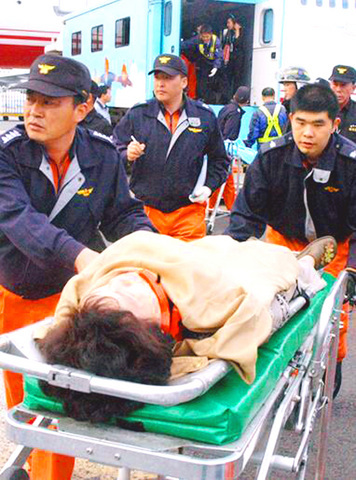
PHOTO: AP
The sudden plunge caused injury to 16 passengers and five crew members who had not fastened their safety belts.
After the plane landed on Jeju Island, the 21 injured individuals were sent to a hospital, the airline said.
Medical officials in Jeju said two people suffered fractured ribs and one had a brain hemorrhage.
Far Eastern Air Transport spokesman Chang Yu-peng (
"The pilots said they suspected that a Thai jetliner was flying nearby at the same altitude," he added, praising the pilots' "correct and proper" handling of the incident.
The pilots had no time to warn passengers of the sudden descent, Chang said.
The incident occurred shortly before the flight touched down in Jeju, he said.
As for what had caused the incident, the airlines said that more information would be provided when it becomes available.
Chang said that around half the passengers were en route to Shanghai and were transiting in South Korea.
A four-member team from South Korea's transport ministry was sent to Jeju to investigate.
"An investigation will be carried out to determine the cause of the accident by analyzing the cockpit voice recorder and flight data recorder of the aircraft and interviewing the pilots, flight attendants and passengers," ministry official Byeon Soon-cheol said.
"We don't know yet what caused the airplane to lose height so suddenly," Byeon said.
An Incheon Air Traffic Center official said the flight lost height around 50km to 60km south of Jeju.
"It is true that a Thai Airways aircraft was flying nearby," the official said, adding that the Thai plane had been bound for Bangkok after taking off from Incheon west of Seoul.
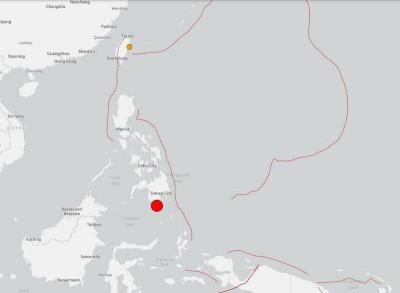
A magnitude 7.8 earthquake struck off the southern coast of Mindanao in the Philippines at 7:38am today, prompting the US Tsunami Warning System to issue an alert for neighboring countries, including Taiwan. The system issued a purple alert indicating a "tsunami threat." The potential threat zone includes Taiwan, the Philippines, Papua New Guinea, Yap and Palau. Philippine authorities were assessing the damage from the quake, with the office of civil defense seeking to verifying initial reports that 15 people had been killed and 129 injured in the region, mostly from falling debris. Arlene Hollero, disaster chief of Maasim town in the Philippines' Sarangani Province,
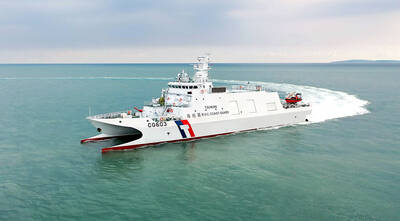
‘GRAY ZONE’ PRESSURE: Beijing’s activities are intended to create the deceitful impression that China has jurisdiction over the area around Taiwan, the CGA said Taiwan’s rights over its territorial waters and exclusive economic zone must not be violated by any country, the Mainland Affairs Council said yesterday, adding that it will not accept any unprovoked actions. The council issued the remarks in response to the China Coast Guard conducting maritime enforcement drills near eastern Taiwan and claiming to fully exercise China’s maritime administrative law enforcement authority. The Coast Guard Administration (CGA) has been closely monitoring the situation and is taking concrete steps to defend the nation’s sovereignty and secure its waters, the council said. China has no sovereign rights over the waters off eastern
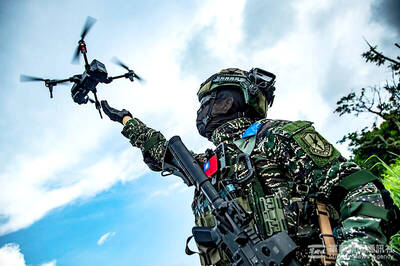
RESILIENCE: Taiwan plays a key role in semiconductors, energy, information infrastructure and advanced manufacturing, AIT Director Raymond Greene said Taiwan’s continued investment in deterrence and resilience remains vital, especially in uncrewed systems and other emerging technologies, American Institute in Taiwan (AIT) Director Raymond Greene said yesterday. Greene made the remarks at the annual National Strategic Summit on Supply Chain Resilience held by the Research Institute for Democracy, Society and Emerging Technology (DSET), a government-backed think tank. As Taiwan last year became the US’ fourth-largest trading partner and supply chain security is becoming more important, cooperation in emerging technologies continues to deepen between the two countries, he said. The US is committed to accelerating innovation, building key infrastructure, strengthening cooperation

RIGHT DIRECTION: Taiwan’s efforts to prevent forced labor include a proposal to ‘fully prohibit’ employers from withholding workers’ documents, an official said Taiwan is to establish a mechanism to restrict imports of goods linked to forced labor, the Executive Yuan said yesterday, after the US proposed imposing additional tariffs on Taiwanese goods over labor concerns. “The Ministry of Labor and the Ministry of Economic Affairs are to establish an interministerial review procedure,” Executive Yuan spokesperson Michelle Lee (李慧芝) said at a news briefing in Taipei. “The government is to use the Foreign Trade Act [貿易法] as the legal basis to restrict imports of goods produced with forced labor” and bring its supply chain governance more in line with international standards on human rights, resilience


 RSS
RSS