


The nation's de facto embassy in Washington requested the return of diplomatic papers relating to an espionage investigation involving a top US diplomat last month, according to court documents -- possibly signaling the Taiwanese government's unwillingness to cooperate with Washington in the case.
The papers relate to the US' case against Donald Keyser, former principal assistant secretary of state for East Asian and Pacific affairs, who was arrested in September 2004 on suspicion of espionage, after the FBI witnessed him handing an envelope to two Taiwanese intelligence officers, Isabella Cheng (程念慈) and Lieutenant General Huang Kuang-hsun (黃光勳).
Keyser admitted to having an affair with Cheng, but denied that he had been involved in espionage or that the Taiwanese officials had sought classified information from him.
Cheng handed over the papers that Taiwan wants returned to the FBI in 2004.
Ministry of Foreign Affairs Spokesman Michel Lu (呂慶龍) said that "he had no information" on Taiwan's request to retrieve the documents. But the Taipei Economic and Cultural Representative Office (TECRO), which represents Taiwan in Washington, felt the issue was sensitive enough that they asked for a gag order on the motion.
District of Columbia District Court Judge Paul Friedman rejected TECRO's request that the motion to return the papers be kept secret, and transferred the hearing to the court responsible for the Keyser case.
The development is the latest in a long series of twists.
Prosecutors were initially unable to establish a solid case against Keyser, and espionage charges were never brought against the 63-year-old former diplomat.
In December, he made a deal with prosecutors in which he pleaded guilty to two counts of making false official statements in connection with his relationship with Cheng, and one count of unlawfully removing classified documents, which the FBI found in his home.
Keyser faced a possible 13 years in prison, and was already awaiting sentencing when, in June, prosecutors decided to overturn the plea-bargain, saying they would seek new "espionage-related" charges against Keyser.
In support of their motion, prosecutors cited the results of two polygraph tests, which are inadmissible in most US courts as evidence because of their unreliability. Prosecutors also cited classified accusations provided by an undisclosed source, which have not been shared with Keyser, although his defense team received a summary of the evidence.
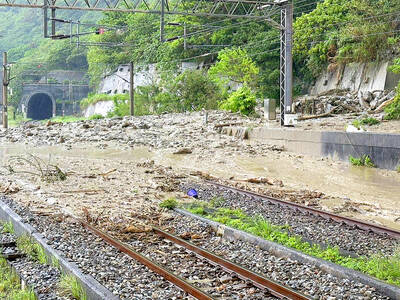
ROLLER-COASTER RIDE: More than five earthquakes ranging from magnitude 4.4 to 5.5 on the Richter scale shook eastern Taiwan in rapid succession yesterday afternoon Back-to-back weather fronts are forecast to hit Taiwan this week, resulting in rain across the nation in the coming days, the Central Weather Administration said yesterday, as it also warned residents in mountainous regions to be wary of landslides and rockfalls. As the first front approached, sporadic rainfall began in central and northern parts of Taiwan yesterday, the agency said, adding that rain is forecast to intensify in those regions today, while brief showers would also affect other parts of the nation. A second weather system is forecast to arrive on Thursday, bringing additional rain to the whole nation until Sunday, it

LANDSLIDES POSSIBLE: The agency advised the public to avoid visiting mountainous regions due to more expected aftershocks and rainfall from a series of weather fronts A series of earthquakes over the past few days were likely aftershocks of the April 3 earthquake in Hualien County, with further aftershocks to be expected for up to a year, the Central Weather Administration (CWA) said yesterday. Based on the nation’s experience after the quake on Sept. 21, 1999, more aftershocks are possible over the next six months to a year, the agency said. A total of 103 earthquakes of magnitude 4 on the local magnitude scale or higher hit Hualien County from 5:08pm on Monday to 10:27am yesterday, with 27 of them exceeding magnitude 5. They included two, of magnitude
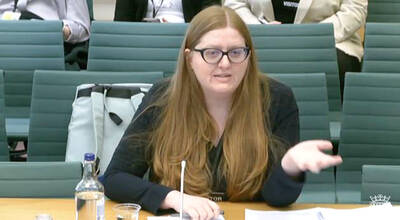
CONDITIONAL: The PRC imposes secret requirements that the funding it provides cannot be spent in states with diplomatic relations with Taiwan, Emma Reilly said China has been bribing UN officials to obtain “special benefits” and to block funding from countries that have diplomatic ties with Taiwan, a former UN employee told the British House of Commons on Tuesday. At a House of Commons Foreign Affairs Committee hearing into “international relations within the multilateral system,” former Office of the UN High Commissioner for Human Rights (OHCHR) employee Emma Reilly said in a written statement that “Beijing paid bribes to the two successive Presidents of the [UN] General Assembly” during the two-year negotiation of the Sustainable Development Goals. Another way China exercises influence within the UN Secretariat is

Taiwan’s first drag queen to compete on the internationally acclaimed RuPaul’s Drag Race, Nymphia Wind (妮妃雅), was on Friday crowned the “Next Drag Superstar.” Dressed in a sparkling banana dress, Nymphia Wind swept onto the stage for the final, and stole the show. “Taiwan this is for you,” she said right after show host RuPaul announced her as the winner. “To those who feel like they don’t belong, just remember to live fearlessly and to live their truth,” she said on stage. One of the frontrunners for the past 15 episodes, the 28-year-old breezed through to the final after weeks of showcasing her unique


 RSS
RSS