


Iran's senior nuclear negotiator said yesterday that "many misunderstandings were removed" in talks with the EU about his country's refusal to meet UN Security Council demands that it freeze uranium enrichment.
The EU's foreign policy chief, Javier Solana, agreed that progress was made in a second day of talks with Iranian top negotiator Ali Larijani, and that talks would continue next week.
"The meeting has been worth it," he said.
The two had hoped to build on reported progress in efforts to reconcile Tehran's rejection of the UN demand.
The meeting has been billed as possibly the last chance for Iran to avoid penalties for rejecting the UN Security Council's demand that it stop enriching uranium, which can be used to make nuclear weapons.
On Saturday, Larijani spoke of "good and constructive talks, and ... some progress in some areas," while Solana's spokeswoman, Cristina Gallach, described them as "constructive and positive."
The two sides have been working to see if there is common ground for negotiations between six world powers and Iran over its nuclear defiance.
While the five permanent Security Council members and Germany have demanded that Iran fully freeze enrichment as a condition for further talks, Tehran has steadfastly refused to do so.
With positions seemingly so far apart, hopes for success had been slim for the mission by Solana -- who is authorized by the six powers to carry their message and listen to the Iranians, without actually negotiating.
Still, positions appeared to have shifted slightly.
European officials, who asked for anonymity in return for sharing confidential information, suggested that at least some of the six nations were ready to listen if Iran committed itself to an enrichment freeze soon after the start of negotiations instead of as a condition for such talks.
The officials declined to provide details. But such readiness would be a blow to US-led attempts to hold fast to the demand that Iran freeze enrichment before any talks -- or face the prospect of Security Council sanctions.
One of the officials said Solana discussed the issue with US Secretary of State Condoleezza Rice before going into the meeting, but declined to offer details.
As late as Friday, US Undersecretary of State Nicholas Burns said Washington expected the Security Council to start discussing a draft on sanctions as early as next week, unless Tehran does a last-minute turn.
But there might be opposition to that within the council. Russia and China have resisted a quick move to sanctions even though they agree to them as the ultimate punishment. French Foreign Minister Philippe Douste-Blazy on Thursday appeared to suggest that the demand to stop enrichment before talks was negotiable, saying: "The question is to know at what moment this suspension takes place compared to negotiations."
He later appeared to reverse himself, saying in separate comments that "suspension ... is an absolute prerequisite for restoring trust and resuming negotiations."
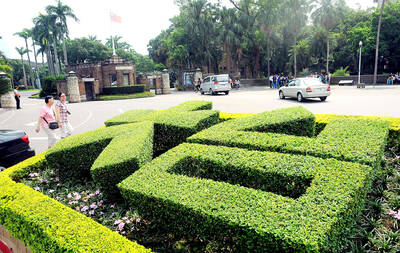
Taiwan has experienced its most significant improvement in the QS World University Rankings by Subject, data provided on Sunday by international higher education analyst Quacquarelli Symonds (QS) showed. Compared with last year’s edition of the rankings, which measure academic excellence and influence, Taiwanese universities made great improvements in the H Index metric, which evaluates research productivity and its impact, with a notable 30 percent increase overall, QS said. Taiwanese universities also made notable progress in the Citations per Paper metric, which measures the impact of research, achieving a 13 percent increase. Taiwanese universities gained 10 percent in Academic Reputation, but declined 18 percent

Chinese President Xi Jinping (習近平) yesterday met with former president Ma Ying-jeou (馬英九) at the Great Hall of the People in Beijing, with Xi’s opening statement once more emphasizing that people on both sides of the Taiwan Strait are Chinese and that foreign intervention cannot change their inevitable unification. Xi said that 5,000 years of history of zhonghua minzu (中華民族, ethnic Chinese group) have seen their ancestors move to Taiwan to establish new lives, while also documenting them fighting side-by-side against foreign forces and finally freeing Taiwan. “Both sides are Chinese,” and there are no issues that cannot be worked through, he
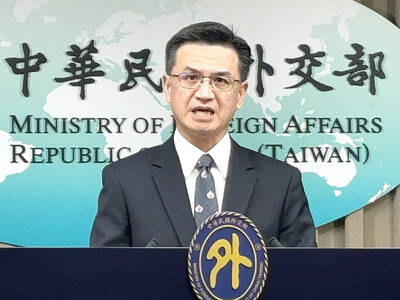
BULLY TACTICS: Beijing has continued its incursions into Taiwan’s airspace even as Xi Jinping talked about Taiwan being part of the Chinese family and nation China should stop its coercion of Taiwan and respect mainstream public opinion in Taiwan about sovereignty if its expression of goodwill is genuine, the Ministry of Foreign Affairs (MOFA) said yesterday. Ministry spokesman Jeff Liu (劉永健) made the comment in response to media queries about a meeting between former president Ma Ying-jeou (馬英九) and Chinese President Xi Jinping (習近平) the previous day. Ma voiced support for the so-called “1992 consensus,” while Xi said that although the two sides of the Taiwan Strait have “different systems,” this does not change the fact that they are “part of the same country,” and that “external
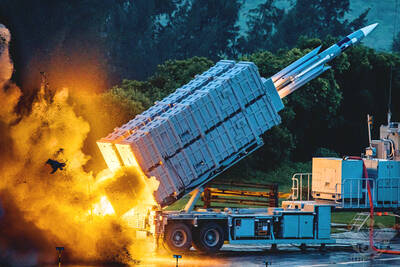
UNDER DISCUSSION: The combatant command would integrate fast attack boat and anti-ship missile groups to defend waters closest to the coastline, a source said The military could establish a new combatant command as early as 2026, which would be tasked with defending Taiwan’s territorial waters 24 nautical miles (44.4km) from the nation’s coastline, a source familiar with the matter said yesterday. The new command, which would fall under the Naval Command Headquarters, would be led by a vice admiral and integrate existing fast attack boat and anti-ship missile groups, along with the Naval Maritime Surveillance and Reconnaissance Command, said the source, who asked to remain anonymous. It could be launched by 2026, but details are being discussed and no final timetable has been announced, the source


 RSS
RSS