


President Chen Shui-bian (
"The cooperative programs are different from the `Jung Pang Project' (
The "Jung Pang Project" refers to the investment project worth NT$7.5 billion (US$250 million) that Chen announced during his visit to Central America in October last year. The funding is allocated to help the development of the nation's 12 allies in Central and South America.
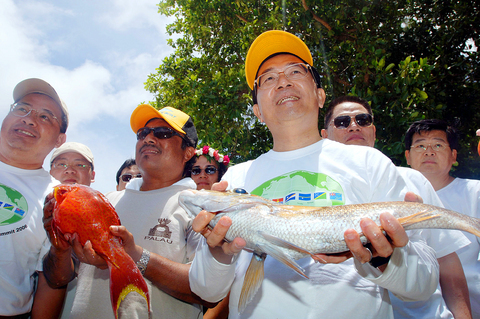
PHOTO: CNA
Chen made the remark in response to a report in yesterday's Chinese-language newspaper the China Times that Chen had promised the Solomon Islands US$10 million and the Marshall Islands US$3 million in aid during his visit.
Chen signed a cooperation declaration with the nation's six Pacific allies at the first annual Taiwan-Pacific Allies Summit, promising to work together in eight areas including law-enforcement training, digital government, tourism, health care and the protection of natural resources.
Summit members supported Chen's proposal to let him and the leaders of Palau and the Marshall Islands form a task force to implement the projects.
If necessary, Chen said that he would like to meet with his diplomatic counterparts again before next year's summit, which is scheduled to be held in Majuro, Marshall Islands.
Chen said that the administration used to focus solely on bilateral ties with its diplomatic allies, but now it wanted to build multilateral ties.
Chen dismissed speculation that the summit had been organized in response to similar meetings held by China, Japan and France earlier this year. He said the summit met the needs of the nation's Pacific allies.
Despite the pressure exerted by China, Chen said that Fiji, which recognizes China, sent an observer to the summit, but Australia and New Zealand bowed out due to China's pressure.
"China's suppression of our diplomatic space is ubiquitous," he said. "We are different from them because we don't write blank checks. Instead, we offer practical and useful programs designed to solve their problems."
Chen said that he could not see the nation's Pacific allies switching ties in the foreseeable future, but that his administration would carefully manage relations with them and other diplomatic partners.
Chen said that he planned to attend an African summit in Malawi by the end of the year, despite Chad switching its allegiance to China last month. While details of the meeting are still being arranged, Chen said he believed that the nation's five African allies would attend. Taipei will also host the sixth Central America summit next year.
When asked about relations with the US, Chen said they remained good and had not been affected by this trip. The trip was made more significant by his use of "Air Force One" on the first leg of the three-day journey.
Chen said that he had decided not to skip a transit stop in Guam on his return journey because he did not want to disappoint the US government, which had been notified of the stopover plan.
"It would be rude not to go there after we notified them of the plan," he said. "It wouldn't be nice to do [that] more than once."
Chen was referring to the transit controversy ahead of his last overseas trip to Latin America. During his nine-day trip to South American allies, Chen's plane was diverted in mid-air and he visited five countries not on his original schedule, while skipping a stopover in the US. The move deepened a spat with the US and put two of his hosts in hot water with China.
Chen spent most of yesterday morning fishing. He and Palauan President Tommy Remengesau Jr. won the Fish Derby, catching 30 ocean water fish weighing 11.3kg.
They were followed by Marshall Islands President Kessai Note and Tuvalu President Apisai Ielemia, who caught 9.5kg of fish. Note was the first to catch a fish.
The second runner-up was Solomon Islands President Manasseh Sogavare and Nauru President Ludwig Scotty, who caught 19 pounds of fish.
Wives of the leaders caught 12.2kg of fish, but they did not get a trophy because they did not enter the contest.
In a meeting with Taiwanese reporters yesterday -- which ran almost 140 minutes -- Chen took 26 questions, including those about the controversies over the Presidential Office's special allowance fund, first lady Wu Shu-jen's (吳淑珍) use of Sogo Department Store vouchers and his in-laws.
Chen said he believed the truth of the controversies would come out soon.
Chen said "none of the money [from the Presidential Office's special allowance fund] went to my own pocket."
"As prosecutors are investigating the case, I cannot comment on the details. The Presidential Office and I will continue to respect the judicial investigation and fully cooperate," he said.
On controversy over the first family's asset declaration, including Wu's jewelry and watches, Chen said the declaration was filed in accordance with the law and they had corrected the declaration as requested by the Control Yuan.
Since the law does not require Wu to say who has lent her pieces of jewelry, Chen said he and Wu would protect the privacy of the lenders.
"In response to questions on whether he planned to step down, Chen said he will not shirk any responsibility that he should shoulder, but “for me to assume the responsibilities that are not mine is far from necessary. I don't think I need to act as if I am morally better than others.”
“People can try to topple me, but they can't try to topple Taiwan. Now people are supporting me and encouraging me. Instead of protecting me, I would rather they protect Taiwan — protect its democracy, rule of law and constitutional system,” Chen said."
During an interview with Fuji TV yesterday morning, Chen said that he would like to invite Japanese Prime Minister Junichiro Koizumi to attend the opening of Taiwan's high-speed railway next month.
Chen said Taiwan wanted to express its gratitude to Japan for the assistance, since the system uses Shinkansen technology.
Calling Shinzo Abe his “good friend,” Chen said that many polls have placed Abe ahead of other candidates vying for Japan's next prime minister. Chen said that he believed Abe would win the Sept. 20 contest for president of the ruling party, a post that virtually guarantees election as prime minister.
During his four-hour visit in Guam today, Chen is scheduled to meet with American Institute in Taiwan (AIT) Chairman Raymond Burghardt and other officials and expatriates.
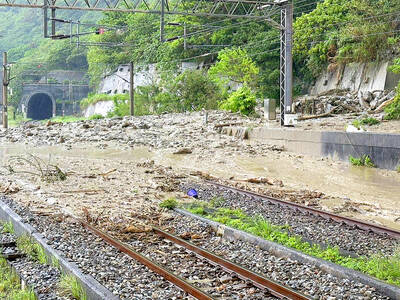
ROLLER-COASTER RIDE: More than five earthquakes ranging from magnitude 4.4 to 5.5 on the Richter scale shook eastern Taiwan in rapid succession yesterday afternoon Back-to-back weather fronts are forecast to hit Taiwan this week, resulting in rain across the nation in the coming days, the Central Weather Administration said yesterday, as it also warned residents in mountainous regions to be wary of landslides and rockfalls. As the first front approached, sporadic rainfall began in central and northern parts of Taiwan yesterday, the agency said, adding that rain is forecast to intensify in those regions today, while brief showers would also affect other parts of the nation. A second weather system is forecast to arrive on Thursday, bringing additional rain to the whole nation until Sunday, it
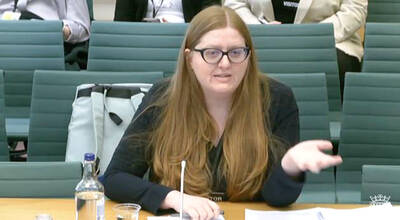
CONDITIONAL: The PRC imposes secret requirements that the funding it provides cannot be spent in states with diplomatic relations with Taiwan, Emma Reilly said China has been bribing UN officials to obtain “special benefits” and to block funding from countries that have diplomatic ties with Taiwan, a former UN employee told the British House of Commons on Tuesday. At a House of Commons Foreign Affairs Committee hearing into “international relations within the multilateral system,” former Office of the UN High Commissioner for Human Rights (OHCHR) employee Emma Reilly said in a written statement that “Beijing paid bribes to the two successive Presidents of the [UN] General Assembly” during the two-year negotiation of the Sustainable Development Goals. Another way China exercises influence within the UN Secretariat is
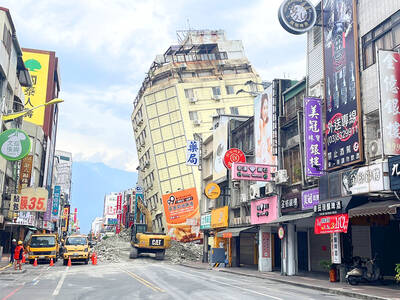
LANDSLIDES POSSIBLE: The agency advised the public to avoid visiting mountainous regions due to more expected aftershocks and rainfall from a series of weather fronts A series of earthquakes over the past few days were likely aftershocks of the April 3 earthquake in Hualien County, with further aftershocks to be expected for up to a year, the Central Weather Administration (CWA) said yesterday. Based on the nation’s experience after the quake on Sept. 21, 1999, more aftershocks are possible over the next six months to a year, the agency said. A total of 103 earthquakes of magnitude 4 on the local magnitude scale or higher hit Hualien County from 5:08pm on Monday to 10:27am yesterday, with 27 of them exceeding magnitude 5. They included two, of magnitude

Taiwan’s first drag queen to compete on the internationally acclaimed RuPaul’s Drag Race, Nymphia Wind (妮妃雅), was on Friday crowned the “Next Drag Superstar.” Dressed in a sparkling banana dress, Nymphia Wind swept onto the stage for the final, and stole the show. “Taiwan this is for you,” she said right after show host RuPaul announced her as the winner. “To those who feel like they don’t belong, just remember to live fearlessly and to live their truth,” she said on stage. One of the frontrunners for the past 15 episodes, the 28-year-old breezed through to the final after weeks of showcasing her unique


 RSS
RSS