


The Chinese Nationalist Party (KMT), which has been attacked over its stolen wealth, released a report on its assets yesterday, acknowledging its previous failure to explain the issue transparently while promising to put future assets into trust and stop operating for-profit corporations.
Despite acknowledging that the asset-acquiring procedures had lacked legitimacy and caused a negative public impression, KMT Chairman Ma Ying-jeou (
"It happened during a special period, so there's no point in being too critical about it," Ma said.
"This issue can't be explained under normal circumstances, but I promise to maintain a clear separation of party, state and government in the future. This is our pledge, and the first step to the KMT's rebirth," he said.
The KMT report, entitled "Bidding farewell to the past and explaining to the people," claims to reveal the total value of the party's assets and how they have been handled under different chairmen dating back to Chiang Kai-shek (蔣介石).
According to the report, which KMT Deputy Secretary-General Chang Che-chen (
This makes Ma the poorest chairman, compared with former chairman Lee Teng-hui (
While claiming that Lee Teng-hui, who served as KMT chairman from 1988 to 2000, was responsible for losses amounting to NT$42.7 billion because of bad domestic and foreign investments, the report gave the former chairman some credit for making the biggest profit and bringing assets' value to their peak of NT$91.8 billion in 1998.
"Although the bad investments happened under Lee Teng-hui's chairmanship, he was not the decision-maker in all of the deals, and so it would be unfair to blame him for the entire loss," Chang said yesterday at the party headquarters.
Chang said Lee Teng-hui had actually come up with most of the solutions to the bad investments made under his chairmanship.
The KMT deputy secretary-general said that the KMT would inquire into the legal responsibility of those responsible for the bad investments and request compensation for the party's losses.
Dividing the historical background of the assets into three periods, the report acknowledged that the KMT had used its "own discretion" in handling the assets in the first period -- the "one-party state" regime of Chiang Kai-shek and his son Chiang Ching-kuo (
The second period, from 1988 to 2000, which includes Lee's chairmanship, was labeled as a time when the KMT began to seek cooperation with private business. Investments in stock markets and real estate during the period sparked controversies over the party's involvement in corruption scandals, the report said.
After Lien took over the chairmanship in 2000, the KMT lost its position as governing party to the Democratic Progressive Party and began to "face the asset issue honestly," as both Lien and Ma prioritized the clean-up of party assets.
Under Ma's chairmanship, the KMT has sold five party assets, including its Policy Research and Development department, three media outlets and the party's former headquarters, for a total of NT$11.4 billion.
Most of the income, Chang said, was used to pay pensions amounting to NT$1.6 billion and other personnel fees.
In response to accusations from the Executive Yuan and Examination Yuan that the KMT had only returned 25 pieces of land it had received free from local governments, and demands that it should return 19 movie theaters inherited from the Japanese colonial period, Chang said that the KMT had acquired all of the real estate and theaters legally.
"We gave 56 pieces of land back to the local governments, not 25 ... We returned the plots of land not because they had been illegally acquired, but as a positive response to public expectations," Chang said.
Lee Yung-jan said that the KMT had only directly operated five of the 19 theaters, and would return the total value of NT$300 million to the government.
Looking ahead, the KMT's current priority is to sell its Central Investment Corporation, the party's major asset with the highest value at about NT$2.3 billion, to ease its financial burdens, Chang said.
The money will be pumped into its retirement fund, which includes an annual pension budget of NT$2 billion for 900 party workers and a further NT$900 million for 900 retirees.
While approving the party's efforts to make its assets public, members of the Central Standing Committee said that the KMT should not apologize over the issue, but urged the party to put the assets into trust and withdraw from all private investments.
"The assets will remain an issue even after we publish the report ... The question is whether a political party should have assets," KMT Legislator Lu Shiow-yen (
KMT Legislator Huang Chao-shun (
KMT Legislator John Chiang (
"The KMT's management of the assets during the party-state period made a contribution to the country ... We don't need to explain anything," he said.
Pledging to sell the Central Investment Corporation before 2008, Ma promised that the KMT would put the remaining assets into trust.
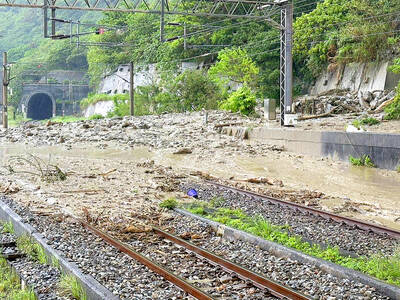
ROLLER-COASTER RIDE: More than five earthquakes ranging from magnitude 4.4 to 5.5 on the Richter scale shook eastern Taiwan in rapid succession yesterday afternoon Back-to-back weather fronts are forecast to hit Taiwan this week, resulting in rain across the nation in the coming days, the Central Weather Administration said yesterday, as it also warned residents in mountainous regions to be wary of landslides and rockfalls. As the first front approached, sporadic rainfall began in central and northern parts of Taiwan yesterday, the agency said, adding that rain is forecast to intensify in those regions today, while brief showers would also affect other parts of the nation. A second weather system is forecast to arrive on Thursday, bringing additional rain to the whole nation until Sunday, it
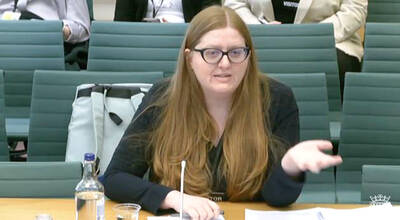
CONDITIONAL: The PRC imposes secret requirements that the funding it provides cannot be spent in states with diplomatic relations with Taiwan, Emma Reilly said China has been bribing UN officials to obtain “special benefits” and to block funding from countries that have diplomatic ties with Taiwan, a former UN employee told the British House of Commons on Tuesday. At a House of Commons Foreign Affairs Committee hearing into “international relations within the multilateral system,” former Office of the UN High Commissioner for Human Rights (OHCHR) employee Emma Reilly said in a written statement that “Beijing paid bribes to the two successive Presidents of the [UN] General Assembly” during the two-year negotiation of the Sustainable Development Goals. Another way China exercises influence within the UN Secretariat is
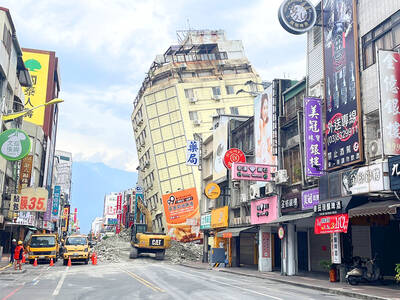
LANDSLIDES POSSIBLE: The agency advised the public to avoid visiting mountainous regions due to more expected aftershocks and rainfall from a series of weather fronts A series of earthquakes over the past few days were likely aftershocks of the April 3 earthquake in Hualien County, with further aftershocks to be expected for up to a year, the Central Weather Administration (CWA) said yesterday. Based on the nation’s experience after the quake on Sept. 21, 1999, more aftershocks are possible over the next six months to a year, the agency said. A total of 103 earthquakes of magnitude 4 on the local magnitude scale or higher hit Hualien County from 5:08pm on Monday to 10:27am yesterday, with 27 of them exceeding magnitude 5. They included two, of magnitude
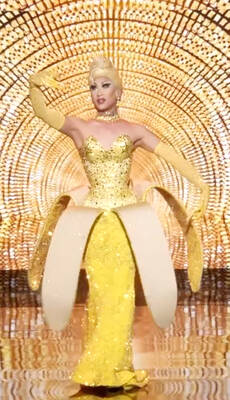
Taiwan’s first drag queen to compete on the internationally acclaimed RuPaul’s Drag Race, Nymphia Wind (妮妃雅), was on Friday crowned the “Next Drag Superstar.” Dressed in a sparkling banana dress, Nymphia Wind swept onto the stage for the final, and stole the show. “Taiwan this is for you,” she said right after show host RuPaul announced her as the winner. “To those who feel like they don’t belong, just remember to live fearlessly and to live their truth,” she said on stage. One of the frontrunners for the past 15 episodes, the 28-year-old breezed through to the final after weeks of showcasing her unique


 RSS
RSS