


US Secretary of State Condoleezza Rice headed back to the Middle East yesterday to try to broker an end to the bloody Lebanon conflict, but Israel flatly rejected a UN appeal for a three-day truce to allow in desperately needed humanitarian aid.
Israel launched a new wave of air strikes against Lebanon, refusing to set a date for ending its 18-day-old war on Hezbollah that has left hundreds of people dead, and made hundreds of thousands homeless.
"We cannot accept a ceasefire with Hezbollah because this terrorist organization would exploit it to gather civilians to use them as a human shield in the combat zone," senior foreign ministry official Gideon Meir said.
UN humanitarian coordinator Jan Egeland had appealed for a truce between Israel and the Shiite militant group to allow casualties to be removed and food and medicine to be sent into the war zone.
Meir said Israeli Prime Minister Ehud Olmert had already agreed to set up humanitarian corridors, although aid groups have complained they have little access to south Lebanon which has borne the brunt of the Israeli onslaught.
En route to Jerusalem for the second time in a week, Rice said she was expecting a "fairly intense" round of talks with "give and take" on both sides, but that she was encouraged by progress on some fronts.
Rice hailed as a "positive step" a Lebanese Cabinet agreement on a ceasefire plan outlined by Prime Minister Fuad Siniora which calls for a prisoner exchange and for the government to assert its sovereignty over the Hezbollah-controlled south.
Israel however, continued to pound Hezbollah targets, including a missile launch pad it suspected was used to fire a new type of missile that landed in Afula, 50km south of the border, the deepest strike into Israel since the conflict began.
The army said six soldiers were wounded in the battle for the key Lebanese border town of Bint Jbeil, a Hezbollah stronghold that has been the scene of the deadliest combat between Israeli troops and Shiite Muslim guerrillas.
Israel, which last week lost nine soldiers in fighting around Bint Jbeil and a neighboring village in its biggest single-day death toll of the conflict, said on Friday that it had killed 26 Hezbollah fighters.
Tanks and armored vehicles pulled back from Bint Jbeil yesterday towards Marun Al-Ras, a strategic hilltop village closer to the border that Israeli forces captured last weekend, Lebanese police said.
US President George W. Bush said that Rice would "work with Israel and Lebanon to come up with an acceptable UN Security Council resolution that we can table next week."
Bush and his staunchest ally, British Prime Minister Tony Blair, held talks in Washington on a plan to end the crisis, isolate Hezbollah and its backers Iran and Syria, and set the stage for a long-term solution.
Blair said world powers would meet at UN headquarters tomorrow to discuss the possible deployment of a multinational stabilization force in Lebanon, which is under the deadliest Israeli onslaught in a quarter century.
But despite pledging aid for Lebanon, they again refused to call for an immediate ceasefire to stop Israel's offensive which has left Lebanese infrastructure in tatters.
The two leaders also warned Israel's arch-foes Syria and Iran that they must become "proper and responsible members of the international community" or face "the risk of increasing confrontation."
Egeland cited Lebanese health ministry figures saying that more than 600 people had been killed since Israel launched its offensive on July 12 following Hezbollah's capture of two soldiers in a deadly cross-border raid.
He said at least one third of the casualties were children.
"There is something fundamentally wrong with a war where there are more dead children than armed men. That has to stop," he said.
Israel has ordered the mobilization of thousands of army reservists to bolster its assault and decided to step up its air war.
The government said it plans to create a narrow buffer zone in Lebanon until the mooted international force is deployed, but will restrict ground offensives and has no plans to reoccupy its northern neighbor.
Israel had seized on the failure of an international conference in Rome last week to call for a quick truce as a green light to press on with its offensive.
But that claim was dismissed on Friday as "outrageous" by Washington, in its strongest open criticism of Israel yet.
With no sign of a let-up in violence, Hezbollah militants gave a new display of their firepower on Friday. The rebels launched a new "Khaibar I" missile that Israel said was capable of carrying 100kg of explosives.
Hezbollah leader Hassan Nasrallah, who declared "open war" on Israel after his home and headquarters were destroyed, warned that his guerrillas would fire missiles beyond the northern port city of Haifa, which has faced a barrage of deadly rocket fire since the conflict began.
The Israeli military said it would deploy Patriot anti-missile batteries near the capital Tel Aviv if Hezbollah were to use long-range missiles.
Army chief Dan Halutz on Thursday claimed that "enormous" damage had been inflicted on Hezbollah.
With 800,000 people displaced by the fighting, the International Committee of the Red Cross criticized the "unacceptable" humanitarian situation in Lebanon and said Israel had to do much more to spare civilians.
International medical charity Medecins Sans Frontieres said Israel's promised aid corridors were an illusion.
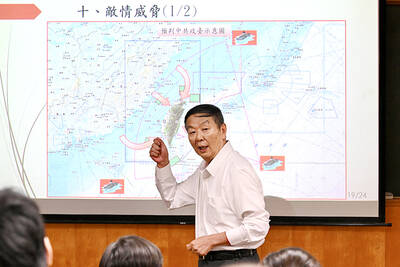
RETHINK? The defense ministry and Navy Command Headquarters could take over the indigenous submarine project and change its production timeline, a source said Admiral Huang Shu-kuang’s (黃曙光) resignation as head of the Indigenous Submarine Program and as a member of the National Security Council could affect the production of submarines, a source said yesterday. Huang in a statement last night said he had decided to resign due to national security concerns while expressing the hope that it would put a stop to political wrangling that only undermines the advancement of the nation’s defense capabilities. Taiwan People’s Party Legislator Vivian Huang (黃珊珊) yesterday said that the admiral, her older brother, felt it was time for him to step down and that he had completed what he

ROLLER-COASTER RIDE: More than five earthquakes ranging from magnitude 4.4 to 5.5 on the Richter scale shook eastern Taiwan in rapid succession yesterday afternoon Back-to-back weather fronts are forecast to hit Taiwan this week, resulting in rain across the nation in the coming days, the Central Weather Administration said yesterday, as it also warned residents in mountainous regions to be wary of landslides and rockfalls. As the first front approached, sporadic rainfall began in central and northern parts of Taiwan yesterday, the agency said, adding that rain is forecast to intensify in those regions today, while brief showers would also affect other parts of the nation. A second weather system is forecast to arrive on Thursday, bringing additional rain to the whole nation until Sunday, it

CONDITIONAL: The PRC imposes secret requirements that the funding it provides cannot be spent in states with diplomatic relations with Taiwan, Emma Reilly said China has been bribing UN officials to obtain “special benefits” and to block funding from countries that have diplomatic ties with Taiwan, a former UN employee told the British House of Commons on Tuesday. At a House of Commons Foreign Affairs Committee hearing into “international relations within the multilateral system,” former Office of the UN High Commissioner for Human Rights (OHCHR) employee Emma Reilly said in a written statement that “Beijing paid bribes to the two successive Presidents of the [UN] General Assembly” during the two-year negotiation of the Sustainable Development Goals. Another way China exercises influence within the UN Secretariat is
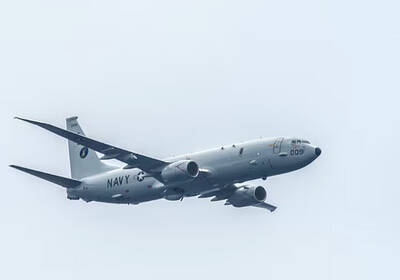
CHINA REACTS: The patrol and reconnaissance plane ‘transited the Taiwan Strait in international airspace,’ the 7th Fleet said, while Taipei said it saw nothing unusual The US 7th Fleet yesterday said that a US Navy P-8A Poseidon flew through the Taiwan Strait, a day after US and Chinese defense heads held their first talks since November 2022 in an effort to reduce regional tensions. The patrol and reconnaissance plane “transited the Taiwan Strait in international airspace,” the 7th Fleet said in a news release. “By operating within the Taiwan Strait in accordance with international law, the United States upholds the navigational rights and freedoms of all nations.” In a separate statement, the Ministry of National Defense said that it monitored nearby waters and airspace as the aircraft


 RSS
RSS