


"Should we stay or should we go?"
That was the question facing the remaining nine members of the National Communications Commission (NCC) last weekend, after the Council of Grand Justices ruled that the law establishing the commission was unconstitutional.
Yesterday, the nine members came to a unanimous decision that they would stay, on one condition: That the Organic Law of the National Communications Commission (
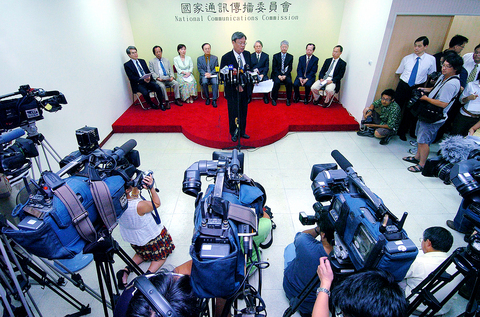
PHOTO: CHEN TSE-MING, TAIPEI TIMES
"All nine of us will step down along with the legislators who approved the appointment of the NCC members regardless of whether the administration has finished amending the law by then," said NCC Chairman Su Yeong-ching (
When asked about his rationale, Su said that the commission felt the need to pressure legislators. The commission, he said, will refuse to play along if the administration and the legislature cannot change the law by that deadline.
The grand justices' ruling had provided a longer grace period for the amendment of the law, allowing the commission to function until the end of 2008 under the current law.
The commission was responding to the council's interpretation last Friday, which Su said was based on faulty reasoning. Su had announced then that commission members would decide by yesterday whether they would continue to serve after the ruling.
Su said that the focus of the members' considerations over the weekend was not about their own personal careers. Rather, he said, they were concerned about whether the interpretation, which has major flaws, should still allow an independent organization such as the NCC to exist and function.
Su emphasized that what dis-heartened commission members the most was the council's argument that if members were recommended by political parties, they would not be able to operate independently, and thereby would not be able to win the people's trust. That argument, he said, wasn't backed up by any evidence.
"The way for an organization to win the people's trust is to follow a strict code of self-discipline," Su said.
The interpretation has completely negated the commission's efforts over the past five months, he added.
In a written statement, the commission attempted to define its authority based on the interpretation.
The commission, the statement said, is a constitutional and independent organization. The government agencies that are now placed under the commission's administration will not be returned back to their original organizations. Moreover, other organizations have no legal authority to take over the commission's operations.
The verdicts handed down by the commission members, who can still legally exercise their authority through 2008, will continue to be legally binding both before and after the interpretation.
Su said the commission was nevertheless "devastated" by the interpretation, which he said had given commission members a sense of the "unbearable heaviness of being." Su said that the nation had come to a critical moment, when it must face the global trends of digital convergence and the withdrawal of political influence from the media and the corporations.
The commission, he said, was willing to endure the humiliation of the grand justices' interpretation, and continue to take up its challenging tasks. Otherwise, the entire society would face a "dark age" in the telecommunications industry.
Su noted that society cannot afford to allow the government to become the biggest shareholder in firms that dominate the market, because it lacks the necessary expertise and capacity to effect long-term change in the industry.
Despite the interpretation, the commission has received support from industry heavyweights for continuing its operations. In a press conference last Saturday, some have warned the members' dismissal will have a direct impact on the trillion-dollar industry.
Su also urged the Executive Yuan to quickly pass the budget allotted for the commission and facilitate the transfer of new agencies to the commission.
also see story:
NCC members' decision sows discord

ROLLER-COASTER RIDE: More than five earthquakes ranging from magnitude 4.4 to 5.5 on the Richter scale shook eastern Taiwan in rapid succession yesterday afternoon Back-to-back weather fronts are forecast to hit Taiwan this week, resulting in rain across the nation in the coming days, the Central Weather Administration said yesterday, as it also warned residents in mountainous regions to be wary of landslides and rockfalls. As the first front approached, sporadic rainfall began in central and northern parts of Taiwan yesterday, the agency said, adding that rain is forecast to intensify in those regions today, while brief showers would also affect other parts of the nation. A second weather system is forecast to arrive on Thursday, bringing additional rain to the whole nation until Sunday, it

CONDITIONAL: The PRC imposes secret requirements that the funding it provides cannot be spent in states with diplomatic relations with Taiwan, Emma Reilly said China has been bribing UN officials to obtain “special benefits” and to block funding from countries that have diplomatic ties with Taiwan, a former UN employee told the British House of Commons on Tuesday. At a House of Commons Foreign Affairs Committee hearing into “international relations within the multilateral system,” former Office of the UN High Commissioner for Human Rights (OHCHR) employee Emma Reilly said in a written statement that “Beijing paid bribes to the two successive Presidents of the [UN] General Assembly” during the two-year negotiation of the Sustainable Development Goals. Another way China exercises influence within the UN Secretariat is

LANDSLIDES POSSIBLE: The agency advised the public to avoid visiting mountainous regions due to more expected aftershocks and rainfall from a series of weather fronts A series of earthquakes over the past few days were likely aftershocks of the April 3 earthquake in Hualien County, with further aftershocks to be expected for up to a year, the Central Weather Administration (CWA) said yesterday. Based on the nation’s experience after the quake on Sept. 21, 1999, more aftershocks are possible over the next six months to a year, the agency said. A total of 103 earthquakes of magnitude 4 on the local magnitude scale or higher hit Hualien County from 5:08pm on Monday to 10:27am yesterday, with 27 of them exceeding magnitude 5. They included two, of magnitude

Taiwan’s first drag queen to compete on the internationally acclaimed RuPaul’s Drag Race, Nymphia Wind (妮妃雅), was on Friday crowned the “Next Drag Superstar.” Dressed in a sparkling banana dress, Nymphia Wind swept onto the stage for the final, and stole the show. “Taiwan this is for you,” she said right after show host RuPaul announced her as the winner. “To those who feel like they don’t belong, just remember to live fearlessly and to live their truth,” she said on stage. One of the frontrunners for the past 15 episodes, the 28-year-old breezed through to the final after weeks of showcasing her unique


 RSS
RSS