


A new "virtual helmet" which harnesses the power of brain waves is allowing severely disabled people to feel as if they can walk and move again, opening up the prospect of using the mind to help them control wheelchairs, computers and even false limbs.
Just by imagining their feet moving, patients using wheelchairs can again experience what it feels like to stroll down a street, thanks to the work of British scientists who have found a new way of using the power of thought. They have devised the helmet which can link brain wave patterns to a virtual reality system, allowing the wearer to enter an illusory world of movement.
The new system has been tried out for the first time by an Austrian man who became a paraplegic after a swimming accident. Tom Schweiger was injured on holiday in Greece seven years ago when a wave swept him on to rocks, leaving him paralyzed apart from some movement in his left arm.
Last week Schweiger, 31, was able to enter a different virtual world when the scientists from his country and a team at University College London tested the new system. When he was asked by researchers to think about moving either his foot or his hand, the changes in his brain waves were recorded by electrodes on the top of his head. These were turned into a control signal which was linked to the virtual reality system.
Schweiger was given special 3D glasses to wear so that the images created in the "virtual cave" created for the experiment, made up of a four-sided room complete with stereo sound and projected images, gave him the illusion of walking through a street. Different characters appeared on the screen and talked to him and he was asked to respond.
"I found it exciting, very exciting," he said afterwards. "At first it all felt strange, having the cap on and being asked to think about moving my feet, but gradually I felt as if I was in that world."
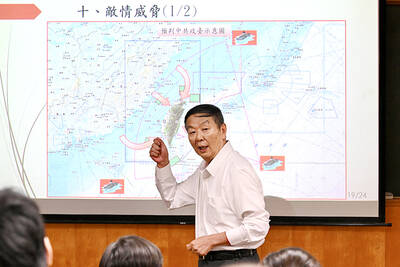
RETHINK? The defense ministry and Navy Command Headquarters could take over the indigenous submarine project and change its production timeline, a source said Admiral Huang Shu-kuang’s (黃曙光) resignation as head of the Indigenous Submarine Program and as a member of the National Security Council could affect the production of submarines, a source said yesterday. Huang in a statement last night said he had decided to resign due to national security concerns while expressing the hope that it would put a stop to political wrangling that only undermines the advancement of the nation’s defense capabilities. Taiwan People’s Party Legislator Vivian Huang (黃珊珊) yesterday said that the admiral, her older brother, felt it was time for him to step down and that he had completed what he

Taiwan has experienced its most significant improvement in the QS World University Rankings by Subject, data provided on Sunday by international higher education analyst Quacquarelli Symonds (QS) showed. Compared with last year’s edition of the rankings, which measure academic excellence and influence, Taiwanese universities made great improvements in the H Index metric, which evaluates research productivity and its impact, with a notable 30 percent increase overall, QS said. Taiwanese universities also made notable progress in the Citations per Paper metric, which measures the impact of research, achieving a 13 percent increase. Taiwanese universities gained 10 percent in Academic Reputation, but declined 18 percent

UNDER DISCUSSION: The combatant command would integrate fast attack boat and anti-ship missile groups to defend waters closest to the coastline, a source said The military could establish a new combatant command as early as 2026, which would be tasked with defending Taiwan’s territorial waters 24 nautical miles (44.4km) from the nation’s coastline, a source familiar with the matter said yesterday. The new command, which would fall under the Naval Command Headquarters, would be led by a vice admiral and integrate existing fast attack boat and anti-ship missile groups, along with the Naval Maritime Surveillance and Reconnaissance Command, said the source, who asked to remain anonymous. It could be launched by 2026, but details are being discussed and no final timetable has been announced, the source
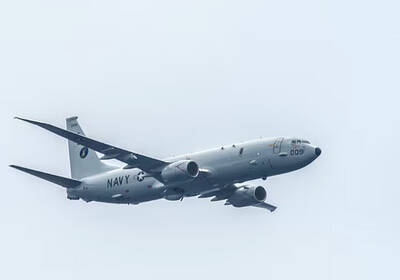
CHINA REACTS: The patrol and reconnaissance plane ‘transited the Taiwan Strait in international airspace,’ the 7th Fleet said, while Taipei said it saw nothing unusual The US 7th Fleet yesterday said that a US Navy P-8A Poseidon flew through the Taiwan Strait, a day after US and Chinese defense heads held their first talks since November 2022 in an effort to reduce regional tensions. The patrol and reconnaissance plane “transited the Taiwan Strait in international airspace,” the 7th Fleet said in a news release. “By operating within the Taiwan Strait in accordance with international law, the United States upholds the navigational rights and freedoms of all nations.” In a separate statement, the Ministry of National Defense said that it monitored nearby waters and airspace as the aircraft


 RSS
RSS