


President Chen Shui-bian (
The Chinese Nationalist Party (KMT) and the People First Party (PFP) had demanded their legislators attend yesterday's session and vote to recall, while the Democratic Progressive Party (DPP) caucus requested its 86 legislators not to vote. The DPP caucus walked out of the legislature before the vote to join a pro-Chen rally going on outside.
Before casting their ballots, KMT legislators chanted slogans, including "oppose corruption," "integrity protects Taiwan," "Step down A-bian [Chen's nickname]."
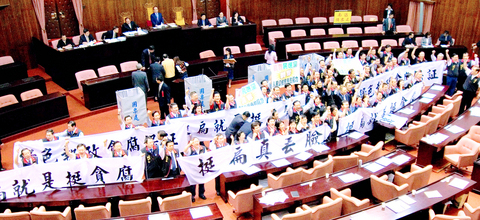
PHOTO: AP
The 119 affirmative votes came from the 90 KMT legislators, 22 PFP legislators, six legislators of Non-Partisan Solidarity Union and Independent Legislator Li Ao (李敖).
The Taiwan Solidarity Union's (TSU) 12 lawmakers cast invalid votes by writing "abstention" on their ballots and displaying them before putting them in the box.
Independent legislators Lin Wei-chou (林為洲) and Peter Lin (林進興), both former DPP members, also cast invalid votes.

PHOTO: LIU HSIN-DE, TAIPEI TIMES
Because 148 votes were needed to pass the motion, Legislative Speaker Wang Jin-pyng (王金平) announced it had not passed.
Although the legislative speaker is supposed to remain neutral, Wang cast a "yes" vote. He said that as KMT member he he had to respect the KMT caucus' resolution.
Although the failure of the recall motion was a foregone conclusion, the DPP appeared buoyed by the result.
DPP Chairman Yu Shyi-kun urged the pan-blue camp to stop causing political conflicts and help pass bills concerning people's livelihood and economic development as soon as possible.
"It's a victory for people power. We hope that the end of the recall vote will also bring an end to political confrontation. It is time to do something meaningful for the people of Taiwan," Yu said.
He said he hoped to meet with KMT Chairman Ma Ying-jeou (馬英九) and PFP Chairman James Soong (宋楚瑜) to discuss how to "rationally" pass the pending bills.
DPP caucus whip Ker Chien-ming (
TSU Chairman Shu Ching-chiang (蘇進強) said his lawmakers' invalid ballots proved the party did not always back the DPP because "the TSU sides with the people of Taiwan, not the DPP."
Ma told a news conference at KMT headquarters after the vote that the opposition had been defeated by an "unrepentant" DPP which has lost its core values.
"History will remember this day. Today is a day of humiliation. The recall rights of 23 million people have been deprived by a party which claimed to be incorruptible, hardworking and patriotic," he said.
He condemned the DPP boycott.
"[DPP legislators] opposed the recall of a corrupt president ? but they lacked the courage to cast negative votes. It's stunning to see a party become so depraved," he said.
If the victory belongs to "those who lied, enjoyed privileges and are corrupt," the KMT would rather be the loser, Ma said.
"This is a choice between right and wrong. We need to stand up for what's right," he said.
Ma said the TSU's actions showed it was trying to draw a distinct line between itself and the DPP.
He said that the TSU's move, coupled with former president Lee Teng-hui's (李登輝) recent remarks against Chen, showed the falseness of the DPP's claims to be defending a "localized government" against efforts to recall it.
"Doesn't former president Lee represent localized power? Isn't the TSU part of the localized power? They support localized power but not corruption," Ma said.
While acknowledging that the recall motion had created confrontations between political parties as well as ethnic groups, he denied the motion had created social unrest.
"Social instability has been created by the first family's corrupt practices... I don't see any social turmoil," he said in response to questions about the street protests for and against Chen.
Saying the president had angered the people with his corruption and incompetence, Ma said political struggles and ethnic confrontations were the price that had to be paid for Taiwan to seek its core values. He urged the DPP to stop triggering political clashes with its "localized power" ideology.
He also rejected Yu's offer of a meeting, saying the KMT has been cooperating with the government in the legislature.
"The cooperation is right there. We passed 75 bills during the last legislative session ? It's more important for the DPP to clean its own house than meet with opposition parties," he said.
Soong said what happened in the legislature showed that pan-green lawmakers "have been forced to distance themselves from a corrupt president."
He said the pan-green legislators hadn't voted against the recall motion because they were afraid of endorsing the president.
"Except for the 14 invalid votes, half the legislators voted to recall the president. However, the recall motion failed anyway. That is Taiwan's democratic miracle," Soong said.
Meanwhile, Ministry of Foreign Affairs Spokesman Michel Lu (呂慶龍) said the recall motion had attracted international attention but most countries had expressed respect for the procedure to avoid interfering in Taiwan's internal affairs.
Lu said as long as the recall vote and the demonstrations ended peacefully, it would prove Taiwan's democracy was still strong.
He said the ministry would send telegraphs to its embassies and representative offices about the vote's result and advise diplomats to make appropriate explanations to their host governments.
Additional reporting by Shih Hsiu-chuan and Chang Yun-ping
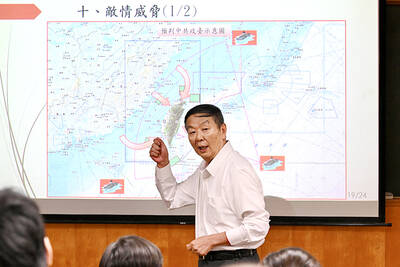
RETHINK? The defense ministry and Navy Command Headquarters could take over the indigenous submarine project and change its production timeline, a source said Admiral Huang Shu-kuang’s (黃曙光) resignation as head of the Indigenous Submarine Program and as a member of the National Security Council could affect the production of submarines, a source said yesterday. Huang in a statement last night said he had decided to resign due to national security concerns while expressing the hope that it would put a stop to political wrangling that only undermines the advancement of the nation’s defense capabilities. Taiwan People’s Party Legislator Vivian Huang (黃珊珊) yesterday said that the admiral, her older brother, felt it was time for him to step down and that he had completed what he
Taiwan has experienced its most significant improvement in the QS World University Rankings by Subject, data provided on Sunday by international higher education analyst Quacquarelli Symonds (QS) showed. Compared with last year’s edition of the rankings, which measure academic excellence and influence, Taiwanese universities made great improvements in the H Index metric, which evaluates research productivity and its impact, with a notable 30 percent increase overall, QS said. Taiwanese universities also made notable progress in the Citations per Paper metric, which measures the impact of research, achieving a 13 percent increase. Taiwanese universities gained 10 percent in Academic Reputation, but declined 18 percent
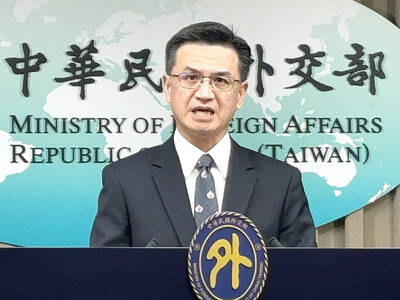
BULLY TACTICS: Beijing has continued its incursions into Taiwan’s airspace even as Xi Jinping talked about Taiwan being part of the Chinese family and nation China should stop its coercion of Taiwan and respect mainstream public opinion in Taiwan about sovereignty if its expression of goodwill is genuine, the Ministry of Foreign Affairs (MOFA) said yesterday. Ministry spokesman Jeff Liu (劉永健) made the comment in response to media queries about a meeting between former president Ma Ying-jeou (馬英九) and Chinese President Xi Jinping (習近平) the previous day. Ma voiced support for the so-called “1992 consensus,” while Xi said that although the two sides of the Taiwan Strait have “different systems,” this does not change the fact that they are “part of the same country,” and that “external

UNDER DISCUSSION: The combatant command would integrate fast attack boat and anti-ship missile groups to defend waters closest to the coastline, a source said The military could establish a new combatant command as early as 2026, which would be tasked with defending Taiwan’s territorial waters 24 nautical miles (44.4km) from the nation’s coastline, a source familiar with the matter said yesterday. The new command, which would fall under the Naval Command Headquarters, would be led by a vice admiral and integrate existing fast attack boat and anti-ship missile groups, along with the Naval Maritime Surveillance and Reconnaissance Command, said the source, who asked to remain anonymous. It could be launched by 2026, but details are being discussed and no final timetable has been announced, the source


 RSS
RSS